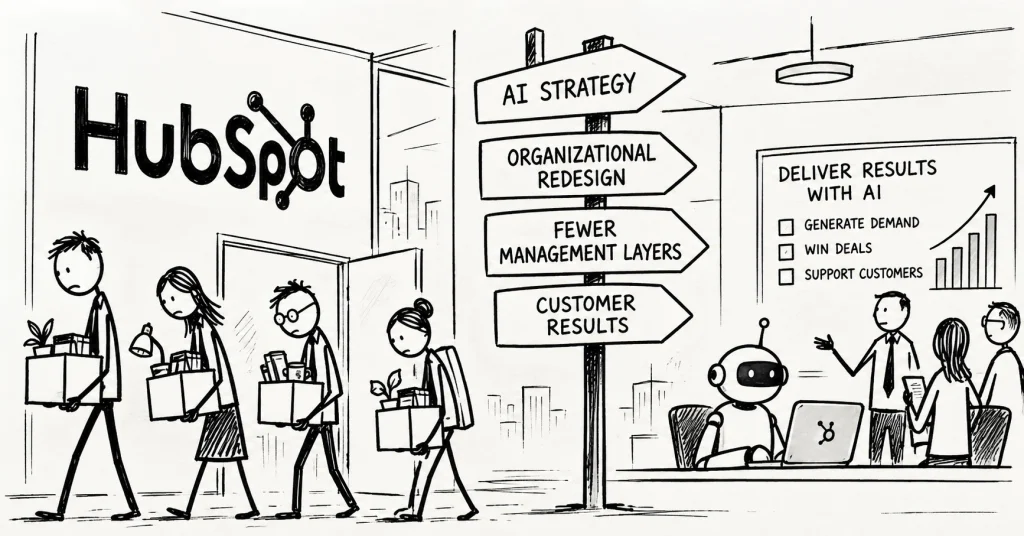
The company says AI efficiencies did not drive the layoffs. Its reorganization shows how a change in business strategy can threaten jobs before software replaces the work.
HubSpot is cutting nearly 660 jobs, approximately 7% of its workforce, as it reorganizes around a strategy focused on delivering customer results with AI. Lucia Maffei of the Boston Business Journal reported the cuts Tuesday, October 6, citing a public employee memo from CEO Yamini Rangan. The announcement comes roughly a month after the company experienced its largest single-day stock decline in more than 12 years, according to Maffei’s reporting. That sequence puts the restructuring under investor scrutiny, although the timing alone does not establish that the stock decline caused the layoffs.
In Rangan’s memo, the mechanism is organizational redesign: teams organized around customer results, fewer management layers and clearer ownership. She writes, “This is not driven by AI-related efficiencies.” But she also connects the new structure to HubSpot’s move toward delivering outcomes with AI. Those statements describe different routes to displacement. A company can eliminate a role because a machine performs its tasks, or because leadership decides that role no longer fits the business it wants to build. The memo describes the second route.
The Product Changes. The Organization Follows.
HubSpot’s September product announcement shows what the company is trying to sell. HubSpot Communicationsdescribed an expanded Breeze Assistant that puts agents to work through conversational requests. Its Fall Spotlight product page groups tools around generating demand, winning deals and supporting customers, including systems that automatically update customer records. Selling those capabilities changes the promise made to buyers: customers are being asked to expect help completing work, alongside access to software. Our reading is that HubSpot’s internal reorganization follows that same logic—placing responsibility around the result customers want rather than the individual product they purchase.
That approach also changes how employees are evaluated. Rangan says the company assessed roles against six criteria, including strategic need, management structure, revenue generation, capability, capacity and leadership. A worker’s usefulness inside the existing organization may therefore offer limited protection when executives redraw it. Reducing management layers also redistributes authority: remaining teams may gain decision-making responsibility while managers lose positions. Whether that produces faster decisions or heavier workloads will depend on how responsibilities are reassigned. The memo establishes the intended structure; it does not establish that the smaller organization can deliver the promised results.
Employees Face the Transition Before Investors See the Results
The financial timetable stretches beyond Tuesday’s announcement. StreetInsider’s account of HubSpot’s filing says the board authorized the restructuring on October 1. HubSpot estimates $65 million to $75 million in charges, primarily for severance, notice periods, transition support and benefits. Most charges are expected in the fourth quarter, with role eliminations substantially complete by the end of the first quarter of 2027. The company also reaffirmed its third-quarter and full-year financial guidance. Investors receive continuity in the forecast while affected employees face an immediate change in their income and plans.
Departing employees will generally receive 20 weeks of base pay plus one week per year of service, capped at 30 weeks, along with benefits assistance and career support, according to Rangan’s memo. That provides a financial bridge, but finding another job still depends on employers making hiring decisions. For workers elsewhere, the practical implication is that learning AI tools may strengthen their capabilities without protecting their position on an organizational chart. Skills and job security remain connected, but executives retain the power to decide which roles survive a strategic change.
HubSpot’s next test will be whether fewer layers and broader team responsibility improve customer results without creating new bottlenecks. If that model succeeds, other software companies could follow the same path, reassessing jobs around the outcomes they promise buyers. Workers would then face a second source of AI-era insecurity: changing organizational priorities, alongside automation. The employment consequences could arrive well before companies demonstrate that machines can perform the departing employees’ work.