
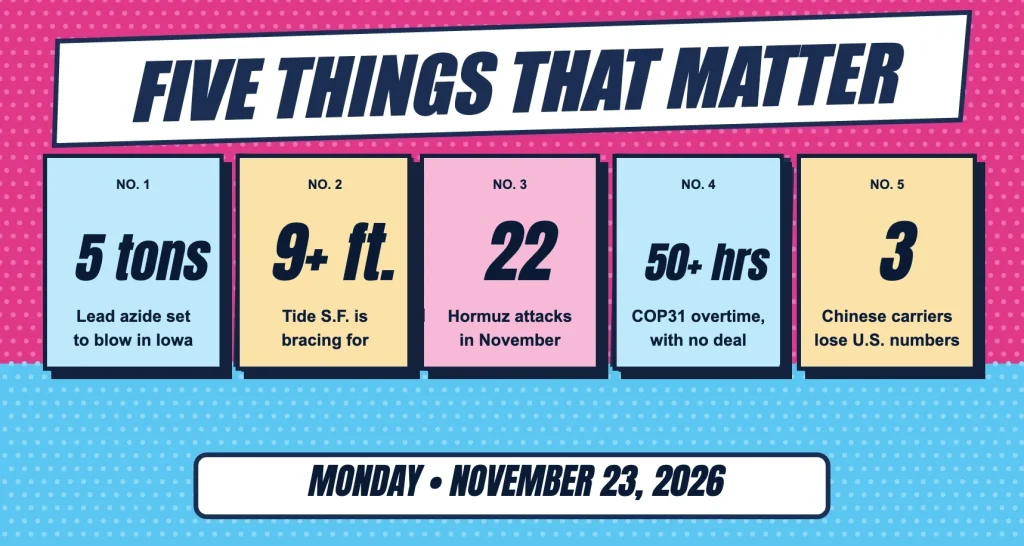
The Army says it will blow up five tons of lead azide in Iowa this week despite a court pause, San Francisco is bracing for record tides on the busiest travel days of the year, attacks in the Strait of Hormuz are back near their peak, the COP31 climate talks collapsed without a deal, and Washington cut three Chinese carriers off from American phone numbers.
Monday’s stories share a question: who gets to decide when the risk is shared? An Army plant, a city seawall, a shipping lane, a climate treaty and the phone network all carry consequences for people who weren’t in the room when the call was made. Here are five things that matter on November 23.
1. The Army Says It Will Detonate Five Tons of Lead Azide in Iowa, Court Pause or Not
The Army plans to detonate 68 barrels of degraded lead azide at the Iowa Army Ammunition Plant by invoking an emergency exception to federal environmental law, after a federal appeals court froze its permit, Reuters reported. The 8th Circuit granted that stay late Thursday while it weighs a request from the Iowa Environmental Council and the Sierra Club Iowa Chapter to halt the blast, according to ABC News. On Sunday night, the Army moved the detonation to Wednesday to allow for better weather and to put mitigation measures in place, ABC News reported.
The Army says the material has grown so sensitive that destroying it in place is the only responsible option, and federal officials told the court that falling temperatures could set off an uncontrolled explosion. The environmental groups, represented by Earthjustice, argue the lead dust plume could travel up to 100 miles depending on the wind. Middletown has about 400 residents, and the Army has told people nearby to hose down outdoor surfaces and wipe off children’s play equipment afterward, Gray News reported. When the date first slipped, we noted residents wanted real air measurements and clear notice. Watch whether the 8th Circuit rules before Wednesday, because an Army that proceeds during a court pause turns a safety question into a fight over who gets the final word.
2. San Francisco Is Bracing for the Highest Tide in Its History, During Thanksgiving Week
Mayor Daniel Lurie asked San Franciscans to avoid traveling unless absolutely necessary from Monday afternoon through Wednesday, as king tides, a strong storm and El Niño line up during the holiday week, ABC7 reported. The city is preparing for tides above 9 feet, past its record of 8.66 feet, with peaks around 10 a.m. Tuesday, 11 a.m. Wednesday and 11:30 a.m. Thursday. The National Weather Service has a coastal flood warning for the San Francisco and San Pablo Bay shorelines from Monday through Thanksgiving afternoon, KRON reported.
The city is still drying out from Nov. 18, when downtown got a record 2.31 inches of rain and Waymo cars stalled in floodwater. Waymo is pausing service in San Francisco starting at 4 a.m. Monday, weeks after a California order took its cars off freeways. The flooding could also reach a major West Coast airport on some of the busiest travel days of the year, CNN reported. If you’re flying out of the Bay Area, check your airline before you leave, and if your car sits in saltwater, police say not to charge it, because flooded EV batteries can catch fire days later.
3. Attacks on Ships in the Strait of Hormuz Are Back Near Their Peak
Three outbound tankers were struck by projectiles near Khasab, Oman, between Friday and Saturday, and the Joint Maritime Information Center warned that more attacks on the Omani side of the strait are highly likely, Gulf News reported. No crew casualties were reported. Reported attacks are at the highest levels since the conflict began as Tehran tries to reassert control of the waterway, CNN reported.
The timing is odd for markets. Brent was on track for a weekly drop of nearly 4% because crude shipments through the strait have returned to roughly prewar levels, CNBC reported, and gas prices have followed, as we explained in Cheaper Gas Now Depends on Iran Talks and the Day Congress Changes Hands. Trump said he won’t decide on his next step in the war until after the new year, Axios reported. Watch tanker insurance rates and holiday gas prices, because more strikes on the Omani route are the fastest way to undo the relief at the pump.
4. The COP31 Climate Talks Collapsed Over Two Words: Fossil Fuels
The UN climate summit in Antalya, Turkey, ended Sunday without an overarching agreement after the European Union, the U.K. and small island states rejected a final text that never mentioned fossil fuels, the Guardian reported. The draft leaned on carbon capture, an approach pushed by Saudi Arabia, and developing countries said it offered too little new money to adapt. “It seems like we are negotiating with the Saudis,” said Tuvalu’s climate minister, Maina Talia. Talks ran more than 50 hours past their scheduled finish, making it the longest COP on record, IBTimes UK reported.
Some smaller deals survived, including pledges to scale up geothermal energy, build greener freight corridors and raise electricity’s share of global energy to 35% by 2035. The failed draft would also have acknowledged for the first time that warming is making the 1.5-degree goal hard to reach, the Seoul Economic Daily reported. The cost of that gap shows up in places like Florida, where a second November flood hit families still repairing from the first. Watch whether the EU and island nations carry fossil fuel language into next year’s talks, or whether “transition away” from Dubai in 2023 becomes the high-water mark.
5. Washington Cut Three Chinese Carriers Off From American Phone Numbers
The Federal Communications Commission voted Thursday to bar China Mobile, China Telecom and China Unicom from directly obtaining U.S. phone numbers, citing national security and scam robocalls, Reuters reported. The rule also covers internet-based calling providers that use equipment from Huawei, ZTE and other companies on the FCC’s security list. FCC Chair Brendan Carr called it the agency’s “first line of defense against bad actors and illegal robocallers,” Fox Business reported.
China’s commerce ministry said Sunday that it firmly opposes the ban and will take necessary countermeasures, Business Standard reported. Providers will now need new national security certifications before getting numbers directly, Light Reading reported, which matters because direct access is what lets a call look local on your screen. It’s the same FCC that cleared AT&T to drop California landlines, and both decisions change how ordinary calls reach people. Watch what Beijing does in return, and whether the scam calls on your phone actually drop or just reroute through middlemen.
The Bottom Line
Every story today is about a risk that someone else decided to take on your behalf. An Army plant chose the date, a storm chose the week, a war chose the shipping lane, oil states chose the wording, and a regulator chose which networks can reach your phone. The people downwind, downstream and on the other end of the line usually learn about it last. Context matters.
Five Things That Matter is produced by the Social Storytellers Collective News Desk. Get the End of Day Closing Note free in your inbox.