
The first four parts of this series documented a credentialing economy in distress. MBA applications are down 20% to 30% at mid-tier programs. Schools that built their business models around a specific promise — that the degree would unlock a specific class of professional opportunity — are now discounting that promise by 40% and hoping the math still works. The fire sale is real. The demand collapse driving it is real. And as Part IV — The HBCU Squeeze documented, a 40% cut on something you couldn’t afford is still unaffordable for the students who most need the credential to work.
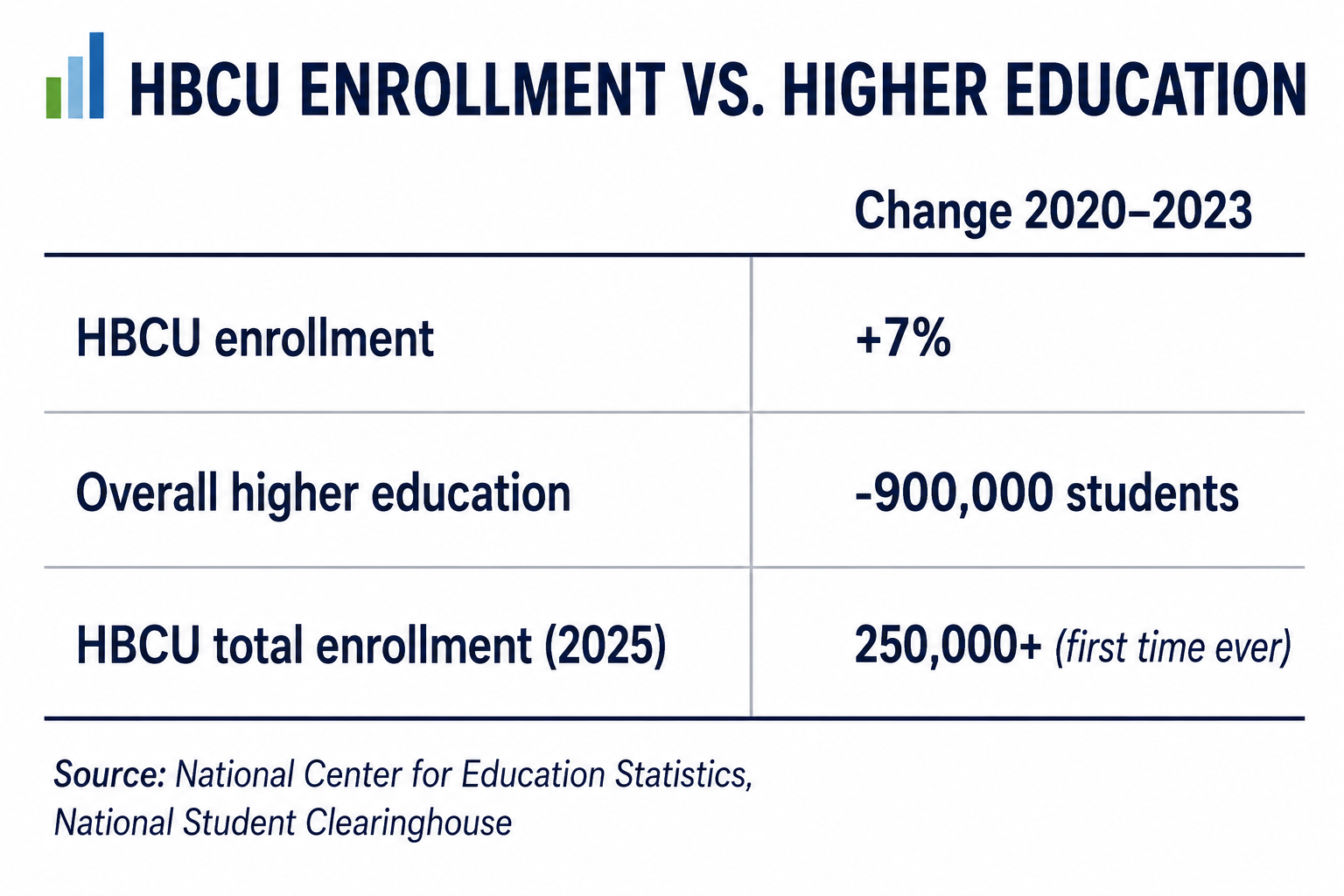
While that restructuring is happening, something else is happening simultaneously. For the first time ever, HBCU enrollment has surpassed 250,000 students. HBCU enrollment rose 7% between 2020 and 2023 — a sharp contrast to the overall decline in higher education, which saw 900,000 fewer students over the same period. That divergence is not accidental and it is not a temporary blip. It is a structural shift that has been building across multiple catalysts simultaneously.
The numbers at individual institutions tell the story more precisely than the aggregate. North Carolina A&T State University broke past 15,000 students for the first time in fall 2025 — a 6.7% jump from the previous year, its biggest single year of growth. North Carolina Central University passed the 9,000-student mark for the first time in its 115-year history. Fayetteville State University set an all-time enrollment record for the fourth consecutive year. Spelman College received over 11,500 first-year applications for fall 2025. Prairie View A&M reached 10,085 students — steady growth building on 9,821 in 2024 and 9,415 in 2023. In Houston — the fourth largest city in the country — Texas Southern University has maintained enrollment above 8,500 students while simultaneously expanding its research enterprise and pursuing Carnegie R1 classification, making it one of the clearest examples of an HBCU absorbing pressure and building forward at the same time. These are not outliers. They are a pattern.
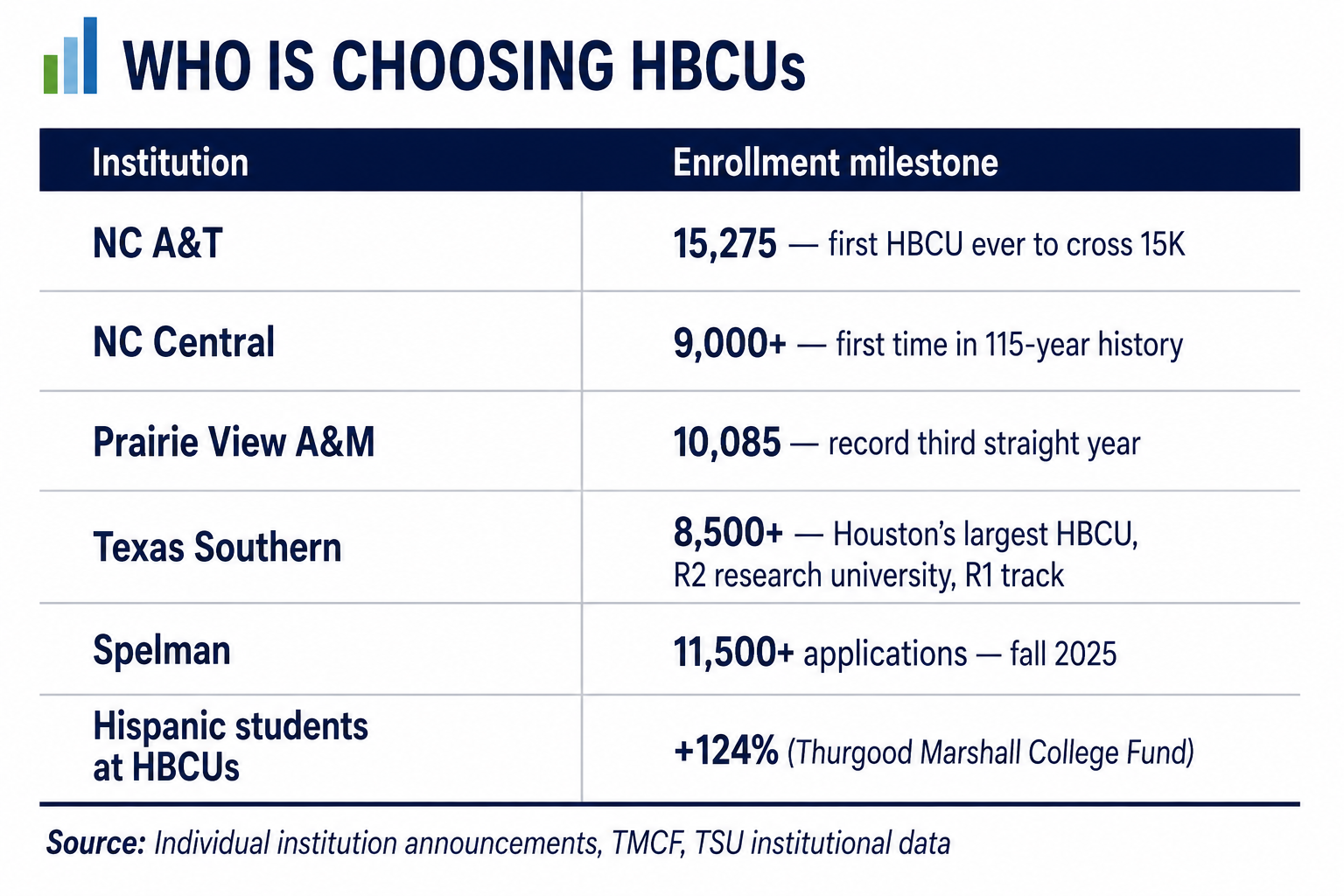
Three forces are converging to produce it. The first is the post-affirmative action environment. Following the Supreme Court’s 2023 decision eliminating race-conscious admissions at PWIs, Black students who would previously have enrolled at flagship state universities and elite private institutions are increasingly choosing HBCUs instead. As SSC documented in The Access Shift: Why Black Students Are Moving Toward HBCUs Again, this is not students settling for second choices — it is students reading policy signals clearly and moving toward spaces where the terms of belonging are not in dispute. When the environment at PWIs feels uncertain or contested, students do not wait for conditions to stabilize. They move. The Thurgood Marshall College Fund has also reported a 124% increase in Hispanic students at HBCUs — a figure that suggests the appeal of HBCUs as environments of intentional community is expanding beyond their historic student base.
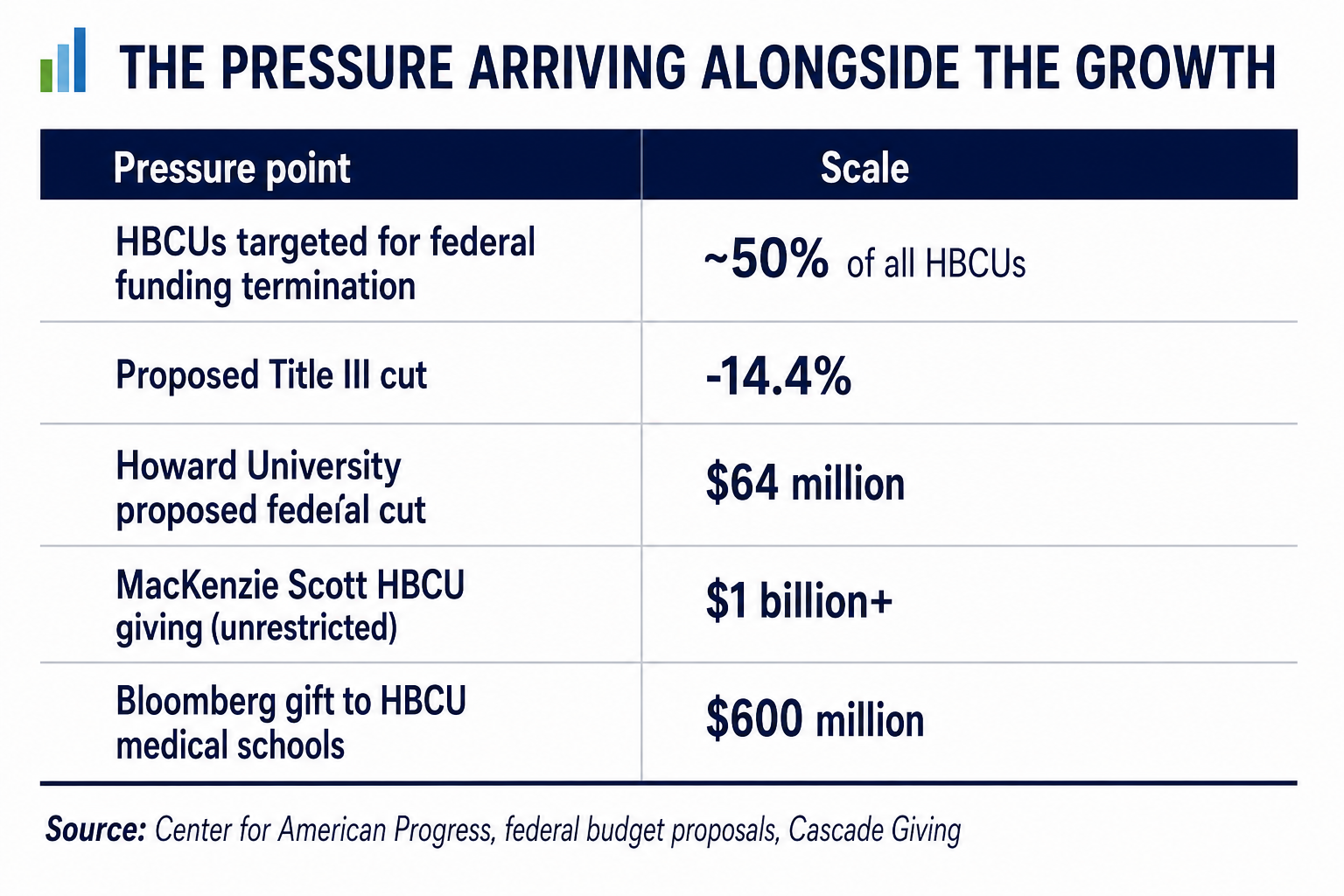
The second force is the hostile federal funding environment. As Part IV — The HBCU Squeeze documented, nearly half of all HBCUs have been targeted for funding terminations under the current administration. And as SSC covered in The Federal Government Just Redefined DEI as Discrimination, legal experts are already questioning whether attending an HBCU career fair now constitutes a violation under the administration’s broad anti-DEI executive orders. The pressure is arriving from multiple directions simultaneously. And the students are still coming.
The third force is philanthropic capital arriving at scale. As SSC documented in The Billion-Dollar Shift That Didn’t Ask for Permission, MacKenzie Scott’s HBCU giving has now surpassed $1 billion — and crucially, the structure of that giving matters as much as the amount. Unrestricted capital returned control to the institutions themselves, allowing them to respond to their most immediate needs rather than conforming to donor priorities. That flexibility is what allows growth to be absorbed rather than strained by it.
The mainstream narrative has been slow to register this divergence. The higher education story being told in 2026 is predominantly a story of contraction — declining enrollment, closing programs, the credential economy restructuring under pressure from AI, demographic shifts, and the collapse of the ROI argument that sustained graduate enrollment for a generation. That story is real. It is just not the only story. And for the institutions that have historically been treated as the margin of American higher education, being the part of the system that is growing while the rest contracts is not a small thing. It is a structural opening — if the infrastructure exists to hold it.
Why This Matters
HBCU enrollment growth is happening in direct contradiction to every force the higher education market is deploying against it. The credential is deflating. The jobs it was supposed to unlock are disappearing. The funding environment is hostile. And the students are still coming — in record numbers, to institutions that were built to serve them when no one else would. Whether the systems surrounding those institutions are willing to invest in what the students are already building is the question the next two parts of this series will address.
Part V of The Degree Economy. Part I — The Credential Is Deflating | Part II — AI Ate the ROI | Part III — Who Gets Left Out of the Sale | Part IV — The HBCU Squeeze