
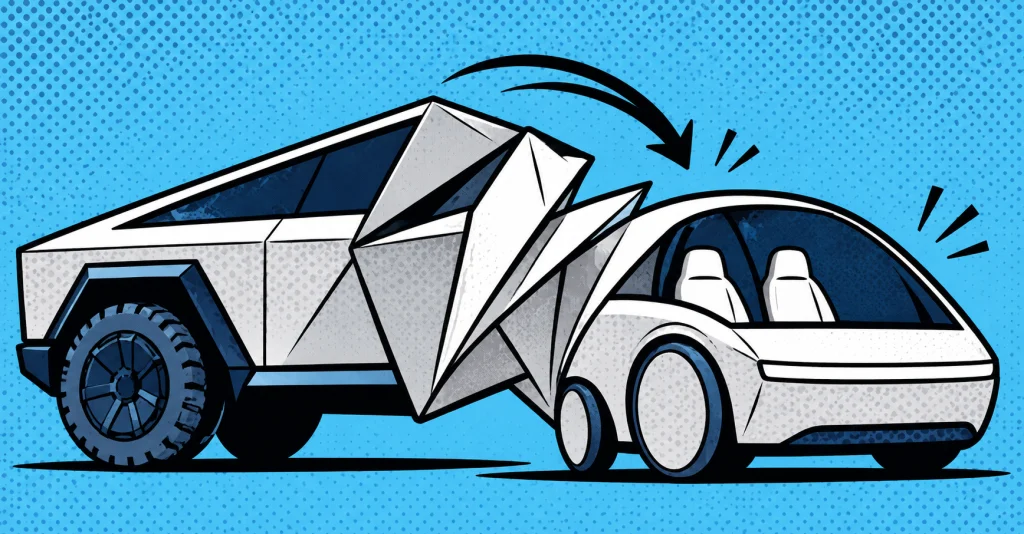
After U.S. sales fell 48% in 2025, Tesla will wind down Cybertruck production in Texas by mid-2027 and give the floor space to its Cybercab. The bigger change is that Tesla will own the cars it builds.
Tesla’s Cybertruck was supposed to redefine the American pickup. Three years after the first deliveries, Elon Muskposted on X early Friday that Tesla “will be winding down production of the Cybertruck at Gigafactory Texas” around the middle of 2027 to make room for more Cybercab robotaxis, CNBC reported. Musk didn’t say whether the truck will be built anywhere else. Austin is the only Tesla plant known to be equipped for its specialized parts, according to Reuters, so the wind-down looks a lot like an ending.
A Pickup That Never Found Its Buyers
Cox Automotive’s numbers show how quickly demand collapsed. Tesla sold an estimated 38,965 Cybertrucks in the U.S. in 2024 and 20,237 in 2025, a 48% drop, CBS News reported. In the fourth quarter alone, sales fell 68% year over year to 4,140, per CarExpert’s read of the Cox data. Musk had once talked about 250,000 trucks a year. The September 2025 expiration of the $7,500 federal EV tax credit hurt every electric pickup, and Ford dropped the F-150 Lightning. The Cybertruck still fell faster than its rivals, though, and that points back to the product itself: a stainless-steel body many truck buyers never warmed to, pricing above early promises and a run of recalls. By April 2025 there had been eight recalls in about 15 months of production, Fortune reported. Bloomberg compared the truck to Ford’s Edsel.
From Selling Trucks to Owning the Fleet
The more important story is the business model. The Cybercab, a two-seater with no steering wheel or pedals, joined Tesla’s unsupervised robotaxi fleet in Austin on Sept. 3. On the October earnings call, vehicle engineering chief Lars Moravy said Cybercab output is going to Tesla’s own Robotaxi fleet, per Yahoo Finance. A Cybertruck brings in revenue once, when a customer buys it. A Cybercab brings in revenue on every ride, and Tesla keeps the vehicle, the data and control over pricing. Power is moving from the person who owns a car to the company that runs the fleet. This has been building all year. In January, Musk ended the Model S and X to free up factory space and said the Cybertruck line would become an autonomous vehicle line, Stocktwits reported. Ten months later, the line is being converted, but the truck is the part that’s going away.
Owners and Regulators Still Have a Say
Owners are the ones left exposed. Cybertruck lead engineer Wes Morrill described the truck as a technology platform that lives on through Cybercab, Paul Tan reported. That may comfort engineers, but owners now have a discontinued model built at a single plant, and they will have to rely on Tesla for parts and resale value. Regulators also get a vote on the robotaxi side. According to Reuters, the National Highway Traffic Safety Administration is still asking whether Tesla properly self-certified the Cybercab under federal safety standards. Tesla is giving up a product people could buy and replacing it with one the government hasn’t fully cleared.
Expect Tesla to use incentives to clear its remaining Cybertruck inventory through the first half of 2027, and expect used Cybertruck prices to drop as buyers price in an orphaned model. The bigger test comes after that. If NHTSA approves the Cybercab and paid rides expand beyond Austin, the Cybertruck will look like an expensive experiment that helped build Tesla’s next business. If regulators slow it down, Tesla will have given up a factory line that sold real trucks for a fleet that can’t yet operate at scale.