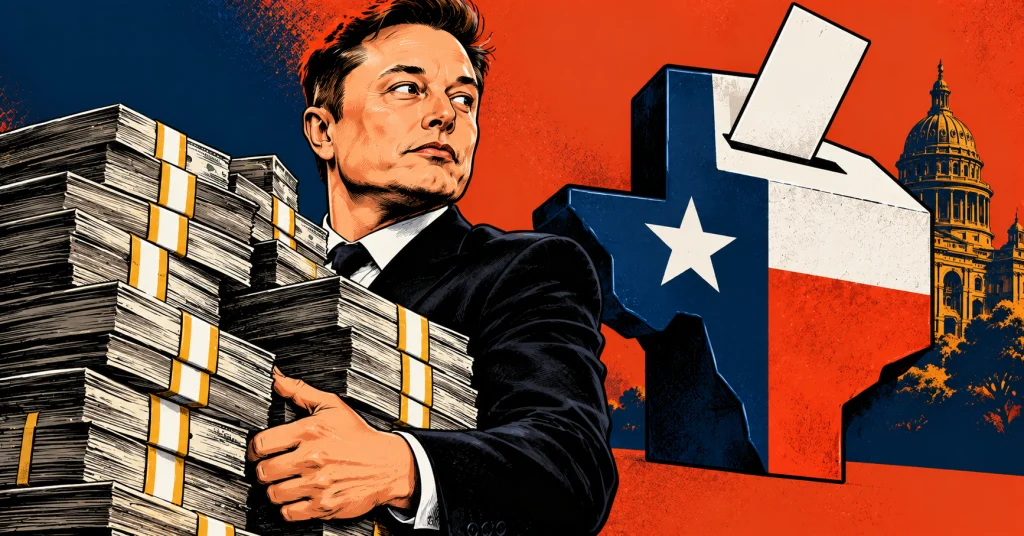
The billionaire is financing a massive effort to elect Ken Paxton to the U.S. Senate while his companies benefit from billions in Texas tax incentives. The money trails are documented. What remains unanswered is how corporate interests and political influence intersect.
Elon Musk has spent years building a business empire in Texas. Tesla is headquartered in Austin, SpaceX runs its Starbase launch site near Brownsville, and several of his other companies have moved operations to the state. Now, a week before Election Day, Musk appears to have put nearly $190 million behind the effort to elect Republican Ken Paxton to the U.S. Senate, according to The Texas Tribune. That’s an extraordinary sum even by today’s standards. It’s more striking alongside how much his companies stand to gain or lose from decisions made in Austin and Washington.
SSC has looked at the overlap between Musk’s companies and government power before. Earlier this month, we reported that Donald Trump’s investment accounts bought SpaceX bonds two days before he signed a space policy expanding commercial space transportation. The White House said the accounts were managed independently, and the purchases didn’t establish wrongdoing. Musk’s Texas spending raises the same accountability question from the donor’s side: how should the public weigh political influence when the people funding elections also run companies shaped by government decisions?
Following the money. On September 9, Musk gave $75 million to the Senate Leadership Fund, the main Senate Republican super PAC. The next day, the group moved the same amount into a new committee called Texas PAC, which backs Paxton against Democrat James Talarico. About two weeks later, Musk gave another $83 million, and the next day the group sent a matching $83 million to Texas PAC. Musk also agreed to put $10 million into Lone Star Liberty PAC, another pro-Paxton group, if the Senate Leadership Fund contributed $5 million and the PAC raised $5 million more. His own America PAC had spent $18.8 million on the race as of mid-October, most of it on messages against Talarico. None of this money goes directly to Paxton’s campaign. It flows through outside committees that can raise and spend unlimited amounts as long as they don’t coordinate with candidates.
That money has reshaped the race. Outside groups backing Paxton have spent about $239 million, more than five times the roughly $45 million from the largest Democratic-aligned groups, Reuters reported. Talarico has raised heavily on his own, bringing in a record $64 million from July through September. The Senate Leadership Fund had estimated it would take $150 million to $200 million to hold the seat with Paxton as the nominee. Musk has covered most of that, letting national Republicans keep money for other races. Polls show Talarico with a small lead, generally within the margin of error.
Texas has a lot riding on Musk, and he on Texas. In August, Gov. Greg Abbott announced that SpaceX would build Terafab, a semiconductor plant in Grimes County, with a first phase of more than $16.8 billion and 3,000 promised jobs. The state awarded a $30 million Texas Enterprise Fund grant, and SpaceX has floated a full buildout of up to $119 billion. The Houston Chronicle reported that the project’s school property-tax breaks, approved through the state’s JETI program, are worth nearly $1.7 billion. Supporters say deals like this bring jobs and investment Texas would otherwise lose. Critics ask why taxpayers should subsidize companies controlled by the richest people on Earth. As we’ve seen with Audi’s $4 billion Georgia plant, an announced investment isn’t the same as a delivered one. The public return depends on the jobs created, the wages paid and whether the promises are enforced.
A Senate seat reaches well beyond Texas. A senator votes on legislation, confirmations and spending, and helps oversee federal agencies. Those decisions touch nearly everything Musk’s companies do, from electric vehicles and trade to commercial spaceflight, satellite internet and federal contracts. SpaceX in particular depends on its relationships with federal agencies. One senator doesn’t control any of that, and backing a candidate doesn’t mean the candidate will act on a donor’s behalf. But if Paxton wins, he’ll have a voice in decisions that affect industries where Musk has enormous financial interests.
There’s also a simple partisan explanation. Republicans want to keep their Senate majority, and Texas has become one of the most expensive races in the country. Talarico has made Musk’s money the center of his closing argument. He said last week that Musk is “trying to buy Texas,” adding that he “wants our land, he wants our water, he wants our taxpayer dollars,” Forbes reported. Musk fired back on X, calling Talarico a “creep” and “pure evil.” Republican groups say their spending is necessary to reach voters and protect the majority. The claim that Musk expects specific favors in return remains an accusation, not an established fact.
All of this spending is legal, and it’s disclosed. That’s what makes it possible to trace. But legality doesn’t settle the bigger questions. State incentives and federal campaign money run through different systems, and having both doesn’t prove a deal was struck. Still, when the same person receiving major public support can also spend hundreds of millions to shape who represents a state in Washington, voters deserve to see the whole picture.
On November 3, Texans will choose between Paxton and Talarico. Musk’s money may prove decisive, or voters may decide that no amount of advertising can change their minds. Either way, his companies’ relationship with Texas, and with the federal government, will outlast Election Day. The question voters should keep asking is whether the public benefits promised in exchange for their tax dollars actually arrive, and who gets heard when the decisions are made.