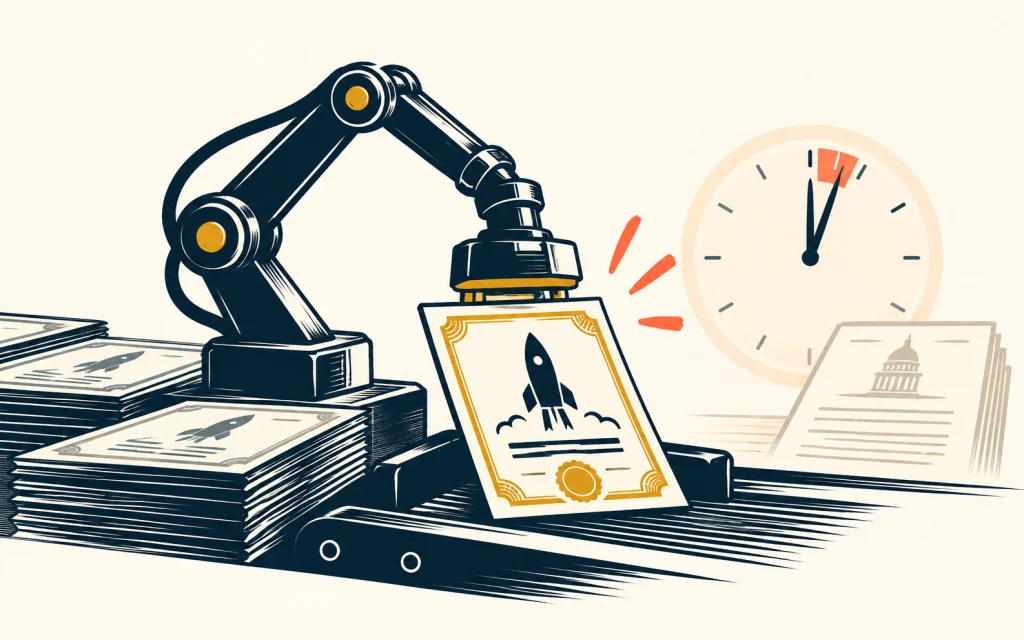
Donald Trump’s investment accounts bought between $1 million and $5 million in SpaceX bonds on Aug. 18. Two days later, Trump signed a national space transportation policy designed to expand the commercial launch market that SpaceX dominates.
The purchase is one of 517 trades disclosed in Trump’s latest monthly financial report, first analyzed by CNBC. The August filing shows a portfolio moving heavily in and out of technology companies, including a single purchase of $5 million to $25 million in Meta stock, at the same time his administration is setting policy for the industries those companies lead.
The White House says Trump has nothing to do with it. Spokesman Davis Ingle told CNBC the portfolio is independently managed through discretionary accounts and computer-based models, with “no ability” for Trump or his family to influence investment decisions. That explanation raises a question of its own: can an algorithm stand in for the firewall that past presidents built by selling their stocks?
Space policy and a SpaceX bet
The space policy Trump signed on Aug. 20 calls for the U.S. to support more than 1,000 launches and reentries a year by 2030. It directs federal agencies to open government launch facilities to commercial companies, speed up permitting for new launch sites and encourage private investment in space infrastructure, Via Satellite reported.
That goal is enormous compared with today’s launch rate, and only one company is operating at anything close to that scale. The U.S. conducted 193 orbital launches in 2025, and SpaceX accounted for 85% of them, according to BryceTech data cited by Via Satellite. Rival rockets from United Launch Alliance, Blue Origin and Rocket Lab are still ramping up or have yet to fly. A policy built around 1,000 launches a year is, in practice, a policy that depends heavily on SpaceX, which is also a major Pentagon contractor and NASA launch provider.
The bonds Trump’s accounts bought pay 5.35% interest and mature in July 2031. Bonds don’t rise and fall with a company’s fortunes the way stock does, but their value depends on the company’s ability to keep paying, and government policy that expands SpaceX’s market helps with that. The accounts had previously bought small amounts of SpaceX stock, between $15,001 and $50,000, in both June, the month of the company’s initial public offering, and July.
A reshuffled tech portfolio
The biggest trade in the filing came on Aug. 21, when the accounts bought $5 million to $25 million in Meta shares. The same day, they bought $1 million to $5 million each of Netflix and AT&T, along with several non-tech companies, and sold $1 million to $5 million of chipmaker Advanced Micro Devices. They also sold stakes of $500,001 to $1 million each in Nvidia, Dell Technologies, Datadog, Palo Alto Networks and T-Mobile. Earlier in the month, on Aug. 10, the accounts bought $1 million to $5 million in Microsoft.
The leaders of many of those companies were at the White House this week. At a science summit on Thursday, Trump honored a group of tech executives and founders whose companies appear among his recent transactions, including Elon Musk, Nvidia CEO Jensen Huang, Microsoft CEO Satya Nadella, Michael Dell, AMD CEO Lisa Su and Google co-founder Sergey Brin.
There is no evidence in the filing that Trump picked any of these trades, and the disclosure doesn’t show exact amounts, only broad ranges. The August trades totaled somewhere between $74.3 million and $273.3 million, according to CNBC’s calculations.
Can an algorithm be a blind trust?
The scale of the trading fits the White House’s description of a model-driven portfolio. Trump’s 2025 annual disclosure showed more than 21,000 securities trades across eight accounts holding at least $858 million. In his first year in office in 2017, he disclosed 86. He reported more than 1,000 transactions in each of June and July this year.
But automation addresses only part of the conflict-of-interest problem. A blind trust works because the owner doesn’t know what he owns. An automated portfolio can make decisions without the owner’s input, yet its holdings are still published every month in public disclosures, which means the owner, and everyone lobbying him, can see exactly which companies stand to gain from his policies. Recent presidents generally avoided that problem by selling individual stocks or moving into blind trusts or broad funds.
An algorithm also can’t separate the person setting policy from the person who benefits from it. Whether a trade is chosen by a human manager or a computer model, the gains flow to the same accounts. When the policy is about technology, from rocket launches to chips to AI, and the portfolio is full of the companies building it, the overlap is structural, not just a matter of timing.
Why it matters
Federal technology policy is now being written in areas where a handful of companies hold enormous market power, from space launch to AI chips to social media. Those decisions can shift billions of dollars in value. Trump’s disclosures show a portfolio that holds positions in many of those same companies and changes them every month. The White House argues that a computer model keeps those two worlds apart. The filings show how closely they sit side by side.
Sources: CNBC, “Trump bought up to $25 million in Meta and millions in SpaceX debt in August,” by Luke Fountain, Oct. 8, 2026; Via Satellite, Aug. 21, 2026.