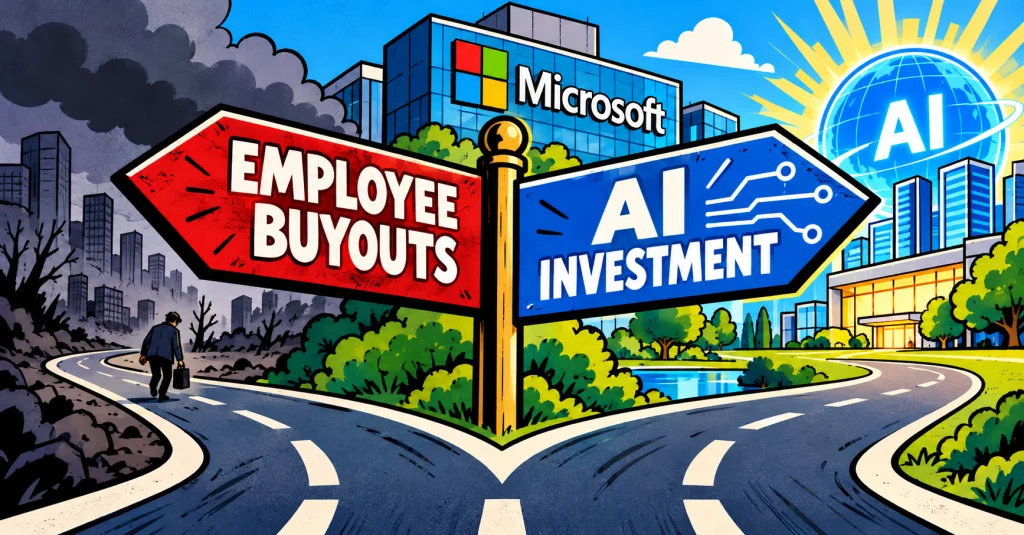
More than a quarter of Microsoft’s workforce is eligible for voluntary buyouts as the company pours billions into artificial intelligence. The offers raise questions about what happens to workers when a company’s priorities change.
Microsoft is giving about 60,000 employees the option to leave the company with a payout, an unusually broad offer from one of the world’s largest technology companies. The voluntary buyout program, announced October 26, covers roughly 27% of Microsoft’s 223,000-person workforce. Eligible employees work on participating teams in the United States, Canada, the United Kingdom and India. The offer comes as Microsoft keeps investing heavily in artificial intelligence infrastructure while looking for ways to control what it spends everywhere else.
The company calls it a Voluntary Exit Offer. In a memo to staff, Chief People Officer Amy Coleman described it as a way for employees already considering a move to “make that transition now with support.” According to Reuters, participating teams include Xbox, Windows, Copilot, finance and human resources, while marketing, commercial and security teams are excluded. The packages are similar to Microsoft’s standard severance and vary by seniority and tenure. Eligible workers have until early December to decide, with departures expected by the end of the year. It’s worth being precise here: 60,000 employees are eligible for a buyout. That doesn’t mean 60,000 jobs have been cut.
The money explains the timing. Microsoft is pouring resources into data centers, cloud computing and AI development, with capital expenditures and finance leases projected to reach about $175 billion, GeekWire reported. At the same time, the company has been shrinking. Microsoft cut about 4,800 jobs in July, after roughly 15,000 layoffs in 2025. The buyouts give it another way to reduce payroll without going straight to involuntary layoffs. But Microsoft hasn’t said whether the offer replaces future cuts or just comes before them, and that distinction matters a lot to the people deciding whether to take it.
Microsoft isn’t alone. Companies have cited AI in more than 120,000 announced U.S. job cuts so far this year, more than any other reason, according to Challenger, Gray & Christmas. The pattern is showing up at companies that are doing well. eBay is laying off about 9% of its workforce while posting some of its strongest results in years, and Qualcomm is cutting jobs while building its AI future. Goldman Sachs economists now estimate that AI could displace about 15 million U.S. workers from their current roles, and faster if a recession hits.
For employees, the decision is more complicated than taking a check. A buyout can buy time, but workers have to weigh it against a slow hiring market, the cost of replacing health coverage and the chance of spending months looking for a comparable job. The typical stretch of unemployment reached 11.5 weeks in September, up from 10.1 weeks a year earlier, and as we’ve reported, recovering from a layoff is harder when openings draw hundreds of applicants. Earlier this year, more than 30% of the roughly 8,750 employees eligible for Microsoft’s voluntary retirement program took it. Microsoft hasn’t said how many it expects to accept this time, only that it will “learn from it.” The bigger question isn’t how many people leave. It’s whether Microsoft is changing the kinds of workers and skills it needs. As tech companies redirect spending toward AI, years of experience in an established business unit may not offer the security they once did.
Microsoft’s offer captures a growing tension in the economy: a company can grow its revenue and invest billions in its future while shrinking the workforce it already has. Voluntary buyouts give employees more control over how they leave, but they don’t change the economics behind the decision. For Microsoft, the program creates flexibility as its priorities shift. For employees, the math is more immediate: financial stability, career prospects, and whether staying carries risks of its own. How many people take the offer will be an early sign of how much uncertainty Microsoft’s workers feel.