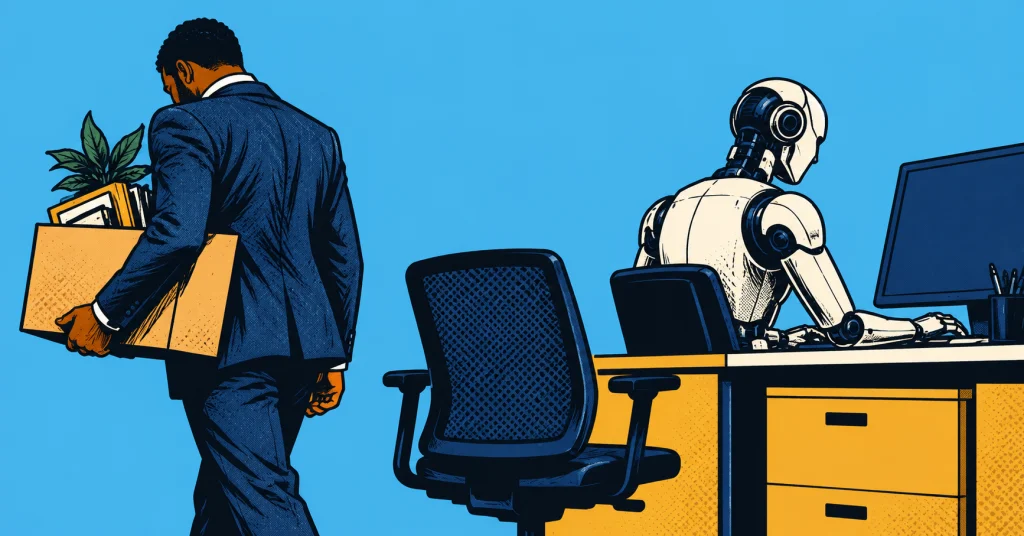
Goldman’s baseline treats AI displacement as gradual, but the same report says a downturn would speed it up, which would turn a temporary layoff into a permanent one.
Jennifer Sor reported for Business Insider on October 23 that Goldman Sachs economists raised their estimate of AI-related job displacement. In the bank’s baseline scenario, with productivity rising 15% in the U.S. and other developed economies, up to 9% of workers would be displaced from their current roles, about 15 million people. Goldman’s chief economist, Jan Hatzius, had estimated 6% to 7% last year, and the bank began floating a rate as high as 9% this summer. Hatzius wrote in a Thursday report that the disruption would likely build gradually and not arrive as an abrupt shock, and Goldman estimates that fewer than a quarter of firms have put AI into regular workflows.
Recessions are when automation locks in. In an ordinary downturn, employers cut workers and rehire them when demand returns, so the cost to workers is a gap in income and not a permanent loss. Hatzius wrote that a cyclical slowdown would likely accelerate AI-related automation and job losses and amplify the broader business cycle. If employers use a slowdown to adopt AI and then do not rehire, the gap becomes permanent. The same layoff produces a different outcome depending on whether a machine is available to fill the job when demand recovers.
The gradual path depends on a condition. Hatzius described it under baseline forecasts for near-potential growth next year, which means the milder scenario assumes no downturn. A downturn is a risk and not a forecast, but conditions that make employers weigh costs closely are already present. The Bureau of Labor Statistics reported consumer prices up 3.7% over the 12 months ending in September, and Associated Press reporters Josh Boak and Melissa Goldin reported on October 21 that employers have added an average of almost 39,000 jobs a month since Donald Trump returned to office, down from more than 121,000 a month the year before. AP did not tie that slowdown to AI, but it describes the market a displaced worker would be looking for work in.
The count of AI layoffs rests on a self-report. Layoff announcements ticked lower in September, but AI was the top cited reason for job cuts, at 21% of announced layoffs, and tech accounted for 29% of all cuts, according to Challenger, Gray & Christmas. Challenger tracks the reasons employers announce, so the 21% measures what companies say about their layoffs, not what machines replaced. An employer cutting costs for other reasons can benefit from naming a technology instead of a decision, and an employer that quietly stops backfilling roles never appears in the tally. Goldman’s 9% is a model and Challenger’s 21% is a statement, and neither measures who was actually replaced.
That gap matters because the people who lose are the least able to see it. Goldman said slower hiring from AI adoption could also weigh on the job market, though it expects the hit to unemployment to come more from outright job losses than from reduced hiring. Some researchers have also warned that AI could cut deeply into entry-level white-collar work, according to the article, a fear that has eased slightly. A worker laid off with the explanation “AI” or “restructuring” has no way to check which one applied, and no one is required to tell them.
Two things about the arrangement shift costs onto workers. In a normal cycle, a downturn costs employers output and workers income, and both recover together. If capital can replace the laid-off workers, the employer’s recovery no longer depends on rehiring them, and the loss falls on the worker alone. The power to decide whether a layoff is temporary moved from the demand cycle to the employer’s adoption schedule.
The next downturn will test Goldman’s baseline, and the number to watch will be jobs restored, not layoffs announced. Whether the first post-slowdown recovery brings workers back or brings machines in will show whether this is a cyclical shock or a structural one. Employers have little reason to announce which it was, which is why the pressure will fall on regulators and researchers to measure what the layoff notices do not say.