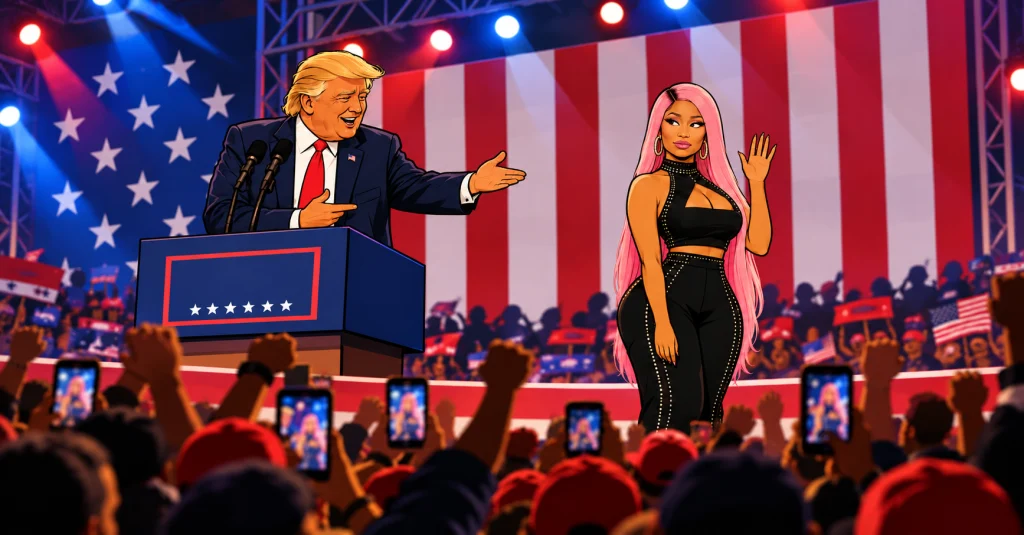
At a Michigan campaign rally, Donald Trump commented on Nicki Minaj’s backside before asking her to stand. Hours after a White House aide floated her for press secretary, the moment brought a very different kind of attention to one of his most visible celebrity supporters, raising questions about gender, political loyalty and the increasingly personal nature of their alliance.
Donald Trump was speaking to supporters in Port Huron, Michigan, on Sunday when he turned his attention to someone in the audience who had flown with him aboard Air Force One: rapper Nicki Minaj. Rather than introducing her through her music, her political views or her growing role in his campaign, Trump commented on her body. “By the way, I’ve looked at one hell of a beautiful ass before,” he said, pointing to Minaj. “That’s hard to miss! Stand up.” Minaj stood and acknowledged the crowd. A moment later, Trump added, “I hope Nicki wasn’t insulted, but we love Nicki.” The exchange, captured on video and widely shared, quickly became another example of how Trump’s unscripted remarks can pull attention away from the political event happening around him.
The comment came as Trump rallied support for Michigan Republicans ahead of the November 3 midterm elections. He had been revisiting earlier remarks about Ohio Sen. Jon Husted, a former college football player whose physique Trump had praised at a rally in Youngstown, Ohio. Explaining those remarks, Trump contrasted looking at a man’s body with looking at a woman’s, then singled out Minaj before returning to Husted. It was not a passing compliment. It was part of a longer riff on physical appearance that, for several minutes, displaced the campaign’s political message.
The Same Day, a Different Kind of Spotlight
Hours earlier, Minaj had been the subject of a very different conversation. Aboard Air Force One, White House Communications Director Steven Cheung filmed her praising the president and declared that the administration might have found its next press secretary, as SSC reported in Nicki Minaj for White House Press Secretary? A Joke That Says Plenty About Politics Today. That morning, she was being floated, even jokingly, as a potential voice of the government. By the afternoon, the president was asking her to stand so a crowd could look at her body.
The two moments sit side by side as a portrait of how Minaj is positioned inside Trump’s orbit: valued for the attention she brings, celebrated for her loyalty and, in Port Huron, reduced for a moment to her appearance.
An Alliance Years in the Making
Minaj’s presence in Michigan was politically significant in its own right. In January, she joined a Treasury Department event promoting Trump Accounts, a federal program of investment accounts for children, and called herself the president’s number one fan. In April, she attended the White House Correspondents’ Dinner, the moment SSC described in Endorsement Becomes Alignment: Nicki Minaj, Political Power, and the Celebrity Gamble as the point where her support stopped reading as commentary and started functioning as a pattern. In September, during an appearance on Fox News, she said she felt personally connected to the president and had no intention of apologizing for supporting him.
That alliance has a strategy behind it. In May, SSC reported in How Nicki Minaj’s Grievance Became Someone Else’s Infrastructure that Trump adviser Alex Bruesewitz has been described as the administration’s “celebrity envoy,” a role built around turning cultural influence into political reach. Minaj brings an audience that speeches, ads and party organizations struggle to reach. Trump offers her access to the presidency and a platform that carries her views well beyond entertainment.
She Came With a Message of Her Own
That relationship makes Sunday’s exchange more complicated than a celebrity receiving an awkward compliment. Minaj was not at a concert or a promotional appearance. She was at a political event where her influence could help move voters, and she came prepared. When she took the stage, she led the crowd in a call-and-response for Republican Senate candidate Mike Rogers, urged support for gubernatorial nominee John James, called Trump a symbol of resilience and said children should not be exposed to messages about changing their sex. She closed by playfully telling Trump she would support him if he ran again, though the Constitution limits presidents to two terms.
She arrived with a political message. Yet the most widely shared moment of the day was the president’s assessment of her body, not anything she said about the election.
When a Woman’s Body Becomes the Headline
The exchange raises a familiar question about how women are treated in public life, especially in spaces dominated by powerful men. Minaj has spent years using sexuality, fashion and physical presentation as part of her artistic identity. That history does not make every public comment about her body inappropriate by definition, and the available reporting does not establish how she personally felt about Trump’s remarks. But there is a difference between an entertainer choosing how to present herself and a president drawing attention to her backside and asking her to stand before a political crowd. One is self-expression. The other places her body at the center of a moment she did not start.
The body Trump singled out is also the one American culture has spent years both selling and scrutinizing. As SSC reported last week in Big Butts Are Having Their Victoria’s Secret Moment. But Is Fashion Really Embracing Every Body?, fuller curves have moved from the margins of fashion to its marketing campaigns. And in The Price of a Bigger Butt: Why Women Continue Risking Their Lives for BBL Surgery, SSC examined how that same silhouette now drives a surgical industry with potentially fatal risks. Minaj helped define that aesthetic. On Sunday, it was turned into an applause line.
There is a longer history here too. Black women in entertainment have often found their talent discussed in the same breath as their bodies, a pattern SSC traced in Janet Jackson’s Latest Viral Moment Is a Reminder of How Much Pop Music Owes Her. Minaj is one of the most commercially successful rappers of her generation and, by her own choice, one of the most politically visible artists in the country. In Port Huron, the most powerful man in the room introduced her by her appearance.
Different Standards, Different Reactions
The reaction split along familiar lines. Supporters online celebrated the moment as classic Trump, unscripted and unafraid. Critics called it degrading and noted that, with Election Day just over a week away, it was hardly the closing message Republicans had planned.
Trump has built much of his public identity around rejecting conventional expectations for presidential language. Supporters often see his spontaneous remarks as proof that he is authentic and unbothered by political correctness. Critics see the same behavior as disregard for the decorum of the office. Those competing views help explain why a comment that might create a lasting controversy for another politician can become one more fleeting episode in Trump’s career. The reaction to Sunday’s remark may say as much about what audiences now expect from the president as it does about the remark itself.
Minaj, meanwhile, has made clear her political allegiance is not a passing curiosity. Her willingness to stand beside Trump, despite criticism of their association, reflects a deliberate decision to attach her cultural influence to his movement. Sunday’s exchange did not erase that choice, but it complicated the image of a celebrity ally being honored for her political contributions. For a few moments, the president turned a prominent female supporter into the subject of a public appraisal of her body. The crowd cheered, the rally continued and Minaj delivered her endorsement. What remained was a revealing example of how celebrity, gender and political power can collide on the same stage.