

A woman who traveled from Uganda has tested positive in Abuja as the fastest-spreading Ebola outbreak on record moves across Africa. Nigeria’s 2014 response became a global model for containment. This time, it faces a different strain and a more strained economy.
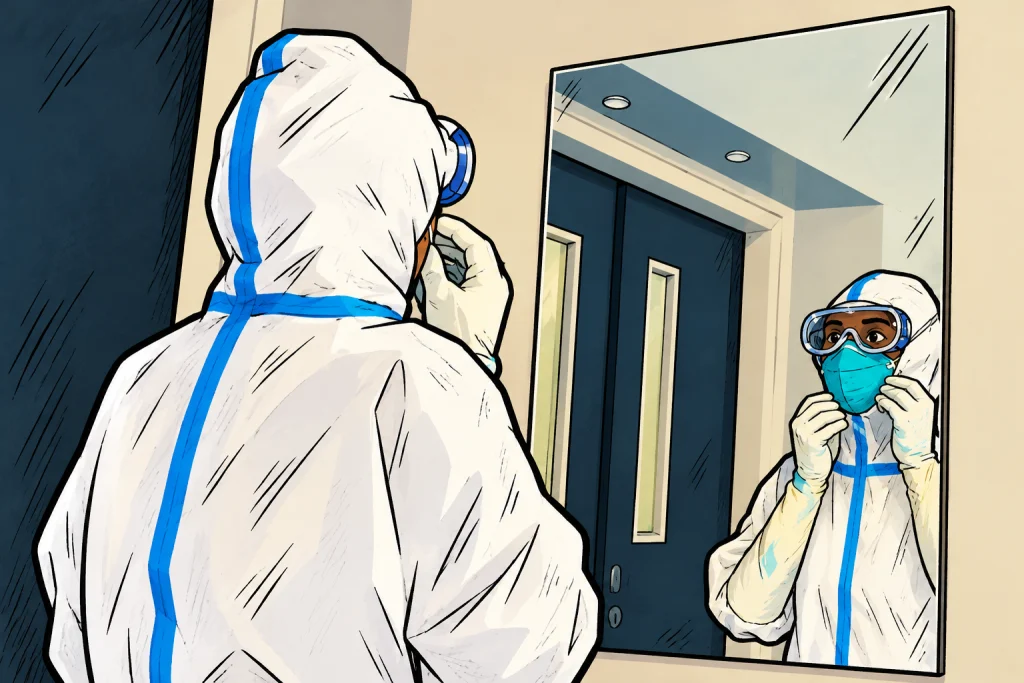

Nigeria confirmed an Ebola case in its capital, Abuja, on Tuesday, the Associated Press reported, after a woman who had arrived from Uganda tested positive for the virus. She began showing symptoms on Oct. 7 and was admitted to a private hospital in Abuja on Oct. 11, where she was later diagnosed. Health Minister Muhammad Pate said authorities have begun tracing 44 people identified as her contacts. “We are doing everything possible to contain this case by tracing all the contacts the individual may have had,” he said.
The case makes Nigeria the latest country touched by an outbreak that began in Congo in mid-May. Kenya confirmed its first case earlier this month and has since recorded nine infections. Uganda, where the patient traveled from, had previously reported cases before declaring itself free of the virus. Across the region, the Bundibugyo strain of Ebola has now infected more than 9,000 people and killed more than 4,300. The World Health Organization says it is the fastest-spreading Ebola outbreak on record and is on track to surpass the deadliest one, the 2014–2016 West Africa epidemic that killed about 11,000 people.
An Outbreak Unlike Any Before It
Dr. Jean Kaseya, director general of the Africa Centers for Disease Control and Prevention, called the situation “an extremely serious threat,” noting that close to half of known cases have been fatal. “This Bundibugyo Ebola outbreak has already become the most geographically extensive in history, affecting several countries spread across three regions of Africa,” he wrote on X. The International Rescue Committee’s director in Congo warned this week that the crisis is far outpacing the response.
Bundibugyo is a rarer form of Ebola than the Zaire strain behind the West Africa epidemic, and that matters for the tools available to fight it. The best-known Ebola vaccine, Ervebo, was developed against the Zaire strain, which means health workers are relying heavily on the fundamentals of outbreak control: finding cases early, isolating patients, tracing contacts and protecting the health care workers who treat them. Those are exactly the steps Nigeria is now racing to carry out in Abuja.
The Country That Stopped Ebola Once
Nigeria has done this before, and done it well. In July 2014, a traveler arriving in Lagos brought Ebola into Africa’s most populous country. The response that followed became a model studied around the world. Nigeria recorded 20 cases before the outbreak was declared over within three months, an extraordinary result in a city of more than 20 million people. Much of the credit went to fast contact tracing, emergency operations built on the infrastructure of the country’s polio eradication campaign and the vigilance of health workers. Among them was Dr. Ameyo Adadevoh, the Lagos physician who identified the first patient, insisted he be isolated despite pressure to release him and later died of the virus she helped contain.
The government is clearly aware of that legacy. Nigeria set up an Ebola task force in June, shortly after the Congo outbreak began. “We do not want a repeat of what happened during the last outbreak when a carrier entered the country, and everyone was scrambling to respond,” Femi Gbajabiamila, chief of staff to President Bola Tinubu, said at the time. Two weeks ago, after Kenya’s first case, the Nigeria Centre for Disease Control said it was stepping up surveillance and focusing on early detection, isolation, lab testing, infection control, contact tracing, public communication and protecting health workers.
A Harder Moment to Fight It
What’s different now is the backdrop. The Abuja patient was symptomatic for several days and spent time in a private hospital before her diagnosis, the kind of gap that gives a virus room to move. And Nigeria is facing this test during a period of deep economic pressure. SSC has reported on how Nigeria’s economy is improving on paper while households are still waiting to feel it, how fuel subsidies aren’t coming back even as families keep paying the price, and how Lagos rents have climbed as much as 120%. Economic strain shows up in health systems too: in staffing, in supplies and in whether people can afford to stay home from work when they feel sick.
None of that means Nigeria will fail this test. The country has the experience, the institutions and an early warning that most nations in 2014 didn’t have. But Ebola outbreaks are won or lost in the first days, through how quickly contacts are found and how much trust communities place in the health workers asking them to isolate. Nigeria is in those first days now, and the 44 people on its contact list may determine whether Abuja becomes a footnote or a turning point.
Reporting sources: Associated Press, via NPR, NPR, World Health Organization, Africa CDC, Nigeria Centre for Disease Control