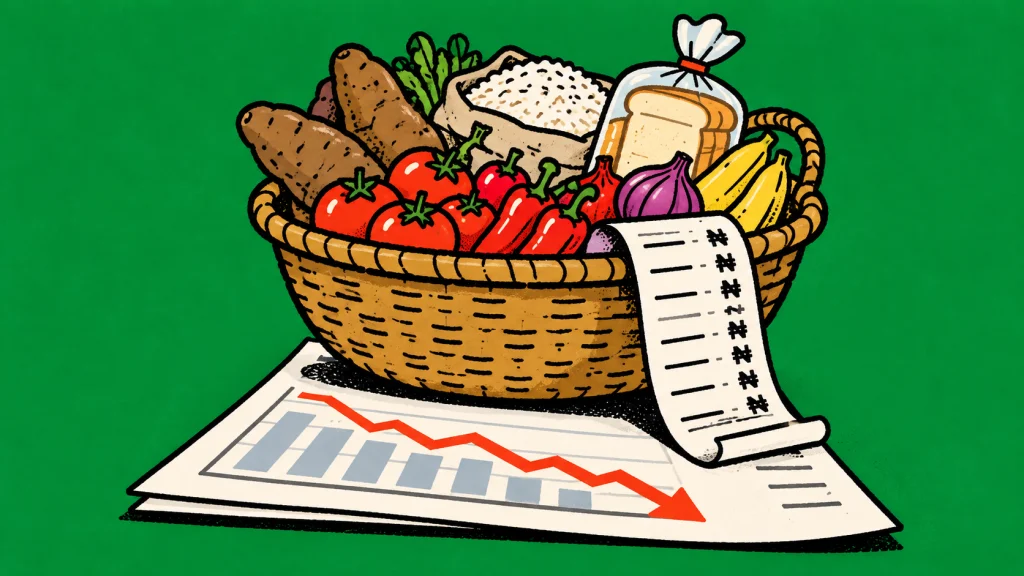
Inflation is falling, but food costs remain high and a $12.4 billion gap in the country’s external accounts is raising a different question about how much confidence the recovery can carry.
Nigeria’s headline inflation rate fell to 14.63% in September, its lowest level since the country rebased its consumer-price index, but the improvement is landing unevenly across an economy where food remains much more expensive and questions persist about the reliability of the country’s external financial data. Cynthia Egboboh of BusinessDay reported Thursday that food inflation stood at 19.59%, virtually unchanged from 19.57% a month earlier. Separately, Wasiu Alli of BusinessDay reported that the World Bank identified a $12.4 billion unexplained gap in Nigeria’s external accounts during the first half of 2026.
The two figures describe different parts of the economy, but they point toward the same problem. Nigeria’s statistical recovery is moving faster than the conditions households and investors use to decide whether the economy is actually becoming more stable.
Falling inflation does not mean prices are falling. It means prices are increasing more slowly. Food inflation at nearly 20% still leaves basic necessities rising considerably faster than the headline index, and food takes up a larger share of household spending for lower-income families. A national inflation number can therefore improve while the part of the household budget people experience most frequently remains under pressure.
September offered some relief. Month-to-month food prices declined 1.55%, according to National Bureau of Statistics data cited by BusinessDay, while overall monthly inflation was only 0.06%. But the annual numbers remain high enough to preserve much of the purchasing-power damage accumulated during earlier price increases.
The external-accounts problem introduces another layer of uncertainty. The World Bank’s $12.4 billion figure represents money recorded in Nigeria’s balance-of-payments data that could not be clearly matched to identifiable transactions, according to BusinessDay. Large discrepancies can arise from weak reporting, informal economic activity, errors or capital movements that are difficult to track. Whatever the cause, an unexplained figure of that scale makes it harder to know precisely how foreign currency is moving through the economy.
Economic management depends heavily on confidence in those measurements. The central bank sets policy based partly on inflation and foreign-exchange conditions. Investors evaluate reserves, currency stability and capital flows. Households make simpler calculations about food, transportation and wages. When those measures improve at different speeds, policymakers can describe a recovery that people have not yet experienced in the same way.
Nigeria has already made painful economic adjustments under Bola Tinubu, including removing fuel subsidies and overhauling the foreign-exchange system. Those policies were intended to correct distortions that had become increasingly expensive for the government to maintain. The costs arrived quickly through higher fuel, transportation and consumer prices. The benefits are appearing more gradually through lower headline inflation and changes in foreign-exchange conditions.
That timing redistributes risk toward households. Government can point to improving macroeconomic indicators while families carry the earlier price shock for much longer. Wages do not automatically rise when inflation slows, and the price level does not return to where it was before the adjustment.
The external-account discrepancy places some risk on investors and policymakers as well. Better economic decisions require credible information about how much capital is entering and leaving the country. If a substantial portion cannot be clearly explained, apparent stability becomes harder to evaluate.
Nigeria may continue producing encouraging headline numbers over the coming months. The political and economic test will be whether food costs, wages and foreign-exchange data begin moving in the same direction. Until then, the country can have an improving economy on a spreadsheet while many of the people living inside it remain unconvinced.