
Part of Culture in Motion — examining who defines culture, how it moves, and what it reveals about the moment.
A fan’s question after Luther Campbell’s performance at an Alpha Kappa Alpha regional conference recently reopened one of popular music’s most durable debates. The question was simple on its surface: how was Luke able to perform at an AKA event when Trick Daddy, another Miami artist, had reportedly been restricted from performing explicit material at a similar gathering? The implied charge was inconsistency. Luke’s response reframed it as a question of context — he stated that he did not perform explicit lyrics during the show, and reminded the commenter that he helped pioneer the very infrastructure that makes clean and explicit versions of music a standard industry practice.
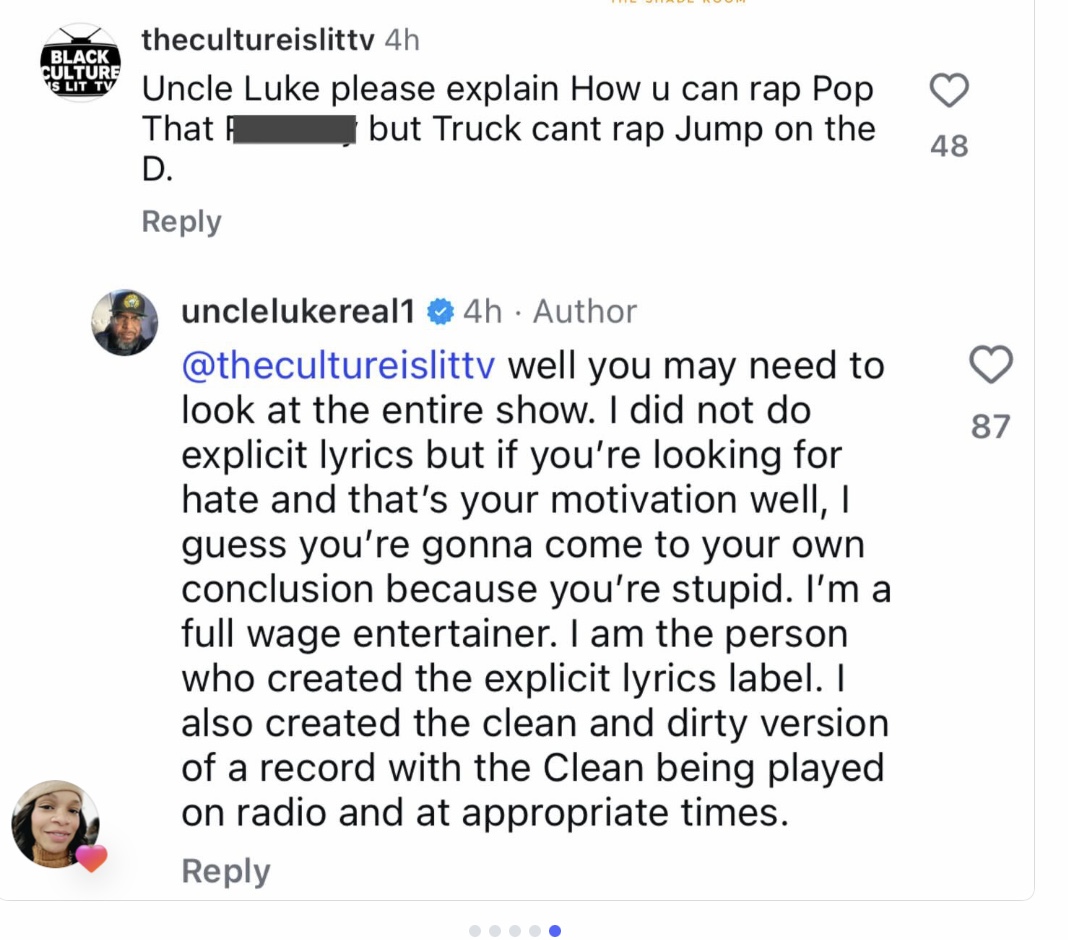
As SSC covered in its analysis of the Uncle Luke and Trick Daddy situations, the distinction the fan was missing was not about catalog or history. It was about situational awareness — the capacity to read a room, honor its terms, and make the adjustment that demonstrates respect rather than simply presence. Luke made that adjustment. Trick Daddy, at an earlier AKA event, reportedly did not. The outcomes reflected the difference. But the exchange also opened a larger question that extends well beyond any single performance or any single organization’s event policies: how did the artist who once defined the outer edge of what American culture considered too explicit become someone who can navigate those same spaces with institutional approval?
The answer requires going back to where the line was drawn in the first place. The Parental Advisory: Explicit Content label was introduced in the mid-1980s under pressure from the Parents Music Resource Center, a lobbying organization whose membership included political wives and whose targets were disproportionately Black artists, hip-hop, and music rooted in communities that mainstream gatekeeping institutions had long treated as culturally suspect. The label was framed as consumer information for parents. It functioned, in practice, as a mechanism of cultural control — one that applied its scrutiny unevenly and that produced its most consequential legal battles almost exclusively around Black expression.
Luke was not on the sidelines of that moment. As the central figure in 2 Live Crew, he was at the center of one of the most significant First Amendment cases in American music history. The obscenity prosecutions his group faced in Florida were not simply about lyrics. They were about who gets to define cultural limits, and whose expression gets subjected to legal scrutiny that comparable content produced by white artists did not face. That context is not incidental to understanding where explicit music sits today. The baseline shifted in part because artists and communities pushed back against a system of cultural policing that was never applied neutrally.
Over time, the industry adapted in ways that institutionalized what was once considered transgressive. Clean and explicit versions became standard distribution practice, allowing artists to move between audiences without abandoning their core identity. What had triggered bans, boycotts, and federal obscenity charges became systematized into format strategy — a dropdown option in a streaming dashboard, a checkbox in a distribution agreement. The infrastructure that Luke helped force into existence by occupying the controversy now runs automatically, and most people who use it have never thought about what it cost to build.
What has shifted most fundamentally is not the content. It is the baseline against which content is measured. Language and themes that drove national political controversy in the late 1980s and early 1990s are now embedded in mainstream listening culture across demographic lines. Streaming eliminated much of the traditional gatekeeping that once gave retailers, radio programmers, and local governments leverage over what audiences could access. The result is a culture in which explicit content is so normalized that the Parental Advisory label has become closer to a genre marker than a warning — information about what kind of music this is rather than a judgment about whether it should exist.
What has not changed is the underlying question of who the rules apply to and how flexibly they are administered. The AKA conference exchange captures that question precisely. Luke navigated the room. That navigation reflects decades of experience, institutional literacy, and an understanding of how Black organizations manage their spaces and their standards. The ability to make that adjustment — to hold your history in one hand and read the current room with the other — is not available equally to everyone. It is a form of cultural competence that some artists develop and others do not, and the organizations that hold those spaces have always retained the authority to determine whether the adjustment that was made was sufficient. That authority is not incidental. For institutions like AKA, which have exercised sovereign control over their spaces across more than a century of American cultural life, it is foundational.
The explicit lyrics label was once a line. It is now a layer — one of several filters through which music passes before it reaches any given room. What the current moment reveals is not that the boundaries disappeared. It is that they became more negotiable, more contextual, and more dependent on who is doing the navigating and how well they understand the space they are trying to enter. Some artists learned that lesson. The ones who did not are still figuring out why the door closed.