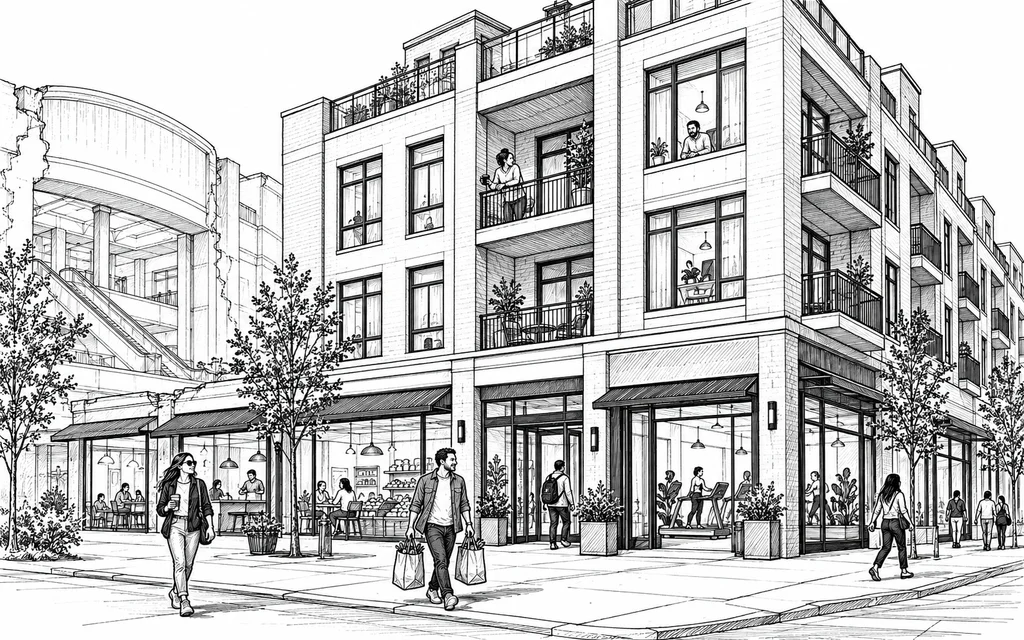
Imagine leaving your apartment on a Saturday morning, riding the elevator down and walking into a coffee shop without ever stepping outside. The gym is across the courtyard, a restaurant is around the corner and a grocery store is a short walk away. That feels like an ideal setup for a resident, and it is also an attractive business model for the company that built the property: the apartment produces rent, the businesses downstairs get nearby customers and everyday errands keep money moving inside the same development.
That idea is reshaping commercial real estate across the country. Aging malls, empty department stores and underused office parks are being torn down or rebuilt as mixed-use districts that combine housing with shopping, dining, fitness and entertainment. Developers are responding to changing shopping habits and a deep need for housing, but there is another advantage in the math. Instead of building a retail destination and hoping shoppers show up, they can build homes that put customers right next to the stores.
The New Anchor Tenant Is the Resident
Traditional malls depended on big retailers to bring in traffic. Department stores like Sears, Macy’s and JCPenney served as anchors, pulling in visitors who also spent money at smaller shops and food courts. When those chains struggled, many malls lost the businesses responsible for most of their foot traffic, and developers began looking for a different anchor.
Increasingly, that anchor is housing. At Brea Mall in Southern California, Simon Property Group is replacing a former Sears store with about 380 apartments, alongside new restaurants and a Life Time athletic club that has already opened at the mall. In Kirkland, Washington, the former Totem Lake Mall has become the Village at Totem Lake, where developers added 852 apartments across two phases alongside Whole Foods, Trader Joe’s, a Cinemark theater and a long list of shops and restaurants.
A 2026 analysis by the Commercial Real Estate Development Association describes housing at Totem Lake as an economic driver of the redevelopment rather than an amenity bolted onto a shopping center. That is the part of this strategy I find most revealing. The resident is no longer just someone who lives near the shopping center, but part of the system that keeps it alive.
Convenience Can Become Predictable Revenue
Consider a development with 400 apartments. If each home averages 1.5 residents, that puts roughly 600 people within steps of the commercial space. That is a hypothetical illustration rather than an occupancy figure for any real project, but it shows why density counts.
Not everyone will shop downstairs. Some residents work elsewhere, prefer other stores or find the local options too expensive. Still, a restaurant or coffee shop sitting under several hundred occupied apartments has a customer base that does not need to drive across town, and those residents can turn into regulars who grab coffee before work, pick up takeout after a long day, use the gym or stop at the pharmacy.
The setup also rewards developers who control both the homes and the storefronts. Good amenities help lease apartments, and a steady population of residents makes retail space easier to rent, so housing and shopping work as complementary businesses instead of separate bets. None of that guarantees a profit, because a restaurant still needs fair prices, good service and customers from beyond the building. It does give these projects an edge over an old mall that depends almost entirely on visitors.
Office Parks Are Part of the Transformation
The same rethinking is happening at outdated office properties. In Dallas, three vacant office buildings along the LBJ Freeway are coming down to make way for 435 apartments from High Street Residential, with 218 of them set aside as affordable housing. Projects like this one are driven mostly by demand for housing, not by spending at nearby shops, and not every office replacement includes storefronts.
What ties them together is a willingness to rethink commercial land that no longer serves its original purpose. In Round Rock, Texas, the first phase of a large mixed-use district called The District started vertical construction in March on 316 apartments, about 23,000 square feet of ground-floor retail and a food-and-beverage plaza spread across six buildings. It is not a former mall, but it is being planned from the start around the link between housing, commerce and everyday convenience, much as cities like New York are converting hotels and church land into homes.
Houston Shows How Different the Outcomes Can Be
Houston’s Greenspoint Mall shows that not every dead mall becomes a neighborhood. Demolition began Oct. 13 to make way for CityNorth Industrial Park, a $150 million project from Lincoln and New York Life Investment Management with about 1.2 million square feet of space for logistics, distribution and manufacturing. Developers expect it to support about 1,200 full-time jobs once it is fully built.
Next door, on part of the old mall’s parking lot, the Zieben Group built Summit at Renaissance Park, a 325-unit affordable apartment community with 17,000 square feet of ground-floor retail. The two projects show there is no single formula: some former malls become industrial parks, others become housing and some blend homes with shops, depending on local demand, land values, infrastructure and financing.
The larger shift is still clear. Properties that once relied on a stream of shoppers or office workers are being rebuilt as places where people live, work and spend money all day long, a pattern that echoes how Houston’s growth is spreading along suburban corridors.
Building Communities or Capturing Customers
I see real benefits in this approach. Walkable developments make daily life easier, cut down on car trips and bring life back to properties that sat half-empty for years. New housing can also add supply in markets where renters have few options.
But I also think we should ask what happens when one developer controls so much of the world around someone’s home. The company may set the rents, decide which retailers can afford the leases and choose the mix of restaurants, stores and services. A project marketed as a vibrant neighborhood can end up serving mostly higher-income residents if both the apartments and the businesses are priced that way.
That raises questions about affordability and access. Can an independent neighborhood restaurant afford a lease in one of these developments, and will residents find reasonably priced groceries and basic services, or mostly upscale restaurants, boutique fitness studios and specialty shops? Walkability alone does not guarantee access, because a grocery store downstairs does little for households that cannot afford what is on its shelves, a tension we saw in the 386 affordable homes that just opened in Brooklyn, where the rents will decide who gets to stay.
The Shopping Mall Is Becoming an Address
For decades, the American mall was somewhere people drove to. Developers built huge parking lots, recruited national chains and marketed the destination to surrounding towns. The mixed-use model flips that relationship by bringing potential customers onto the property and giving them a place to live.
For residents, the appeal is convenience. For retailers, it is a steady customer base close by, and for developers, it is rent income that also props up the value of the commercial space. I think the strategy is more sophisticated than swapping empty stores for apartments, because it recognizes how closely spending follows convenience, routine and proximity.
The most successful projects will still need customers from the wider community, and not every resident will become a regular downstairs. But housing delivers something a struggling department store often cannot: a population that comes back to the property every evening. There is a real chance here to revive dead commercial sites and build neighborhoods that fit how people want to live, as long as those neighborhoods are designed for more than maximizing what their residents spend.
The old mall needed shoppers to show up. The new development gives them a place to live, and for the businesses downstairs, that may be the most valuable amenity of all.