
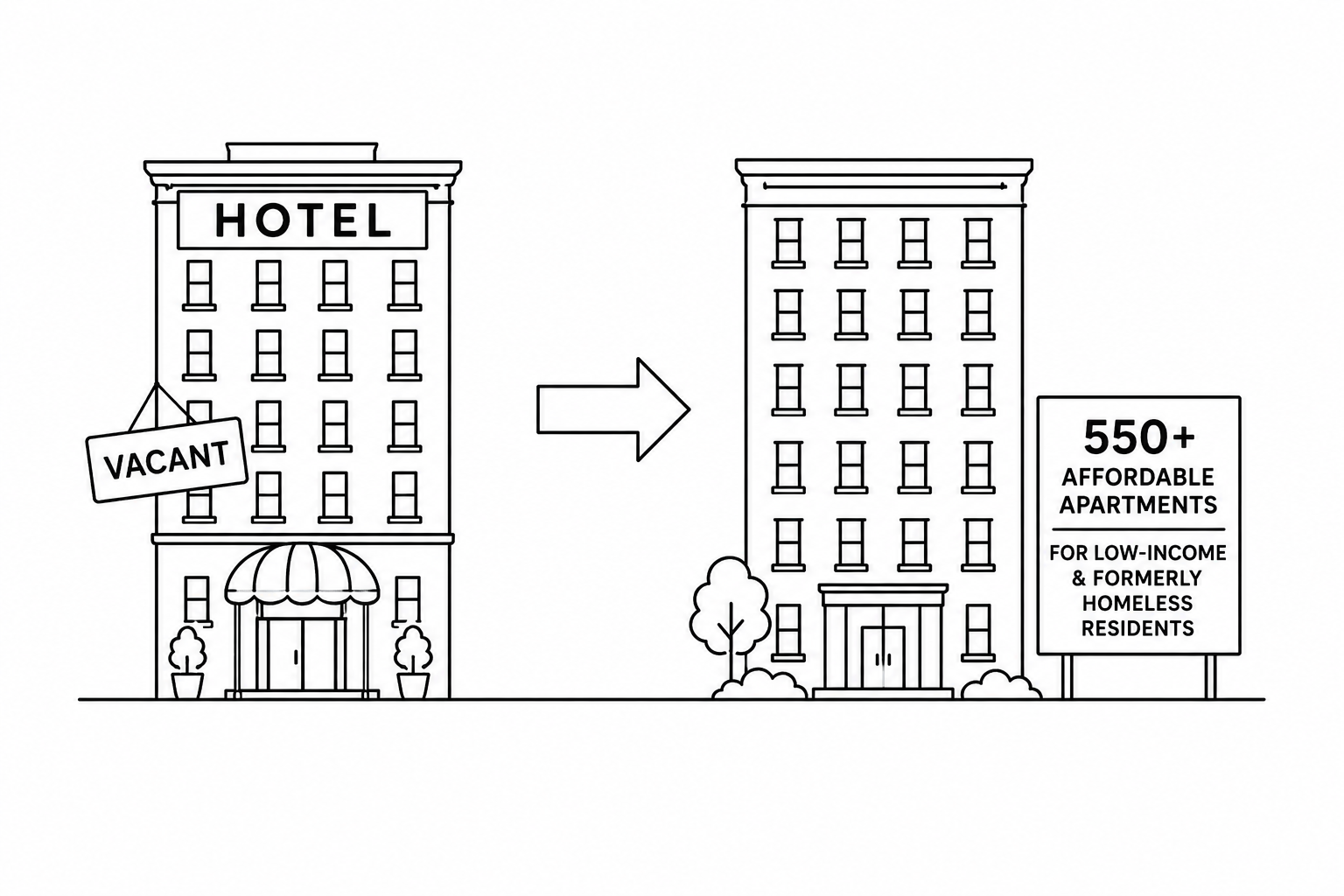
Slate Property Group and Breaking Ground, New York’s largest nonprofit supportive housing developer, acquired the Stewart Hotel at 371 Seventh Avenue in Midtown Manhattan for $255 million, with plans to convert the 611-room property into 579 permanently affordable apartments for low-income and formerly homeless residents, Crain’s New York Business reported in December 2025. Total development costs are estimated at $500 million. Construction is set to begin in late 2027, with a roughly two-year buildout — meaningfully shorter than the 36 months typical for ground-up construction. The project is financed through a combination of New York State’s Housing Our Neighbors with Dignity Act (HONDA), the city’s NYC 15/15 Supportive Housing Initiative, and acquisition financing from Wells Fargo and JPMorgan Chase.
The policy mechanism the Stewart project represents is more consequential than the building itself. Cities traditionally address housing shortages by permitting new construction, expanding density, and encouraging private development. When those processes fail to produce enough units — and in New York they have failed for decades — governments turn to conversion strategies that reuse existing structures. A city does not purchase a hotel and convert it into affordable apartments because that is the traditional model for meeting demand. It does so because conventional production has not generated sufficient supply.
The cost comparison makes the improvisation argument concrete. At roughly $863,000 per unit in total development costs, the Stewart conversion is not a bargain — ground-up affordable housing in New York typically runs $500,000 to $700,000 per unit before land costs. What conversion offers is not primarily savings. It is speed and certainty. Hotel floor plates are highly compatible with residential living, allowing interior work to begin immediately. The Baisley Pond Park Residences in Queens — the first hotel conversion completed under HONDA — was finished in 21 months, compared to the 36-month standard for conventional construction. In a city where the housing shortage compounds monthly, time is the scarce resource.
The racial and distributional dimension of the Stewart project is embedded in its design. Homelessness in New York is disproportionately concentrated among Black and Latino residents — a pattern documented across decades of city housing data. A conversion specifically targeting formerly homeless residents is making a distributional choice: addressing acute need at the bottom of the affordability ladder while the broader middle-income housing shortage remains largely unaddressed. Both are real. They are not the same problem, and the conversion strategy currently being deployed solves only one of them.
Hotel conversions also proceed more readily than office conversions for a specific structural reason. Hotel rooms are already built around individual plumbing, bathroom fixtures, and room separation — the same configuration residential units require. Office buildings, by contrast, have open floor plates, centralized plumbing, and window-to-floor-area ratios that make residential conversion structurally difficult and expensive. As commercial real estate vacancies remain elevated across New York and other major cities, the distinction matters: the empty buildings easiest to convert are hotels, not the office towers generating the most policy attention.
The Stewart project is Breaking Ground’s sixth residential hotel conversion, following the Times Square, Prince George, The Christopher, 90 Sands, and Baisley Pond projects. That track record reveals something about the durability of the improvisation: this is not a crisis response. It is an emerging model. Governor Kathy Hochul framed the approach plainly at the Baisley Pond completion in December 2025: “Digging our city out of this severe housing shortage will require every tool in our toolbox.”
Housing policy is gradually becoming a form of institutional redesign. As conventional construction struggles to match demand, governments are relying more heavily on repurposing the built environment they already possess. The future of urban housing in New York — and in cities confronting the same pressures — may depend less on where cities can build next and more on what they can successfully transform, how quickly, and at what cost to whom.