
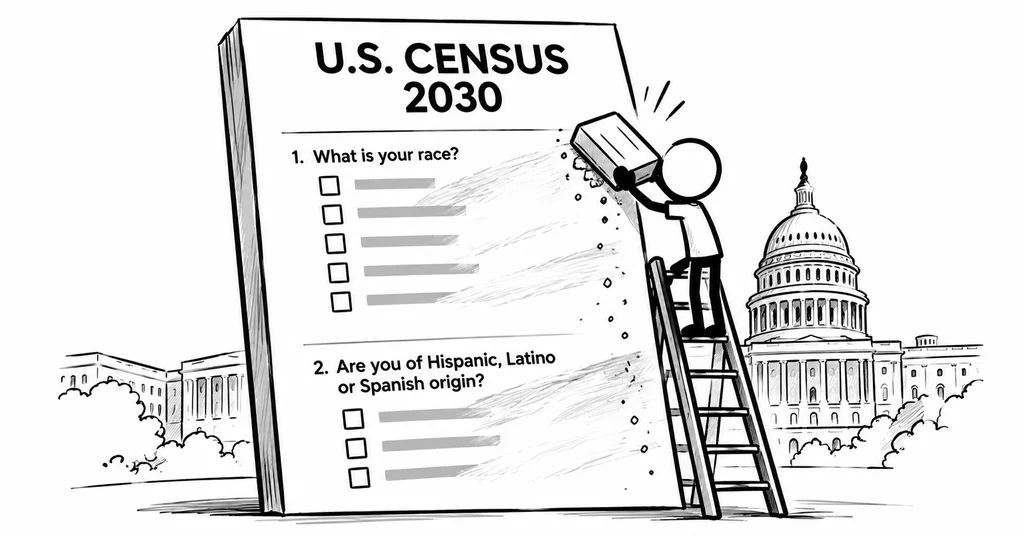
The administration has proposed removing race and ethnicity questions from the 2030 census. Those categories are imperfect, but they help enforce voting, employment and civil-rights laws and determine whether public programs reach the communities they are supposed to serve.
The Trump administration is considering a fundamental change to the 2030 census: stop asking Americans about their race and ethnicity. NPR framed the proposal this weekend as a decision to “know less about America,” and that is a useful way to understand the stakes. Race categories are socially constructed, imperfect and constantly changing. They do not explain everything about a person’s life, and they have never mapped neatly onto American identity. But removing the questions would not make racial differences disappear. It would reduce the government’s ability — and everyone else’s — to measure where those differences exist.
The Census Bureau itself explains why it collects racial data. Federal, state and local governments use it to enforce civil-rights protections, evaluate equal-employment programs, monitor racial disparities in health and environmental risk and draw legislative districts consistent with voting-rights requirements. Census race data are also combined with housing, education, employment and voting information to evaluate whether policies affect groups differently. Hispanic-origin data serve similar functions, including enforcement of bilingual-election requirements and allocation or evaluation of certain public programs.
One of the most direct consequences would be voting rights. The Census Bureau produces detailed Citizen Voting Age Population data by race and ethnicity that are used in voting-rights analysis down to small geographic areas. Courts, state legislatures, advocates and the Justice Department rely on racial demographic data when assessing whether electoral maps dilute minority voting strength. Remove the underlying racial information and proving — or disproving — those claims becomes considerably harder. A district can still disadvantage Black or Latino voters; the government simply has fewer standardized numbers showing who lives there.
The same problem applies to discrimination outside elections. If a city’s Black residents receive mortgages at different rates, if Latino neighborhoods receive fewer health resources, or if one racial group bears disproportionate environmental exposure, analysts need demographic data to establish the pattern. Individual anecdotes may reveal a problem, but civil-rights enforcement often depends on showing disparities across large populations. The Census Bureau specifically says race data are used to monitor compliance with the Civil Rights Act, Voting Rights Act and other antidiscrimination rules.
Supporters of removing the questions could argue that government should treat individuals without racial classification and that official categories can harden divisions the country should move beyond. That debate is not frivolous. Census racial categories have changed repeatedly because American identities do not fit permanently into fixed government boxes. The question, however, is whether eliminating measurement eliminates the conditions being measured. There is little reason to believe it would. Schools, neighborhoods, wealth, health and voting participation can remain racially unequal even if a federal form no longer records race.
There is also a practical funding issue, although it requires precision. Not every federal dollar is allocated directly according to race. Population counts, age, poverty, income and other census variables drive enormous amounts of funding. But Census Bureau guidance says racial and ethnic statistics are used in planning and funding programs serving specific populations, evaluating whether programs operate equitably and identifying populations that may not be receiving needed services. Removing race would therefore not suddenly erase all federal funding formulas, but it would weaken the ability to determine whether money and services are reaching different communities fairly.
This debate also arrives at a moment when America’s electorate and population are becoming more racially complex. SSC recently examined Pew data showing the White share of eligible voters falling from 74% in 2006 to 61% in 2026 while Hispanic and Asian shares nearly doubled. That demographic change does not become less politically consequential because the government stops categorizing it. It simply becomes harder to see with the same national precision.
The census has always done more than count how many people live in America. It tells governments, researchers, businesses and communities who is being counted and how life differs across those populations. There are legitimate arguments about how race should be measured and whether today’s categories accurately reflect the country. But that is different from deciding not to measure it at all. America would not become colorblind. It would become less capable of documenting whether color still affects what happens to people.