
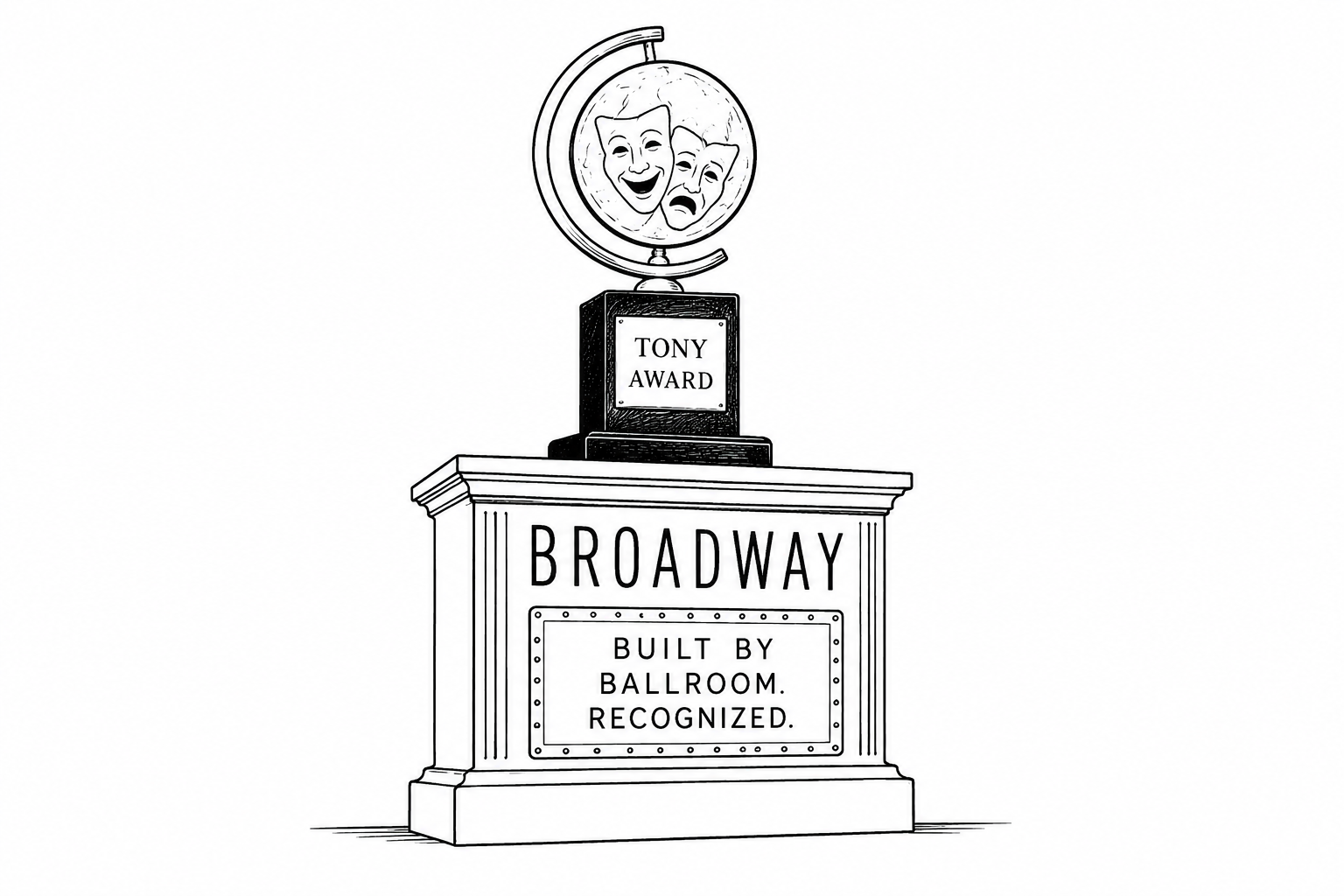
On June 7, choreographers Omari Wiles and Arturo Lyons stood at the podium at Radio City Music Hall and said the first thing that needed to be said: “Thank you, Ballroom.” The two had just won the 2026 Tony Award for Best Choreography for Cats: The Jellicle Ball, a Broadway revival that reimagined Andrew Lloyd Webber’s 1981 property through the aesthetic language of ballroom culture — the vogue battles, the houses, the floor-work, the collective labor of a subculture that has been building its own institutions since the 1970s. Wiles and Lyons brought more than 30 combined years in ballroom to a 1,100-seat Broadway house. In the same ceremony’s pre-show, costume designer Qween Jean became the first openly transgender woman to win a Tony Award in any category, also for Cats: The Jellicle Ball.
The Broadway establishment validated what the ballroom community has always known about its own work. The mechanism worth examining is what happens next.
Ballroom culture has a documented history of producing aesthetic and cultural value that travels upward into mainstream institutions — and leaves most of the economic upside behind. Paris Is Burning captured the culture in 1990 and generated critical acclaim and a lasting cultural record; the houses and performers documented in it saw a fraction of its financial return. FX’s Pose brought ballroom to prestige television, created visibility for trans performers at an unprecedented scale, and was produced, distributed, and owned by a major media company. Beyoncé’s Renaissance drew explicitly from the sonic and visual architecture of Black queer club culture and became one of the highest-grossing concert tours in history. In each case, the recognition was real. The question of who held the infrastructure — the label, the production company, the distribution rights, the intellectual property — pointed in a different direction.
Cats: The Jellicle Ball was produced by Broadway Across America and Jujamcyn Theaters, playing at the Broadhurst Theatre. The creative team — co-directors Zhailon Levingston and Bill Rauch, choreographers Wiles and Lyons, costume designer Qween Jean — is Black and queer in a way Broadway’s creative leadership rarely is. The Tony wins are a genuine milestone. They are also the latest instance of a pattern in which the communities that generate a cultural form receive recognition at the moment the form becomes commercially viable, while the ownership of the infrastructure that monetized it remains elsewhere. André De Shields, Junior LaBeija, Leiomy — the cast includes ballroom legends whose presence was not incidental to the production’s artistic credibility. Their credibility is part of what filled those 1,100 seats.
None of this is an argument against the wins. Wiles and Lyons earned theirs. Qween Jean’s history-making moment is significant and should be named as such. What it is an argument for is clarity about what a Tony Award is and what it is not. It is institutional recognition at the highest level of American theater. It is not a transfer of economic power. The ballroom community that spent decades building the aesthetic vocabulary now celebrated on Broadway’s biggest stage will not receive a percentage of the Broadhurst’s box office. The houses that trained the choreographers and the legend who walked the category that inspired the production’s entire visual logic are not on the production’s financial waterfall.
The pattern producing this outcome is not unique to Broadway. It is the mechanism underlying every moment when a marginalized community’s cultural production enters a mainstream institution and generates commercial value. The institution captures the upside. The community receives the award. Recognition and ownership are not the same event — and the distance between them is exactly where the real story lives.
Get SSC analysis delivered to your inbox every day. Subscribe free on Beehiiv: socialstorytellerscollective.beehiiv.com