
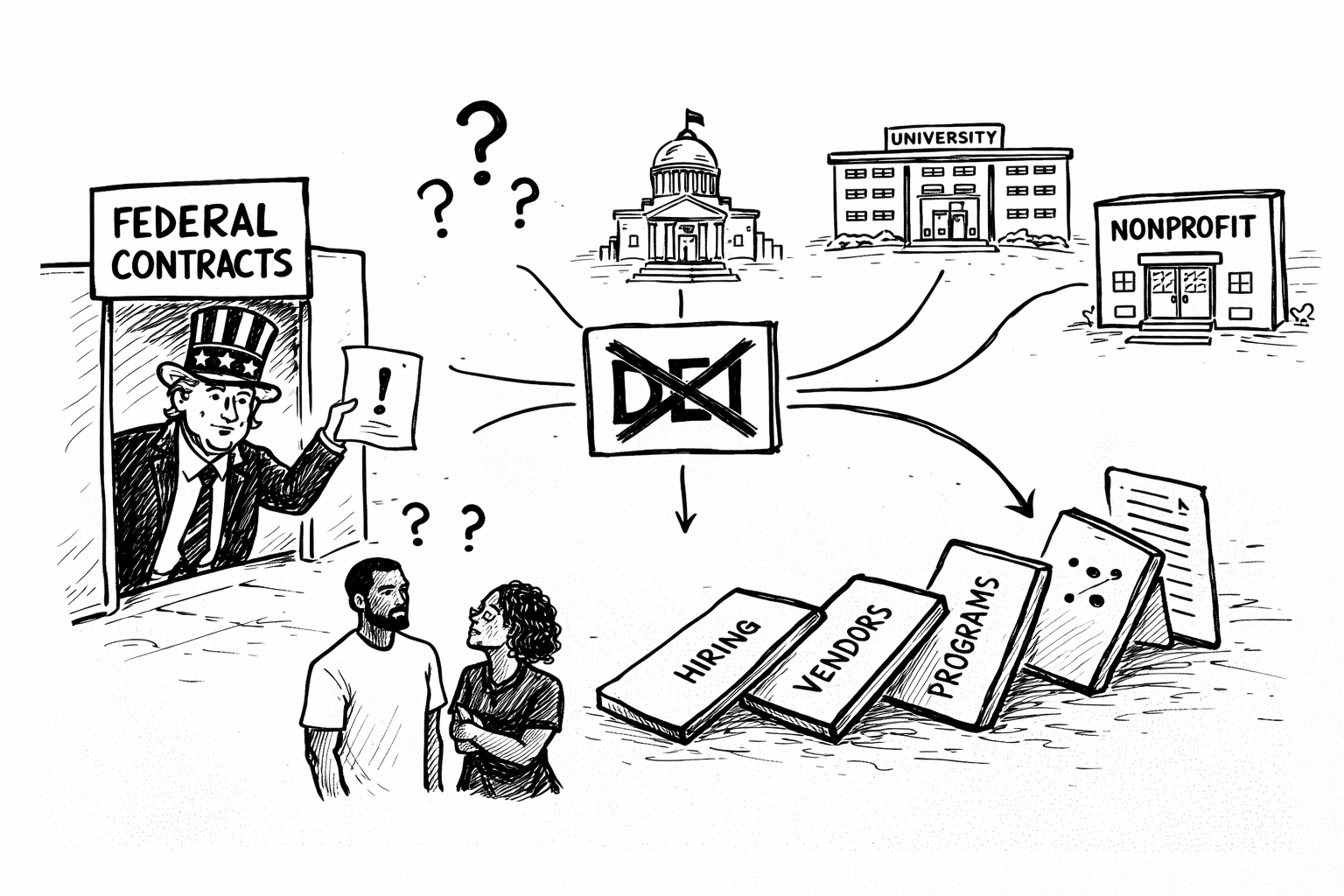

A new federal directive is changing how diversity, equity, and inclusion are treated across government contracting. The policy reframes DEI initiatives as potential forms of discrimination, requiring organizations that receive federal contracts to reassess how those programs are structured — or whether they can continue them at all.
The implications are immediate. Institutions that rely on federal funding must now evaluate hiring practices, vendor relationships, and internal programming through a different lens. What was previously encouraged is now positioned as a potential liability. That shift alters behavior quickly, even without explicit enforcement.
This is not limited to government agencies. Universities, nonprofits, and cultural institutions that depend on federal contracts are all affected. The result is a quiet but significant recalibration across sectors that have historically integrated DEI into their operational models. The State of the Dream 2026 report estimates cumulative DEI rollbacks have already created an estimated $10 to $15 billion annual gap in federal contracting opportunities for Black-owned firms — a figure that reflects not just the loss of specific programs but the compounding effect of closing access pathways that took decades to build. As SSC has since reported in The White House Is Redefining DEI as Discrimination. Federal Contractors Have 30 Days to Comply., the Congressional Black Caucus has characterized this as part of a coordinated system — one in which the contracting pathway that once served as a primary route for Black-owned businesses to access federal dollars is now being used as an enforcement mechanism against the practices that helped create that access.
The policy does not eliminate diversity initiatives outright. It changes the risk associated with them. And in environments where funding is competitive and compliance matters, risk becomes a deciding factor.
Why This Matters
This is a structural shift, not a symbolic one. When DEI becomes a liability in federal contracting, the ripple effects extend into hiring pipelines, institutional priorities, and long-term access to opportunity. The change is administrative. The impact is systemic.