
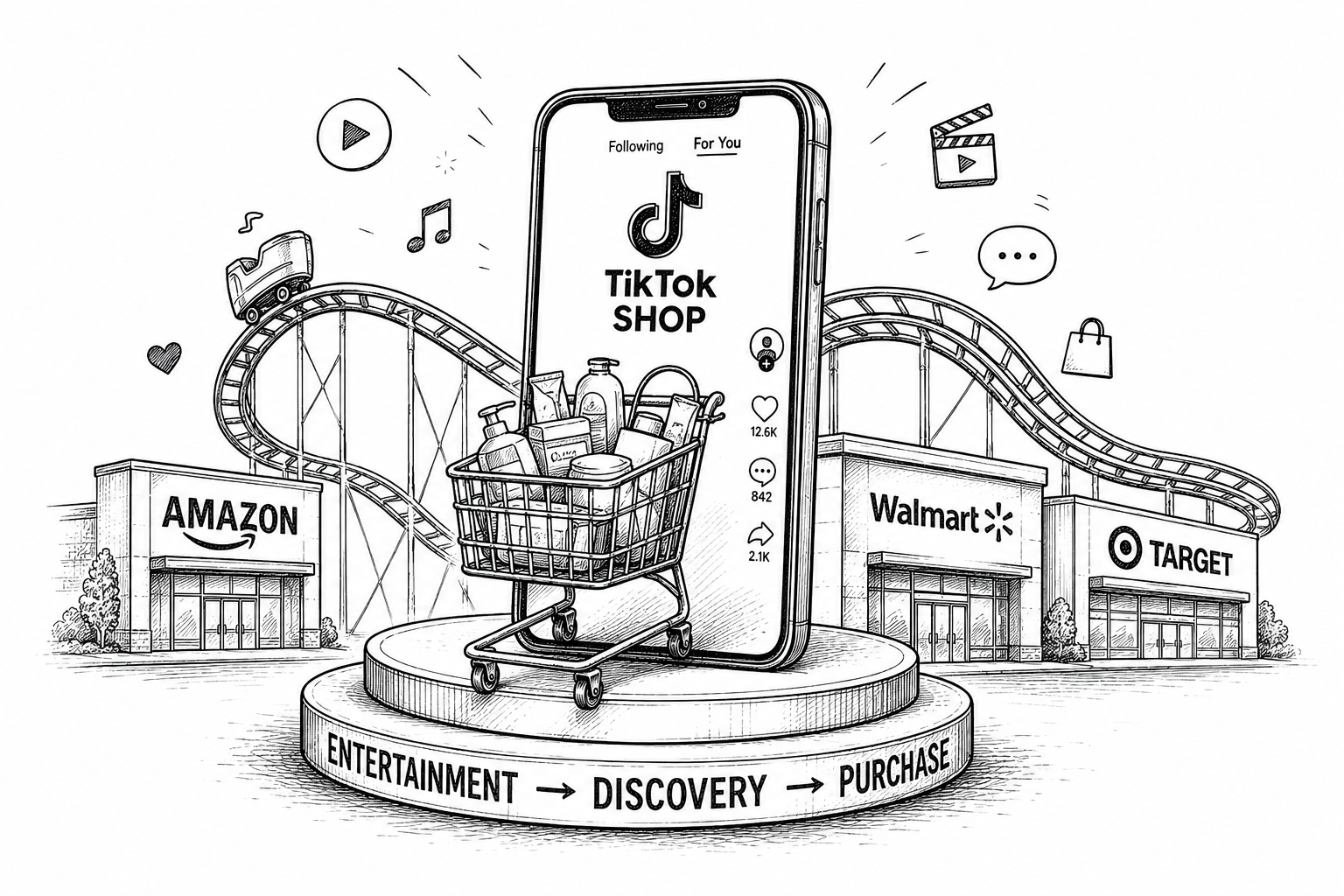
TikTok Shop is now appearing in formal agency request-for-proposal documents alongside Amazon and Walmart as a dedicated commerce channel with committed budgets — not as an experimental add-on. Digiday reported that agencies are treating the platform as a retail strategy rather than a marketing tactic, a shift that names something the industry has been circling for two years without saying directly: the boundary between entertainment and shopping has collapsed.
The numbers confirm brands are following consumer behavior rather than trying to create it. Digiday reports that sales from companies generating more than $30 million in annual revenue on TikTok Shop grew 97% year over year, while transaction volume climbed nearly 80%. Ulta Beauty, Sally Beauty, and PepsiCo have all launched or expanded storefronts. What was built as a short-video platform is being planned like a digital shopping mall.
The more consequential finding in Digiday‘s reporting is not the direct sales figure. It is what agencies say happens everywhere else. TikTok Shop often functions as a loss-leading channel in isolation — but creator content on the platform consistently increases purchases across Amazon, Walmart, Target, Whole Foods, and physical retail locations. The platform may receive only partial credit for a sale. It shapes the decision long before the purchase occurs.
That sequence is the structural shift. Traditional e-commerce assumes consumers decide they need something and then search for it. TikTok reverses the order. Consumers discover something they did not intend to buy through entertainment, recommendation, or community participation — and only afterward become shoppers. The algorithm is no longer organizing information. It is organizing demand.
The economics reinforce the model. Unlike Amazon‘s pay-per-click advertising system, TikTok Shop generally takes a percentage only after a completed sale. Brands receive potentially millions of impressions through creator content before paying any commission. Every video becomes a potential point of sale. Entertainment, advertising, product demonstration, and storefront operate as the same object simultaneously.
The organizational question has not yet been resolved. Marketplace agencies understand retail but lack creator expertise. Social agencies understand creators but not marketplace operations. Digiday‘s reporting found the brands succeeding most are building the capability internally — producing hundreds or thousands of creator videos and iterating rapidly on what converts. Winning on TikTok Shop requires organizational muscle that Amazon search advertising never demanded.
The story is not that TikTok is trying to compete with Amazon. It is that the categories separating media, entertainment, advertising, and retail no longer describe the same distinct activities. For decades, consumers watched television before they shopped. Those activities now happen at the same moment, on the same screen, inside the same scroll. The platform that wins the next decade of commerce may not be the one with the best search engine. It will be the one that makes buying feel like watching.
— SSC News Desk | Social Storytellers Collective
Get SSC analysis delivered to your inbox every day. Subscribe free on Beehiiv: socialstorytellerscollective.beehiiv.com