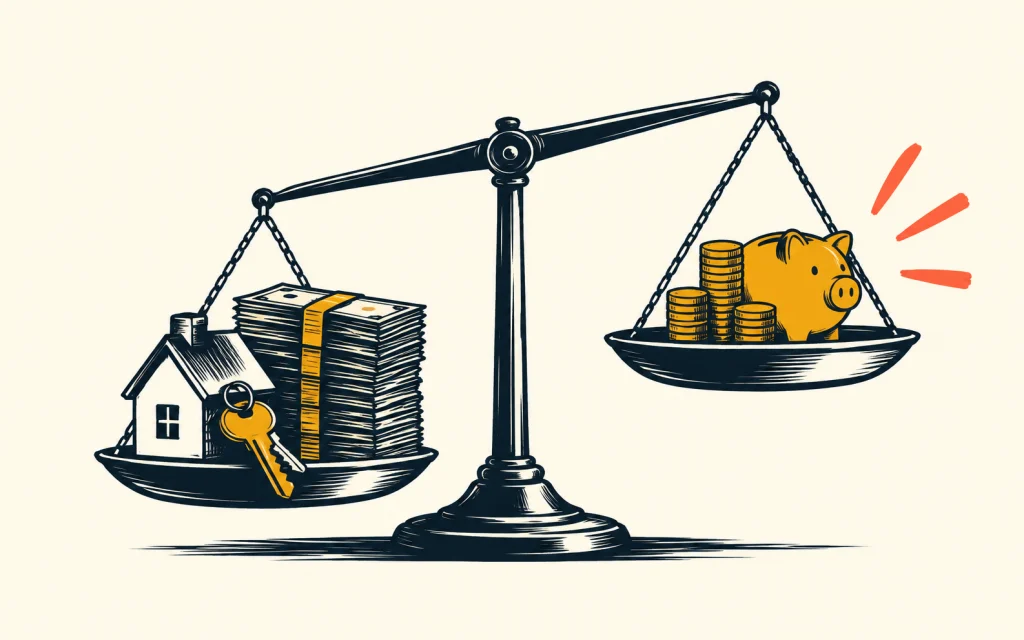
For generations, the advice has been the same: renting is throwing money away, and buying is how you build wealth. At today’s mortgage rates, the numbers no longer back that up, at least not for anyone planning to move within a few years.
The typical U.S. rent was $1,948 a month in August, according to new Zillow data first highlighted by The Playbook. The typical monthly payment for a new buyer, assuming a 30-year fixed loan at 6.67% with 10% down plus taxes and insurance, was $3,014. That leaves renters with an extra $1,066 a month, or $12,792 a year.
Zillow says a renter who invests that difference in 10-year Treasurys at 4.68% would earn another $322 in the first year. Keep saving and investing at the same pace for five years and the total, roughly $64,000 in savings plus about $8,000 in returns, tops $72,000.
“The idea that renting is a consolation prize is outdated,” said Mischa Fisher, Zillow’s chief economist. “When mortgage costs are running hundreds of dollars more per month than rent, renters who are intentional about saving and investing the difference are often making a sound financial decision.”
The math has gotten worse since August
Zillow’s figures may already understate the gap. Its analysis used August conditions, but borrowing costs have climbed since then. As SSC reported earlier this month, the average 30-year mortgage rate reached 7.28%, its highest level since November 2023, while the 10-year Treasury yield rose above 5%. A higher mortgage rate makes buying more expensive, and a higher Treasury yield gives renters a better return on what they save. Both push in the same direction.
The monthly payment is also not the only cost moving the wrong way. Homeowners insurance now averages a record $209 a month for mortgage holders, up nearly 80% since early 2020, as we noted in our look at the housing market’s hidden affordability barrier. And the income needed to buy has pulled far away from the income needed to rent. Zillow estimates a household needs about $77,900 a year to afford the typical rental, but more than $120,500 to afford the typical mortgage payment with 10% down.
That gap helps explain a theme that has run through much of our recent economic coverage: the economy isn’t breaking, but it is getting harder to enter. Homeownership is one of the clearest examples. Owners who locked in low rates years ago are staying put, and would-be buyers are being priced out of the first step.
Renting wins everywhere, but not by the same amount
Renting is now cheaper than buying in all 50 of the largest U.S. metro areas, Zillow found, a reversal from the 2010s, when mortgage rates near 4% made buying the cheaper option across much of the country. The gap is widest in California. Renters in San Jose pay $7,883 a month less than buyers, followed by San Francisco at $5,413, Los Angeles at $4,441 and San Diego at $4,235.
Buying still wins if you stay long enough
None of this means renting is always the better deal. Buyers pay more up front, but they build equity as they pay down the loan and as their home gains value. A separate Zillow analysis found that the typical buyer who puts 5% down comes out ahead of renting after about 5.9 years.
That timeline varies widely by market. In Columbus, Ohio, buyers break even in about three and a half years, with Memphis and Buffalo not far behind. In San Diego, Seattle, Austin, Los Angeles and Portland, it can take 17 to 25 years. In San Francisco, San Jose and New Orleans, Zillow found that buyers who stay for 30 years still end up with less wealth than renters who invest the difference.
Zillow’s analysis also leaves out homeowner tax benefits, such as the mortgage interest deduction, which would make buying look somewhat better. And the renter’s advantage depends on actually saving and investing the money. A lower rent payment only builds wealth if the difference doesn’t get spent.
Why it matters
The old rule was built for an era of cheap mortgages. Today, the right answer depends on where you live, how long you plan to stay and what you would do with the money you don’t spend on a mortgage. With foreclosures rising and borrowing costs still climbing even as inflation cools, stretching to buy is a bigger risk than it was a few years ago. For many households, renting is no longer the consolation prize. It may be the strategy.
Sources: The Playbook, “7% rates broke the ‘It’s better to buy than rent’ rule,” by Judy Dutton, Sept. 30, 2026; Zillow, Sept. 16, 2026; Zillow Research, “Buy vs. Rent 2026.”