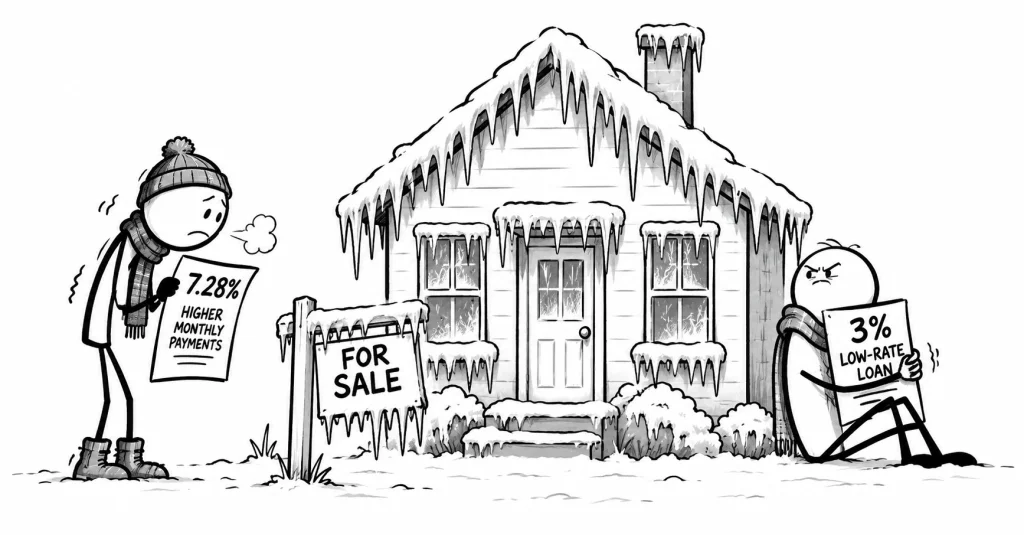
The average 30-year mortgage is at its highest level since November 2023. Buyers are losing purchasing power while owners with older low-rate loans have even less reason to sell.
Fox Business reporters Eric Revell and Matthew Kazin reported Thursday that the average 30-year fixed mortgage rate climbed to 7.28%, up from 7.03% a week earlier and 6.34% a year ago, according to Freddie Mac. The new rate is the highest since November 2023, when the average reached 7.29%. Mortgage rates closely follow the 10-year Treasury yield, which was hovering around 5.23% Thursday as bond yields continued climbing. Realtor.com senior economist Hannah Jones told Fox that the increase over the past year has added more than $200 a month to the principal-and-interest payment on a median-priced home, even as median prices have fallen from a year earlier. Fox Business details the latest Freddie Mac data here.
Higher Rates Are Taking Buying Power Away Faster Than Prices Can Give It Back
The housing market has started producing one of the stranger combinations of this cycle: more listings are getting price cuts, but buyers still are not moving. Realtor.com data cited by Fox Business show 20.8% of active listings had a price reduction in September, the highest share for that month on record, while pending sales fell 4.1%. That would normally suggest buyers are gaining leverage. The financing math is absorbing much of it. A seller can reduce a home by several thousand dollars, but a mortgage rate moving closer to 7.5% can erase that savings through higher monthly payments over the life of the loan. Fox Business reported on the record September price cuts and weaker pending sales here.
The effect is especially sharp for first-time buyers because they do not have existing home equity to bring into the transaction. Jones estimates that borrowers can see nearly a full percentage point of variation in mortgage offers depending on credit score, down payment and lender, a difference worth roughly $28,400 in buying power. In a market where monthly affordability is already stretched, financing has become part of the price of the house rather than a secondary detail. Buyers may negotiate the sticker price down and still end up with a payment they cannot carry.
Existing Owners Have Their Own Reason Not to Move
Higher rates also constrain supply because millions of existing homeowners financed their homes when mortgages were much cheaper. Selling can mean giving up a 3%, 4% or 5% mortgage and replacing it with one above 7%. A homeowner who wants another bedroom, a different neighborhood or a shorter commute has to calculate whether the move is worth resetting the financing on the entire balance.
That lock-in effect changes how a housing slowdown works. In a conventional weak market, buyers pull back, sellers reduce prices and transactions eventually resume. Today, some sellers can simply stay where they are because their existing financing has value. Supply remains restricted precisely because the mortgage attached to the current house is often one of the household’s most valuable financial assets.
Builders have more room to respond. A separate Zillow analysis found newly built homes averaging $205 per square foot in July compared with $212 for existing homes, partly because builders can offer price concessions, mortgage-rate buydowns and other incentives that individual homeowners cannot easily match. Fox Business reported on the widening new-home advantage here. The result is a housing market where new construction can become relatively more competitive even while existing homeowners remain reluctant to list.
Housing Mobility Is Becoming a Financing Privilege
A 7.28% mortgage rate does not affect everyone equally. Someone who bought years ago and has no plans to move can keep paying the loan they already have. Someone who needs to relocate for a job, separate a household, move closer to family or buy for the first time faces today’s borrowing costs immediately. Two households can therefore live in similarly priced homes while operating under entirely different monthly economics because one secured access to cheap debt before rates changed.
That divides the housing market by timing. Owners with older mortgages hold both a home and a financing advantage that becomes more valuable as rates rise. Prospective buyers absorb current rates without that protection. Sellers who do move increasingly have to possess enough equity or income to tolerate the higher replacement cost.
The next phase of the housing slowdown may therefore show up less through a dramatic collapse in home prices than through reduced movement. Fewer first-time buyers can enter. Existing owners delay selling. Employers recruiting across regions face workers who cannot easily afford to move. Families remain in homes that no longer fit because changing houses also means changing interest rates.
If mortgage rates stay above 7%, the housing market can remain frozen even while sellers cut prices. The constraint has moved from the listed price of the home to the financing required to reach it.