
For twenty years, the implicit contract of social media was clear: the platform was free, and in exchange, you were the product. Your attention was the inventory. Your behavioral data was the commodity sold to advertisers at scale. Meta generated $196 billion in advertising revenue in 2025 alone — built entirely on that arrangement, at a 22 percent year-over-year growth rate. The contract was never disclosed in those terms, but it was always the terms.
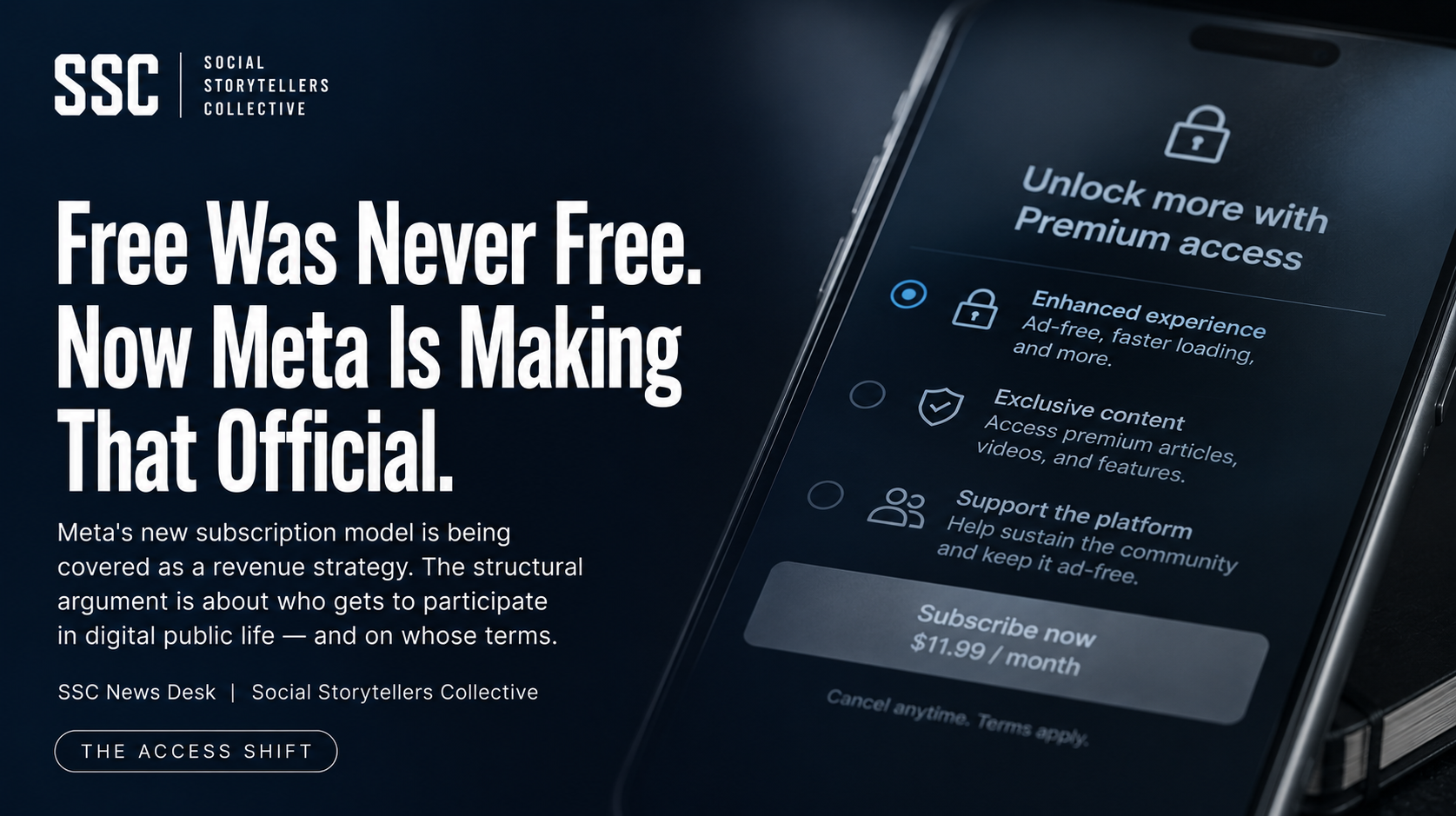
This week, Meta made the arrangement more explicit. The company launched Instagram Plus at $3.99 per month, Facebook Plus at $3.99 per month, and WhatsApp Plus at $2.99 per month globally, with additional tiers being tested for creators, businesses, and Meta AI users under a unified brand called Meta One. The free versions of the platforms remain available. But the architecture has shifted — features that drive reach, visibility, and engagement are now being placed behind a payment layer, and the direction of travel is clear.
The business rationale is not complicated. Meta raised its full-year 2026 capital expenditure guidance to between $125 billion and $145 billion — nearly double what it spent in 2025 and more than it spent in 2024 and 2025 combined — driven by AI infrastructure costs and data center expansion. When asked about the return on that investment, CEO Mark Zuckerberg described the question as “very technical.” Investors pushed back. The stock fell. Subscriptions are part of the answer to a spending commitment that advertising revenue alone may not be able to sustain. The AI subscription tiers being tested — Meta One Essential, Meta One Plus, and Meta One Premium — are the more consequential part of the announcement. If Meta AI becomes the default intelligence layer across WhatsApp, Instagram, and Facebook, then subscriptions are not really about social features. They are about funding the AI infrastructure sitting underneath everything else.
The LinkedIn reaction to this news has been framed almost entirely around the business model math — the argument that even 1 percent of Meta‘s 3.5 billion daily active users paying $10 per month would generate over $4 billion annually in subscription revenue. That math is correct. What it does not calculate is the cost on the other side of the ledger.
The communities that built Meta‘s platforms — that made Facebook the connective tissue of Black family networks, that turned Instagram into a primary distribution channel for Black creators, that use WhatsApp as a cross-border communication lifeline in Caribbean, African, and Latin American diaspora communities — are disproportionately the same communities navigating the grocery inflation, medical debt, and labor market exits that SSC has documented throughout this edition. The digital divide is not a connectivity problem alone — it is an affordability problem, and it falls hardest on the households least equipped to add another monthly subscription to a budget already compressed from every direction. The free tier remains. But free tiers in tiered systems are architecturally designed to feel insufficient. That is the point of the upgrade prompt.
This is the pattern of digital enclosure. What begins as open infrastructure — a platform anyone can join, a tool anyone can use — gradually stratifies by willingness to pay. The users who cannot pay remain on the platform but with reduced reach, reduced visibility, and reduced access to the features that determine whether a small business finds customers, whether a creator builds an audience, whether a community organizer’s post circulates beyond their existing followers. The gap between the free experience and the paid experience is not static. It expands over time, by design, as the features that matter most migrate upward into the subscription tier. Meta One Advanced, currently being tested at $49.99 per month in select markets, already includes higher placement in Facebook and Instagram search and automatic follow invitations — features that directly determine who gets seen and who doesn’t.
The original promise of social media was democratized access to distribution. Anyone with a phone could reach an audience. The subscription model does not eliminate that promise entirely — the free tier still exists. But it does introduce a structural advantage for users who can afford to pay, compounding over time, in a medium where algorithmic visibility is already the primary determinant of reach. The communities that were already navigating algorithmic disadvantage — whose content was already deprioritized, whose accounts were already flagged at higher rates — will now also be navigating a cost barrier to the features that could offset those disadvantages.
Meta is building an AI-funded future on infrastructure its users built for free. The subscription model is how it is asking them to fund the next phase. The question worth tracking is not whether the business model works. It almost certainly will. The question is who gets left behind in the tiered version of a platform that was supposed to belong to everyone.
Social Storytellers Collective covers race, identity, access, and structural inequality. Read more at socialstorytellerscollective.substack.com