
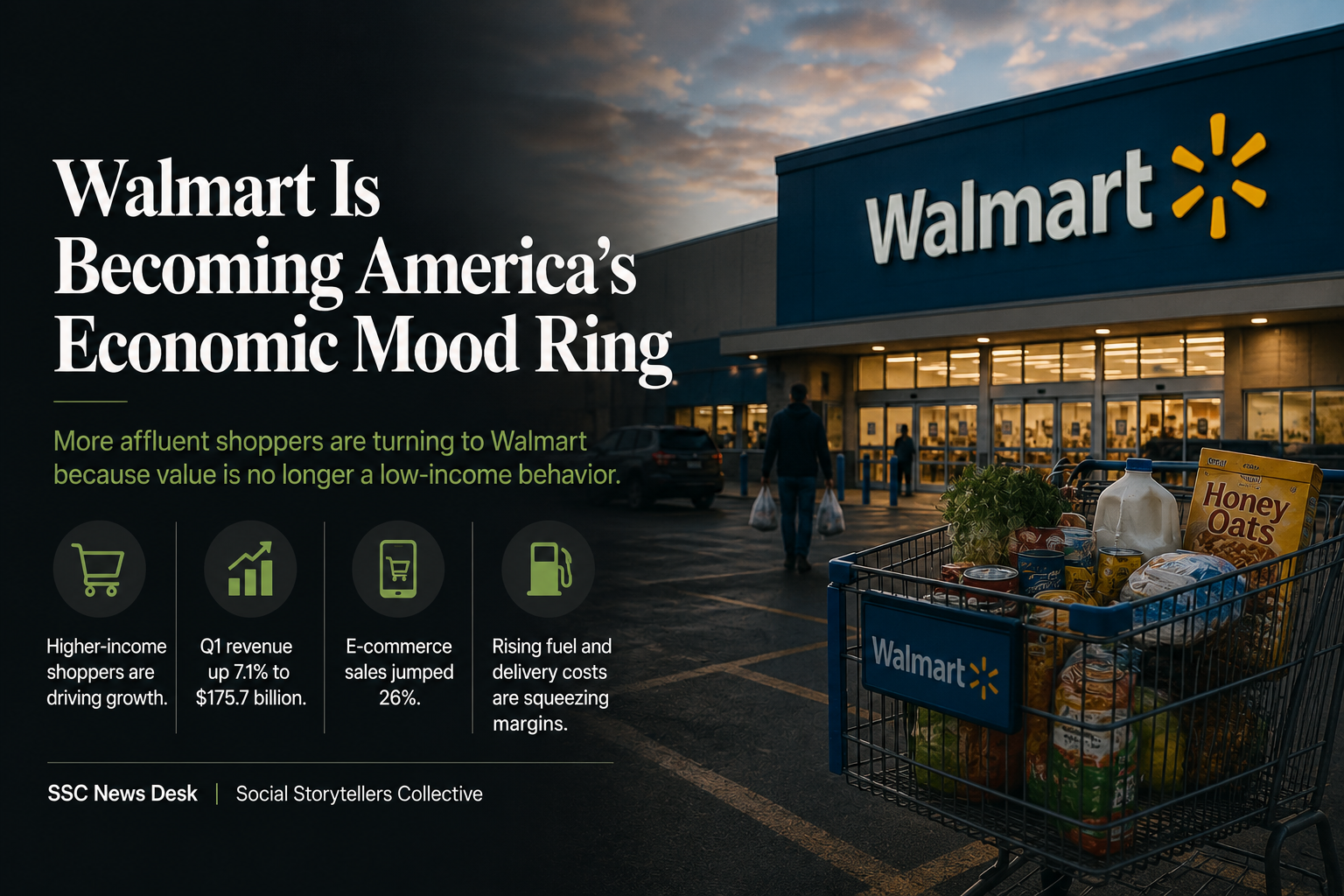
Walmart reported quarterly revenue of $175.7 billion this week, up 7.1% year over year, while executives noted continued growth among higher-income shoppers. E-commerce sales jumped 26%. At the same time, the company warned that rising fuel and delivery costs were continuing to pressure margins. The retailer’s performance reinforced a pattern that has become increasingly visible across the economy: households are reorganizing their spending around defense rather than aspiration.
For years, Walmart occupied a specific psychological position inside American retail culture. It represented affordability, scale, and necessity purchasing. Higher-income consumers might shop there occasionally, but it was not central to their identity as shoppers. That distinction has weakened significantly since the inflation surge that began in 2021. As grocery prices, insurance premiums, housing costs, and transportation expenses climbed, value-seeking behavior stopped being coded primarily as economic hardship. It became mainstream financial behavior.
The company’s growth among wealthier consumers matters because it signals that cost pressure is now reaching households that previously possessed meaningful financial cushion. Walmart executives have repeatedly noted over the last year that shoppers earning more than $100,000 annually are contributing more to sales growth. That shift changes the cultural meaning of discount retail entirely. The issue is no longer whether low-income Americans are struggling to afford necessities. The issue is how broadly financial caution is spreading upward across the income ladder.
At the same time, Walmart’s dominance increasingly reflects structural advantages smaller retailers cannot replicate. The company’s ability to combine groceries, pharmacy services, e-commerce logistics, and fuel access into one ecosystem allows consumers to consolidate economic activity under a single platform. In an inflationary environment, convenience becomes financial infrastructure. A household trying to minimize gas usage and maximize purchasing efficiency is more likely to centralize spending through large retailers capable of absorbing logistical complexity at scale.
The tension underneath this growth story is that consumers are technically still spending while simultaneously feeling worse about their financial condition. Retail sales can remain strong while emotional confidence deteriorates. Americans are not necessarily buying more because they feel prosperous. In many cases they are spending more because maintaining ordinary life now costs more. Walmart benefits because it sits directly inside that recalibration. The retailer is becoming less a symbol of consumer abundance and more a symbol of economic adaptation.
This connects directly to what SSC documented in What Doesn’t Make It Into the Cart. The grocery basket is no longer a preference. It is a calculation. When Walmart’s fastest-growing customer segment earns over $100,000 a year, the calculation has spread well past the households we typically associate with financial strain.
But there is a second Walmart story running underneath the consumer one — and it cuts in the opposite direction. While more Americans are migrating toward Walmart as a survival strategy, Walmart is simultaneously restructuring 1,000 corporate roles, requiring affected employees to relocate to Bentonville, Arkansas or Sunnyvale, California or exit quietly. SSC covered it in May: Walmart’s Streamlining Push Is Really About Where Corporate Work Happens Now. The company generated more than $680 billion in revenue in fiscal year 2026. It is not restructuring because it is struggling. It is restructuring because it has decided that distributed corporate roles are less valuable than a tighter operational core built around AI-assisted workflows. The same institution benefiting from household financial stress is engineering that stress for its own workforce at the same time.
This is also part of why discount culture has expanded so aggressively online. Temu, Shein, dollar stores, warehouse clubs, and secondhand marketplaces all reflect the same broader behavioral shift. The consumer economy is quietly reorganizing itself around optimization. People are comparing prices more aggressively, delaying discretionary purchases, stacking subscriptions more carefully, and treating affordability itself as a skill. Retail is no longer just competing on desire. It is competing on relief.
The larger story is that Walmart’s success increasingly functions as a measure of household stress. When more affluent consumers begin migrating toward value ecosystems at scale, it suggests the definition of financial comfort has changed. The economy is still producing consumption. But it is producing a version of consumption shaped more by caution than confidence. And the company most positioned to capture that caution is the same one quietly telling its own corporate employees that geography is now a job requirement.