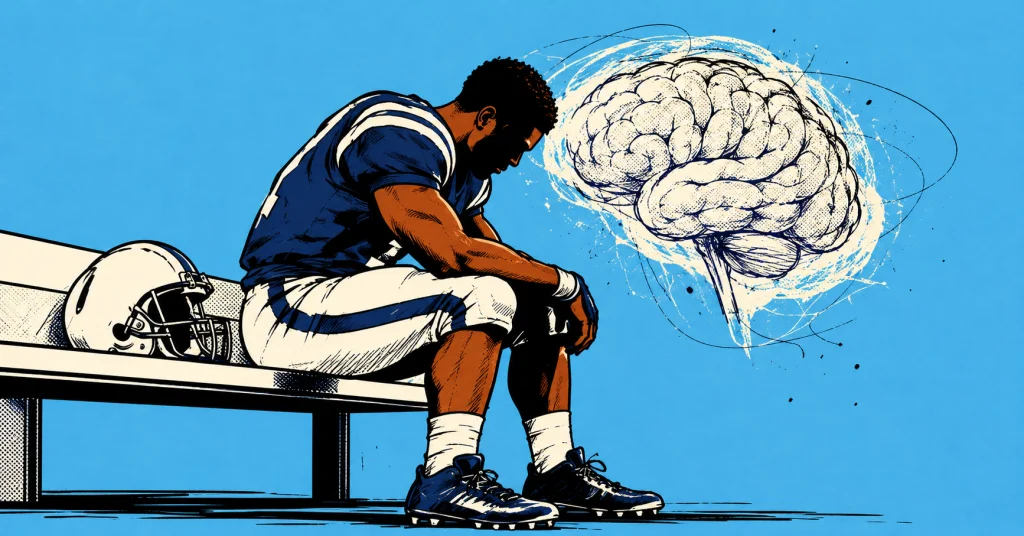
Marshall Faulk is the latest former NFL star to disclose a Parkinson’s diagnosis. Research involving thousands of players points to a link between football, repeated head impacts and neurological disease, even as scientists work out how that risk builds.
Marshall Faulk first noticed it on the golf course. His hand would stiffen, and he chalked it up to nerves or the physical demands of the game, until the stiffness kept showing up when he wasn’t playing. He mentioned it to his doctor, who sent him for further evaluation, and about 18 months ago the Hall of Fame running back learned he had Parkinson’s disease, a progressive neurological disorder that affects movement. Faulk, 53 and now the head football coach at Southern University in Baton Rouge, disclosed the diagnosis this week on The Caring Neurologist podcast with Dr. Sandeep Thakkar. He said medication has helped him manage hand rigidity and occasional tremors, and that he went public partly so others would recognize the warning signs sooner. The Associated Press reported that he hasn’t noticed significant decline since starting treatment.
His announcement lands in the middle of a shift in how researchers study football and the brain. For more than a decade, that conversation has centered on chronic traumatic encephalopathy, or CTE. A growing body of evidence suggests the sport’s neurological footprint is wider than one diagnosis, and Parkinson’s is moving toward the center of it.
What the Research Found
In July, scientists from Boston University, Mass General Brigham and the Concussion & CTE Foundation published a study of 19,824 players who appeared in at least one NFL game and debuted between 1960 and 2019. Using career records and the National Death Index, the study in eClinicalMedicine identified 1,994 deceased players, 178 of whom died from neurodegenerative diseases: 39 from Parkinson’s, 106 from dementia and 33 from ALS. Parkinson’s deaths occurred at about 3.88 times the rate expected in the general population, dementia deaths at 3.8 times, and neurodegenerative deaths overall at close to four times, even though the players had lower overall mortality than the public. Players whose careers lasted five or more seasons had nearly twice the risk of dying from a neurodegenerative disease as those who played one to four.
Those figures measure deaths, not how many former players develop Parkinson’s, so a rate nearly four times higher says nothing about the share of players who will be diagnosed. The study also shows a population-level association rather than proof that football caused any one player’s illness, and age, health history and other exposures all factor in.
An earlier 2023 study in JAMA Network Open found a similar pattern. Among 1,875 men who had played organized sports, the 729 who played football had 61% higher odds of reporting a diagnosis of Parkinson’s or parkinsonism than those who played other sports, and longer careers and higher levels of competition were tied to greater odds. The sample has real limits: participants came from an online Parkinson’s research platform, most already reported a Parkinson’s-related diagnosis, diagnoses were self-reported, and Parkinson’s was grouped with parkinsonism, a broader set of movement symptoms with several possible causes. Most of the football players in that study stopped at the youth or high school level, which raises questions about risk well below the pros that only more representative long-term research can answer.
Repeated Hits, Not Just Concussions
Football exposes players to a pattern of contact few other activities match: years of practice, drills and games, with hits that often never produce a diagnosed concussion. Researchers increasingly focus on the cumulative effect of those repetitive head impacts rather than on documented concussions alone. Parkinson’s involves the progressive loss of dopamine-producing neurons that help control movement, producing tremors, rigidity, slowed movement and balance problems. Genetics, age and environment all shape risk, and prior studies have linked traumatic brain injury to a higher likelihood of Parkinson’s later in life.
Both studies found what researchers call an exposure-response relationship, in which more seasons came with more risk. That pattern strengthens the case for looking hard at football itself, though it doesn’t mean each added season causes a predictable amount of damage. Exposure also starts long before the NFL, since most professional players began in youth leagues and carried hits through high school and college, with totals that vary by position, practice habits and playing style.
The diagnoses also need to be kept apart. CTE is a distinct disease tied to repetitive head impacts and can currently be confirmed only by examining brain tissue after death. People with CTE can develop movement problems, but that doesn’t make it Parkinson’s, and a former player with Parkinson’s shouldn’t be assumed to have CTE. The conditions can coexist and share symptoms without being interchangeable.
A Growing List of Names
Faulk joins other former stars who have gone public. Hall of Fame quarterback Brett Favre disclosed a Parkinson’s diagnosis in 2024, former Packers running back Ahman Green disclosed an early-onset diagnosis in 2026, and former quarterback Bernie Kosar has spoken about living with the disease. Recognizable names raise awareness, but they aren’t a scientific sample, and they reveal little about how common Parkinson’s is among all retired players.
Faulk hasn’t tied his illness to any injury from his 12 seasons with the Indianapolis Colts and St. Louis Rams, a run that produced seven Pro Bowls, an MVP award and a Super Bowl XXXIV title. His career involved years of heavy contact, but it would take far more information to explain his individual case. His disclosure matters because it puts a familiar face on a pattern that only large datasets can measure.
What the League and the Sport Still Owe
The NFL has tightened concussion protocols, limited contact in practice and funded research into player health. Those changes target what happens during a career, while the Parkinson’s findings point to conditions that surface decades after the last snap. The same tension runs through how the league handles injuries in the moment, as SSC examined in Jalen Hurts and the dangerous business of being tough.
Large gaps remain in the evidence. Researchers still need to learn which kinds of exposure matter most, whether some positions face greater risk, how genetics and environment interact with football, and which prevention measures work. That calls for prospective studies that follow representative groups of athletes over time instead of relying on self-reports or death records. A study showing higher mortality can’t identify which rule change would prevent those deaths, and evidence linking head impacts to disease doesn’t yet pinpoint the level of exposure at which harm begins.
Early symptoms can also be easy to dismiss in men whose bodies already carry the wear of a playing career, with stiffness written off as an old injury or simple aging. Faulk’s golf-course story is a case for getting persistent changes in movement checked early, since Parkinson’s has no cure but treatment can manage symptoms and help people keep working, as he has. It also makes the case for long-term neurological care for retired players, including evaluation, rehabilitation and support for families, years after the injuries that make the highlight reels have healed.
The research so far doesn’t prove football causes Parkinson’s in every affected player, or that Faulk’s career caused his. It gives the sport enough reason to stop treating the question as fringe. As the long-term studies mature, Parkinson’s will become part of how leagues, schools and parents weigh the cost of playing, and the next fight will be over who pays for the care that former players need after the collisions stop.