
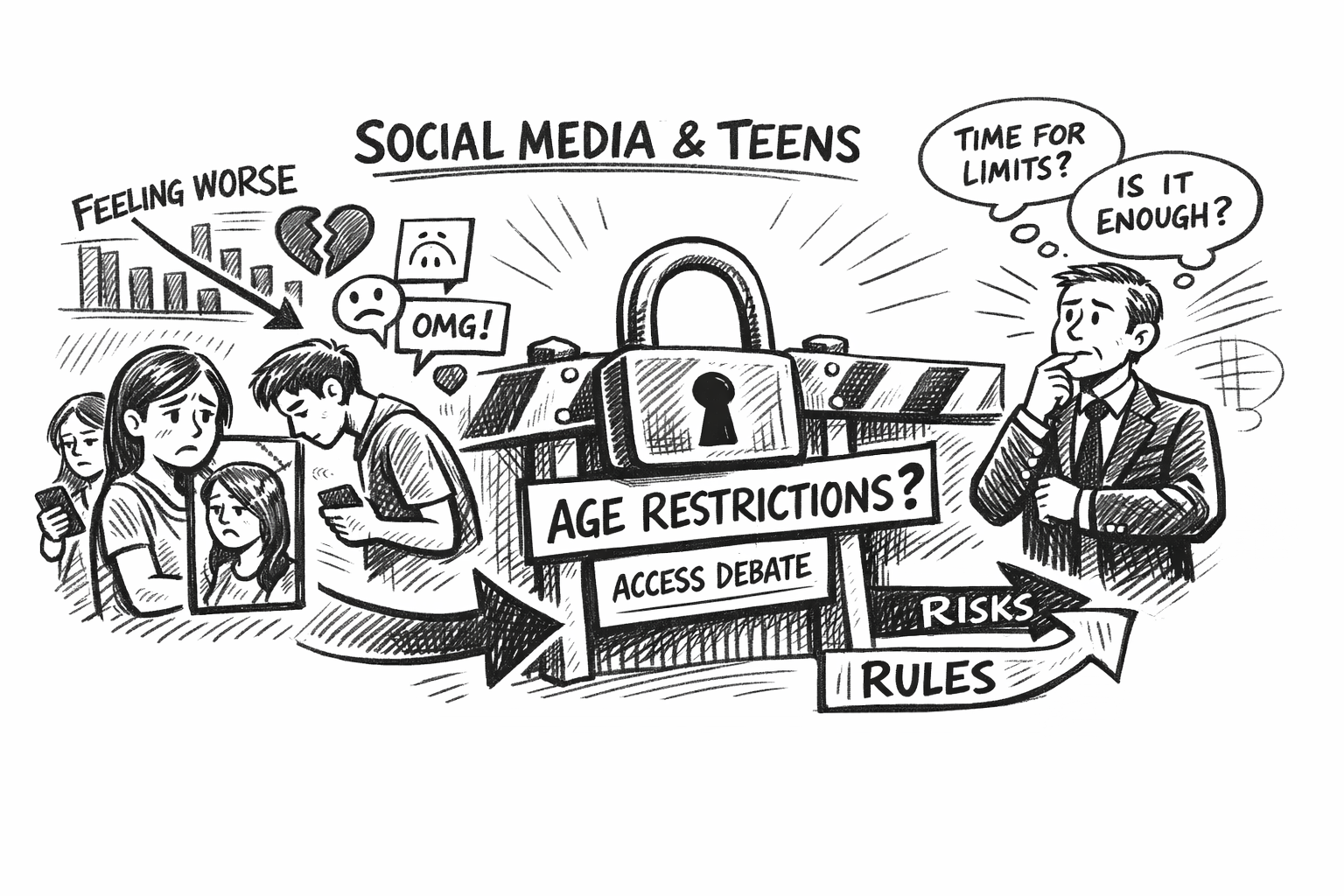
For years, the conversation around social media and young people followed a predictable arc. Concerns were raised, studies were cited, platforms responded with features dressed up as responsibility. The assumption was that the system could be adjusted rather than restructured. That assumption is now cracking.
The data is no longer easy to dismiss. Nearly half of U.S. teenagers — 48% — say social media has a mostly negative effect on people their age, up from 32% in 2022. The gender gap is sharper still: 34% of teen girls say social media makes them feel worse about their own lives, compared to 20% of boys. These aren’t cultural impressions. They’re tracked, compared across borders, and increasingly treated as a public health issue — which means the question has shifted from how to reduce harm within the existing system to whether the system itself requires hard limits.
What makes this moment different is that pressure is no longer coming exclusively from outside the industry. Tech executives have begun signaling support for age-based access restrictions — a recognition that a model built on engagement and frictionless interaction may be structurally incompatible with adolescent development. These platforms were never designed with age segmentation in mind, and retrofitting safeguards onto systems built for scale has consistently fallen short. The appetite for more binary solutions — access or no access — is growing.
What’s less visible in this conversation is that restriction addresses access, but not imprint. By the time policymakers are debating age limits, the system has already done its quietest work — shaping how users interpret themselves and the world around them. As When the Mirror Becomes the Algorithm explores, the platform is not just a space where identity is expressed. It is a system that learns from behavior and reflects it back in ways that can subtly reinforce perception, preference, and self-image. The concern, then, is not only when young people enter these environments, but what those environments are already trained to show them once they arrive.
That shift is part of a larger pattern we’ve been tracking in The Access Shift: services once assumed to be broadly available becoming more conditional, more restricted, harder to navigate without consequence. Here, the stakes are particularly high. For most adolescents, these platforms aren’t optional — they’re the architecture of social life, where identity forms, comparison happens, and validation is sought and often withheld. Restricting access isn’t simply a screen-time intervention. It’s a decision about when individuals enter an environment that actively shapes how they see themselves and each other.
The debate is still unfolding. But what began as a conversation about wellbeing is moving toward a redefinition of access — and once that line is crossed, it rarely gets uncrossed.
The Access Shift
The gradual redefinition of who systems are designed to serve.
Across sectors—from public infrastructure to healthcare to everyday spaces—access is no longer assumed. As costs rise and systems face increasing pressure, services once built for broad reach are becoming more selective, more conditional, and less universal. The Access Shift explores how these changes are unfolding in real time—and what they reveal about who is included, who is left out, and how the structure of everyday life is quietly being reshaped.