
Part of Culture in Motion — an ongoing series examining who defines culture, how it moves, and what it reveals about the moment.
It didn’t take long for a comedy skit to become something else entirely.
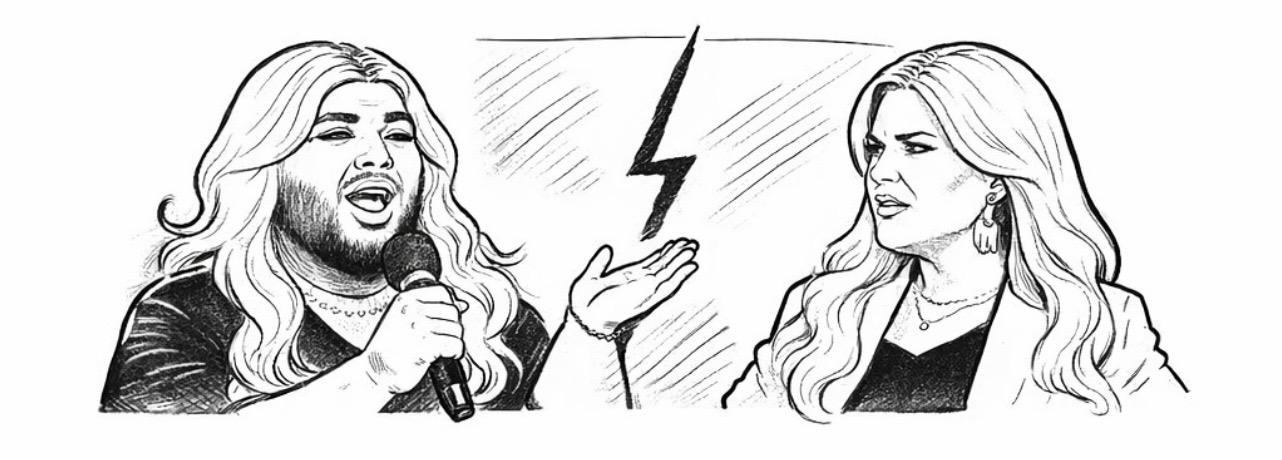
Comedian Druski posted a sketch captioned “How Conservative Women in America act,” appearing in whiteface makeup, a blonde wig, and a white jacket, cycling through scenes: a patriotic rally, a mock press conference about the Iran war, a faith testimony while clutching a Bible. Near the end, his character tells a crowd that the US needs to protect “all men in America, especially all white men in America,” calling them “the boys that we care about in this country” — while a Black security guard reacts with a concerned expression behind him. The video garnered nearly 121 million views.
The skit is clearly modeled on Erika Kirk — CEO of Turning Point USA and widow of conservative activist Charlie Kirk, who was assassinated while speaking at Utah Valley University in September 2025. And it was responding to something specific. On March 11, Kirk appeared alongside Arkansas Governor Sarah Huckabee Sanders at a press conference launching Turning Point USA chapters in Arkansas high schools and colleges. During her remarks, she told the crowd: “Don’t let anyone disenfranchise you because you’re a young man, especially a young white male man. Don’t ever let anyone talk down to you. We need strong men out there, strong men who are convicted that will be good leaders, good husbands, good fathers.”
That is Kirk’s right. Every group has the right to advocate for itself, to name its concerns, and to organize around its interests. What Druski’s skit put under the lens was not whether Kirk could say it — but what it means when she does. The resemblance in the skit was convincing enough to trip up Grok, X’s own AI chatbot, which identified Druski as Erika Kirk in a reply viewed more than 700,000 times. As of publication, neither Kirk nor Turning Point USA has commented publicly on the video.
The discourse that followed was predictably divided. Ted Cruz called it “beneath contempt.” Supporters framed it as classic satire. Others argued it crossed a line by targeting a recently bereaved public figure. But the debate obscured something worth naming directly: Kirk’s Arkansas remarks didn’t emerge in a vacuum. They align with a broader rhetorical pattern that has gained institutional momentum — figures like Stephen Miller have framed cultural change through the language of siege, and Elon Musk has amplified similar concerns about identity and demographic displacement across his platform. Within that context, describing young white men as disenfranchised reads less like an isolated claim and more like a coordinated narrative. Kirk is not inventing this framework. She is giving it a platform at a moment when it is already ascendant.
This is also unfolding against the active rollback of DEI initiatives across institutions — a pattern SSC has tracked in The Cycle of Moral Panic in Public Discourse. What is being framed as loss is often a response to redistribution: of visibility, of access, of narrative control. SSC examined this directly in “White Culture” Was Asked to Define Itself. It Couldn’t. — which traced a Senate confirmation hearing where a nominee who had written an entire book arguing anti-white racism was America’s most pervasive discrimination struggled to define the culture he claimed was being erased. The definition never held. What emerged instead was a portrait of identity that is positional, not cultural — one that draws its urgency from proximity to power rather than from shared history, ritual, or practice. Kirk’s Arkansas remarks operate inside that same framework. Disenfranchisement, in the American context, is historically tied to systemic exclusion — something Black Americans experienced structurally, not symbolically. When that same language is applied outside of that history, it doesn’t read as parallel. It reads as redefinition. And redefinition at scale has consequences.
Druski’s skit exaggerates that redefinition back at the camera. Whether audiences received it as critique or provocation depends almost entirely on what they already believed walking in. The Grok misidentification adds another layer: an AI built into the platform confirmed what viewers already suspected — that the performance was indistinguishable from the real thing. That’s not just a technology failure. It’s a reflection of how thoroughly public personas get reduced to surface elements — the wig, the suit, the cadence, the rhetoric. When a character is that legible, satire and impersonation become hard to separate. And when they blur, so does accountability.
The false Kirk quote followed the same logic. A parody account posted a fabricated response attributing a “blackface” comparison to Kirk directly, and the claim spread widely enough that multiple outlets had to debunk it. Kirk never said it. But the quote traveled because it was believable — it fit the rhetorical posture people already associated with her, which made verification feel unnecessary. The skit and the fake quote were doing different things, but they moved through the same information environment the same way — on recognition, not confirmation. It connects to what SSC examined in Why Stories Are Missing and The Trust Gap: when speed is the primary editorial filter, the truth behind the story is rarely the thing that travels.
Why this matters
This moment is not really about a skit. It’s about how the language of inequity is being stretched, contested, and reassigned in real time. The right to advocate has never been the issue. The friction comes from what happens when that advocacy adopts the language of historical exclusion without sharing its structural foundation. At that point, the debate shifts. It is no longer just about who gets to speak — it’s about what those words are allowed to mean, and what happens when they’re stretched far enough to lose the history that gave them weight.