
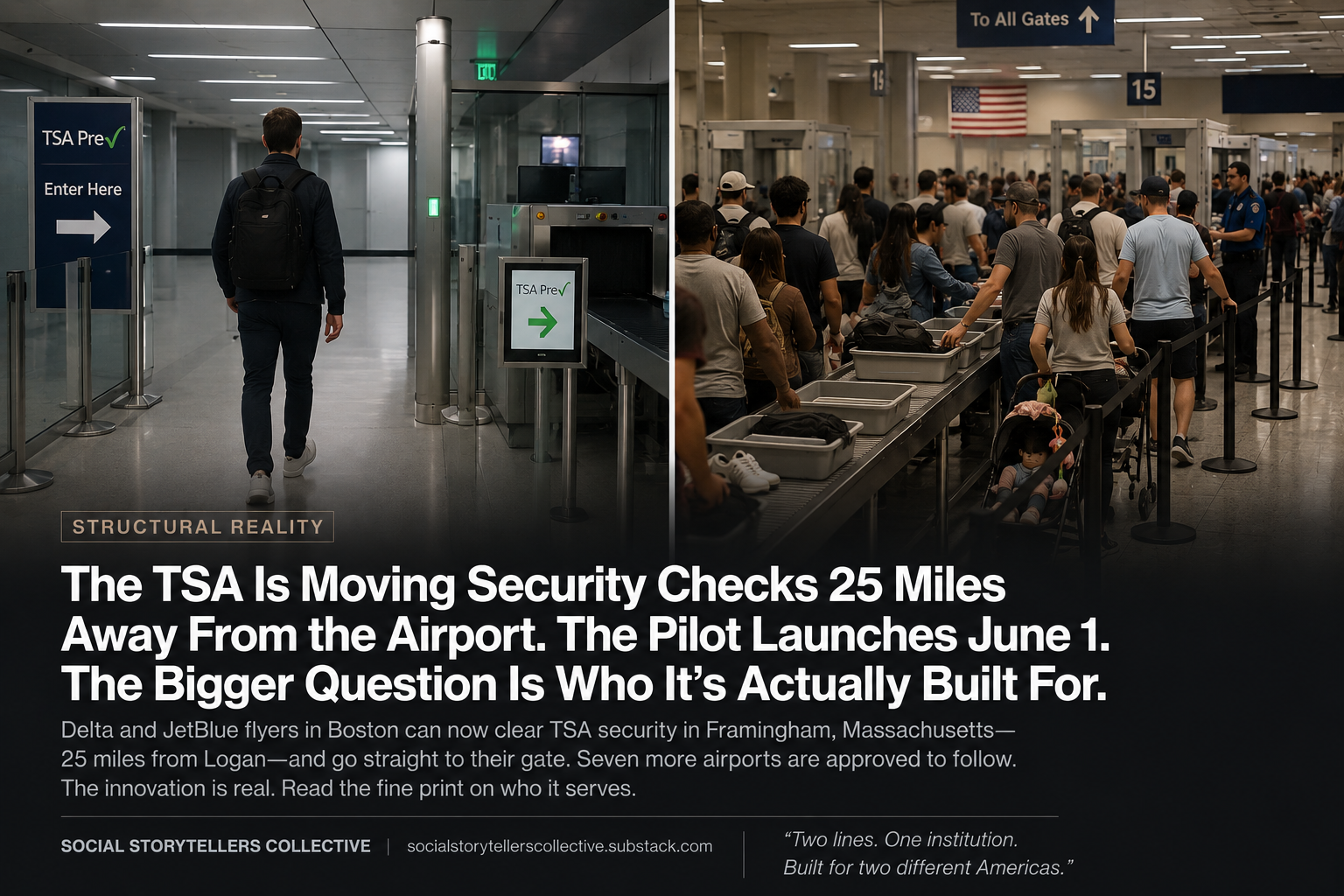
Seven more airports are approved to follow. The innovation is real. Read the fine print on who it serves.
On June 1, a facility in Framingham, Massachusetts — a suburb 25 miles west of Boston Logan International Airport — will become the first off-site TSA security screening location in the United States. The pilot, called “Straight to Gate,” allows eligible Delta and JetBlue passengers to clear security before they ever reach the airport. They drive to Framingham, go through a standard TSA checkpoint, board a shuttle to Logan, and walk directly to their gate without passing through airport security again. No lines. No terminal congestion. No shoe removal, no laptop out, no scramble at the checkpoint. Seven more airports have been approved to follow.
TSA and Massachusetts Port Authority are framing it as the future of air travel — a model that could decongest terminals, reduce checkpoint wait times for everyone, and fundamentally change the pre-flight experience. The timing is deliberate. The 2026 World Cup is coming to North America this summer, bringing record passenger volumes to host cities including Boston, Miami, Dallas, and Houston. The infrastructure pressure is real. The solution TSA is piloting is also, in its current form, a solution built specifically for a segment of travelers that already has the most options.
The Straight to Gate pilot requires TSA PreCheck enrollment. PreCheck costs $78 for a five-year membership and requires an in-person appointment at an enrollment center, an identity verification process, and a background check. Roughly 15 million Americans currently hold PreCheck status — a significant number, but still a small fraction of the 900 million annual air passengers TSA screens. The travelers most likely to use an off-site screening facility are the ones with PreCheck, with a car, with the flexibility to drive 25 miles to a suburb before a flight, and with the scheduling bandwidth to build that detour into their travel day. Those are not the travelers for whom airport security is the most painful part of flying. They are the travelers for whom it is an inconvenience. The people for whom airport security is genuinely high-stakes — travelers without PreCheck, travelers subject to additional screening, travelers navigating the airport with children or disabilities or limited English, travelers who depend on public transit to reach the terminal — are not the target constituency of this pilot.
That gap is not incidental. It is structural. TSA has been simultaneously expanding convenience infrastructure for PreCheck holders — facial recognition at 65 airports, no-shoe-removal policies, Touchless ID lanes — and conducting record numbers of secondary screenings of passengers in demographic categories that correlate with being pulled aside. As SSC has reported, ICE agents have been stationed at TSA checkpoints in ways that change the calculus of who feels safe moving through airport security at all. Two systems are being built simultaneously inside the same physical infrastructure: one that makes air travel faster and more frictionless for credentialed, enrolled, documented travelers — and one that makes it more surveilled and more fraught for everyone else.
The Straight to Gate pilot is a genuine innovation. Moving security off-site, decongesting terminals, giving travelers more control over their pre-flight experience — these are real improvements to a system that has been broadly criticized for decades. The question is not whether the innovation works. It is who it works for, and whether the gap between the frictionless experience being built at the top of the market and the experience everywhere else is narrowing or widening.
The World Cup is coming. Forty-five million Americans are already on the road this Memorial Day weekend. Logan, Miami, Dallas, and Houston are all on the list of airports prioritized for the expanded rollout. TSA is building something new in Framingham on June 1. The people most likely to use it already have the fewest problems. The people with the most problems are still in the same line they’ve always been in — and the line just got a little longer.