
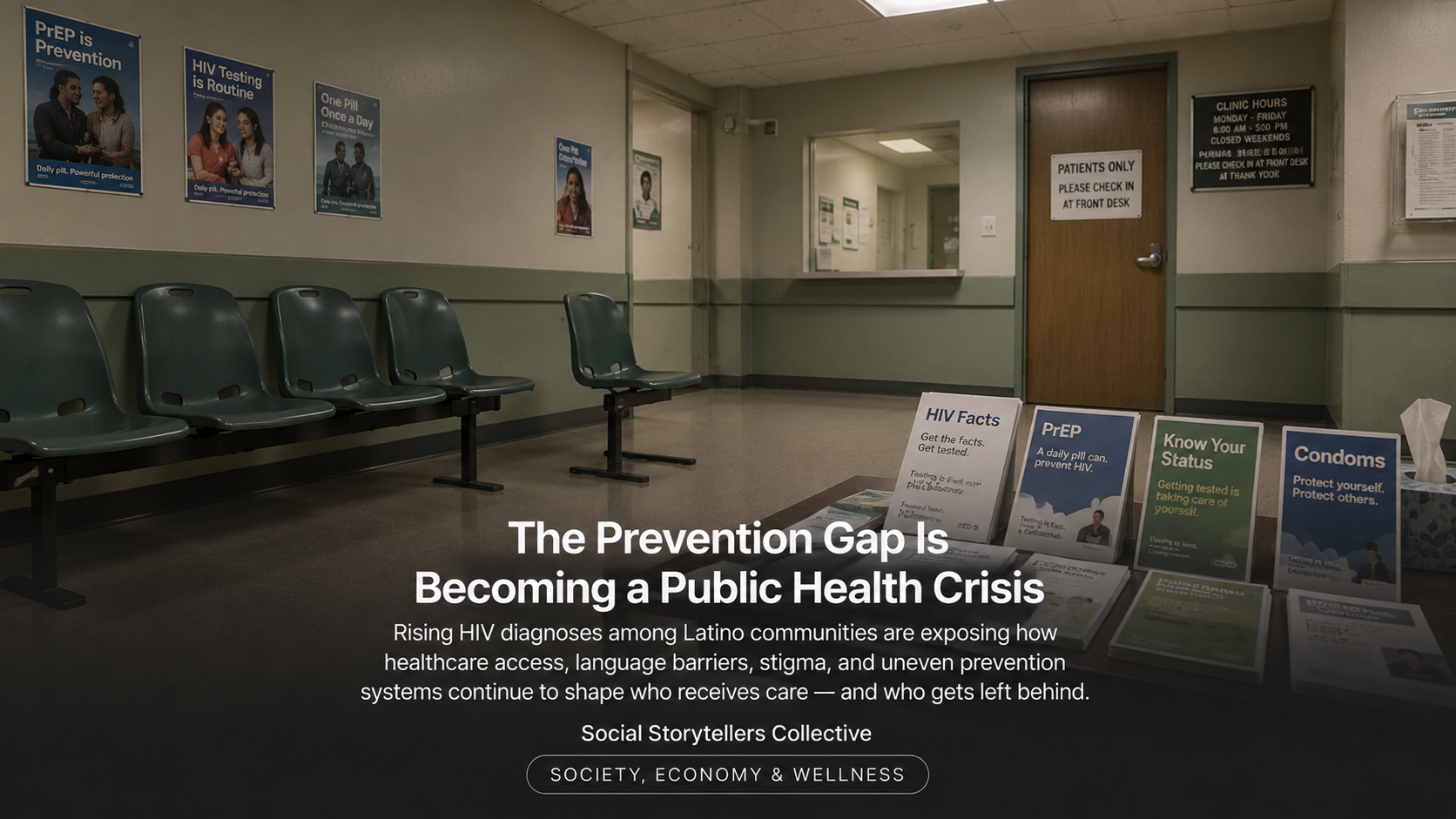
The numbers arrived without fanfare. Latinos now account for nearly one-third of new HIV diagnoses in the United States — despite representing less than one-fifth of the national population. Over the past five years, Latino communities have experienced one of the sharpest increases in new HIV cases nationwide. The United States possesses the medical tools capable of dramatically reducing HIV transmission. What it has struggled to build is a healthcare system where access to those tools is culturally competent, economically reachable, linguistically accessible, and institutionally trusted by the populations most at risk.
That gap between what medicine can do and what the system actually delivers is not new. It is a pattern. And in 2026, the pattern is widening.
The medical infrastructure of HIV prevention has never been stronger. Medications like PrEP have dramatically reduced transmission risk for people with reliable healthcare access. Treatment advances have transformed HIV from a near-certain fatal diagnosis into a manageable long-term condition for patients with stable care. The science moved. The distribution system did not keep pace.
Public health researchers have spent years documenting what that gap looks like in practice. HIV prevention campaigns in many cities still rely heavily on English-language outreach, clinic-centered care models, and digital health literacy assumptions that do not align with how many vulnerable communities actually navigate healthcare. For working-class families, undocumented residents, recent immigrants, and younger men navigating stigma around sexuality and testing, preventive care is not avoided because people do not care about their health. It is avoided because healthcare itself can feel financially risky, culturally inaccessible, or institutionally hostile.
The distinction matters. Delayed testing and delayed treatment are not simply medical outcomes. They are structural ones — tied to trust, access, and the perceived safety of engaging with institutions that have not always protected the communities they are supposed to serve.
The political environment surrounding immigration and healthcare has intensified those pressures in ways that are difficult to overstate.
Across multiple states, immigrant communities continue to report fear around engaging with public systems — including healthcare institutions — because of broader anxieties tied to documentation status, surveillance concerns, and misinformation around eligibility. When a population has been given repeated reasons to distrust the institutions that hold their information, the decision to walk into a clinic and ask for an HIV test is not a simple medical calculation. It is a risk assessment. And in the current environment, many people are calculating that the risk is too high.
That calculation has consequences that extend far beyond the individual making it. Diseases spread fastest where prevention systems are weakest — and prevention systems are weakest where the populations most at risk have the least reason to trust them.
There is also a generational dimension to this story that the data exposes.
Medical advances have changed how HIV is perceived across generations. For older communities with direct memory of the epidemic’s early decades, HIV carries the weight of that history — the urgency, the fear, the loss. For younger generations, that urgency has faded. HIV is increasingly understood as something manageable, something treatable, something that happens to other people or other eras. That normalization has produced a dangerous middle ground: communities where the stigma around testing and disclosure remains powerful even as the sense of urgency that once drove testing behavior has diminished.
The result is a population that fears the social consequences of diagnosis more than the medical realities of prevention — and a prevention system that has not yet figured out how to speak to that shift with the same fluency it once spoke to the crisis.
The Latino community’s rising infection rates are alarming. But they exist inside a broader racial landscape that demands the same candor. Black Americans remain the most disproportionately affected population in the United States by a significant margin. Black people represent approximately 12% of the U.S. population but account for nearly 38% of new HIV diagnoses. The rate of new HIV diagnoses among Black adults is roughly eight times that of White people and nearly twice that of Latino people. Black women have the highest HIV infection rate among all women — ten times that of White women. And only 11% of Black Americans eligible for PrEP were prescribed it in 2022, compared to 82% of eligible White Americans.
That last number is not a medical statistic. It is a system failure rendered in a ratio. The prevention tools exist. The distance between those tools and the communities that need them most is not random. It follows the same fault lines — race, income, geography, institutional trust — that determine access to everything else in the American healthcare system.
Latino populations represent one of the youngest and fastest-growing demographic groups in the United States — particularly in Texas, California, and Florida. If infection rates continue rising disproportionately, the implications extend well beyond individual health outcomes. Long-term healthcare costs, workforce stability, and national public health planning are all downstream of this moment. HIV is not a crisis isolated to the historical narratives many Americans associate with the epidemic’s early decades. The geography and demographics of vulnerability are shifting. The system has not shifted with them.
Who lives near a clinic that offers PrEP in their language. Who has insurance that covers it. Who trusts the institution enough to walk in and ask. Who cannot afford to miss a shift for an appointment. Who fears what the record will say about them if the wrong person sees it.
Those are not medical questions. They are structural ones. And the answers follow, with uncomfortable precision, the same fault lines that determine who gets left out of every other system SSC has been tracking — the credential, the labor market, the housing economy, the Dream itself.
The tools exist. The distance between the tools and the people who need them most is the crisis. And in 2026, that distance is not closing. It is growing.