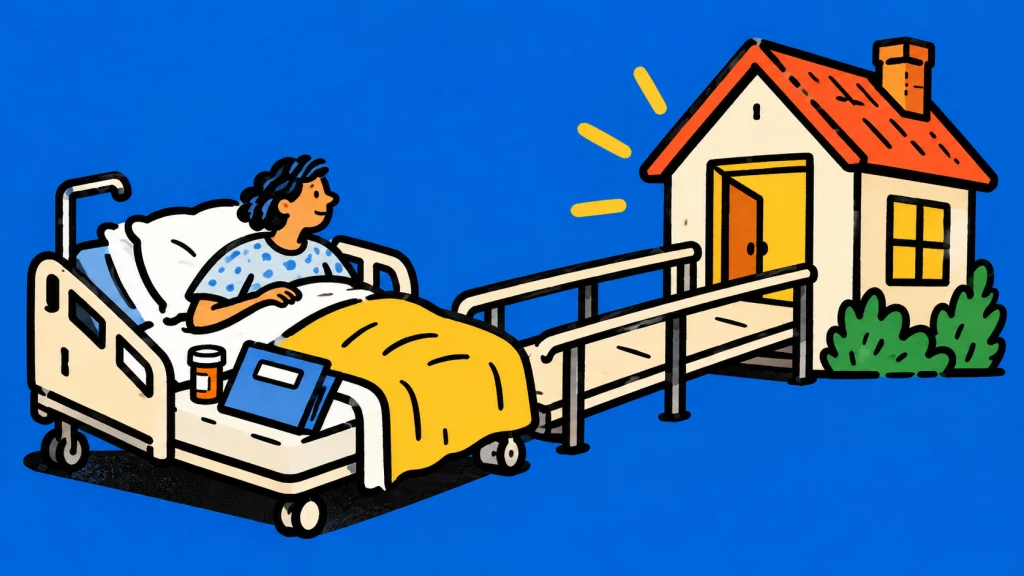
A planned 40-bed recuperative-care center recognizes a failure built into the health system: a patient can be well enough to leave a hospital without having a safe place to recover.
Henderson, Nevada, plans to open a 40-bed Recuperative Care Navigation Center for medically fragile patients who can leave the hospital but do not have a stable place to recover. Casey Harrison of the Las Vegas Review-Journalreported Wednesday that the city is working with St. Rose Dominican Hospital to renovate space on the Rose de Lima campus, with an opening targeted for early 2027. Patients could remain there for 30 to 90 days while receiving medical oversight, meals, transportation and case management.
Hospital discharge rules are built around whether someone still requires hospital-level care. They are not designed to guarantee that the person has a refrigerator for medication, a bed to sleep in, transportation to follow-up appointments or a place where a wound can be kept clean. For patients with stable housing, those conditions are usually assumed. For patients experiencing homelessness or severe housing instability, they can determine whether recovery continues at all.
The result is a weak point between medical care and housing policy. A person can be clinically ready to leave the hospital while still being physically unable to recover safely in a shelter, a vehicle or on the street. The hospital has completed the acute-care portion of the job, but the patient’s health still depends on conditions that fall outside the traditional medical system.
Henderson is building an institution specifically for that in-between period. Mayor Michelle Romero said the center is intended to provide a safe place for patients to recover while they are connected with housing and other services. The proposed model combines temporary accommodation with transportation and case management, which means the city is not treating a bed by itself as the intervention.
The economics behind the approach are fairly straightforward. When an unstable discharge fails, the expense does not disappear. A patient whose condition deteriorates may return to an emergency department, require another ambulance trip or need another hospital admission. Shelters and local agencies can also become involved. Several institutions end up paying for pieces of the same problem because no single institution was responsible for the recovery period.
Recuperative care changes where that responsibility sits. Instead of placing nearly all of the burden on a patient once hospitalization ends, the model keeps an institution involved long enough to stabilize the person and connect them with whatever comes next. That can include permanent housing, benefits, transportation or longer-term medical care.
The power imbalance is easy to miss because it occurs through administrative boundaries rather than a single decision. A patient who is discharged without stable housing has little influence over the systems that determine what happens next. The hospital can say hospital care is no longer medically necessary. A shelter can say it is not equipped to manage medical needs. A housing agency can operate on a waiting list measured in months. The person is left to navigate those systems while recovering from illness or injury.
A recuperative-care center creates one place with responsibility for bridging those boundaries. Whether it succeeds will depend heavily on what happens after the 30- to 90-day stay. If affordable housing and longer-term placements remain scarce, the center can stabilize people without solving the condition that made discharge unsafe in the first place.
Henderson’s approach still changes the definition of what counts as a health-care outcome. Hospitals traditionally measure whether treatment succeeded inside the facility. Recuperative care asks whether the patient had a realistic chance to remain healthy after leaving it.
That standard could become harder for health systems to ignore as housing costs rise and more patients reach discharge without a safe place to recover. The pressure will be especially strong where hospitals repeatedly treat the same people after unsuccessful discharges. Health systems may eventually have to judge discharge not only by whether a patient can leave the building, but by whether the recovery plan can survive outside it.