
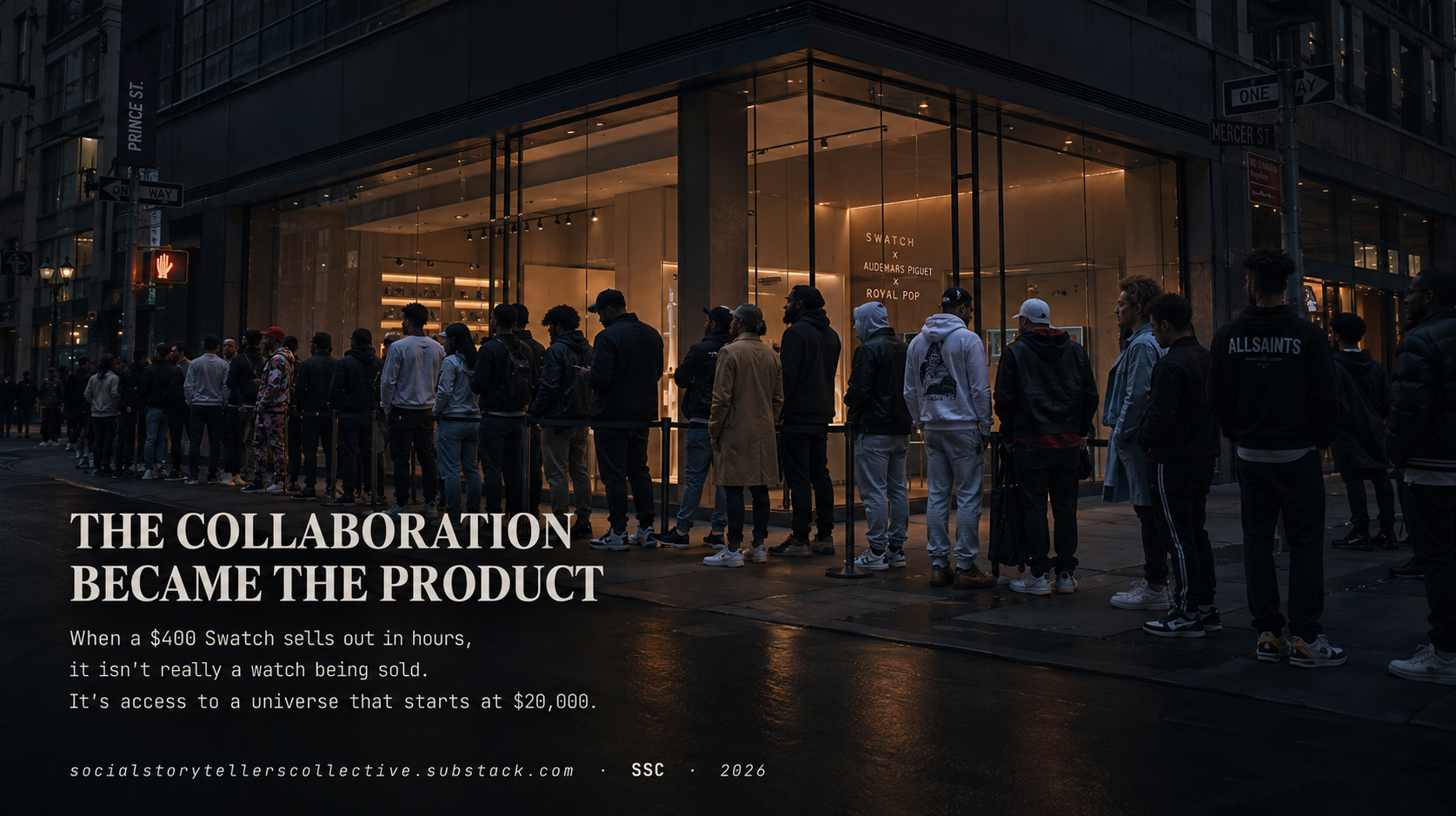
The lines outside Swatch stores this weekend did not look like traditional luxury retail. They looked like sneaker drops, concert queues, and Black Friday footage from the early 2010s.
In cities from New York to Dubai, crowds gathered overnight for the release of the Audemars Piguet × Swatch “Royal Pop” collection — a colorful reinterpretation of the Royal Oak transformed into a wearable pocket watch with a lanyard and retro styling. Stores closed early. Police intervened. Videos of pushing, screaming, and crowd surges spread across social media within hours. The chaos was not incidental. It was the announcement.
The deeper story is that collaboration culture has become one of the dominant economic engines inside modern luxury — and the collaboration now often matters more than the underlying product category. A $400 Swatch became globally desirable this weekend because it temporarily granted access to the symbolic universe of Audemars Piguet, a watchmaker whose core pieces often begin above $20,000 and can climb far higher in the resale ecosystem. Within hours of release, Royal Pop pieces were already listed on eBay for multiples of retail. The product had cleared the retail stage and entered the cultural one before most stores had reopened.
The luxury industry spent decades protecting distance. Scarcity, waiting lists, boutique access, and exclusivity were central to how prestige functioned. The collaboration inverts that logic entirely. Instead of protecting distance, brands now monetize proximity. The modern consumer increasingly does not need permanent ownership of elite status symbols — they want temporary participation in them. That shift is why luxury collaborations now behave more like cultural events than retail launches. The AP × Swatch rollout operated closer to a Supreme drop or a Travis Scott sneaker release than anything recognizable from traditional Swiss horology.
That dynamic helps explain why Swatch keeps returning to this strategy after the commercial success of the MoonSwatch and Blancpain collaborations. The company has effectively discovered a formula for manufacturing cultural urgency at mass scale — pairing its accessible pricing structure with the mythologies of brands whose core customer base will never set foot in a Swatch store. The Royal Oak is one of the most recognizable watch designs in modern luxury history. The Royal Pop does not replicate it. It borrows its aura, packages it in Bioceramic and color, and distributes it to a consumer base that understands exactly what they are purchasing — and what they are not.
The collaboration frenzy also reveals how luxury has absorbed internet behavior. Online culture rewards recognizability, remixing, and symbolic compression. A collaboration immediately communicates status because audiences already understand both brands independently. The consumer does not need to study watchmaking history to understand what AP represents. The signal travels instantly through algorithms, resale markets, TikTok videos, Instagram wrist shots, and the social validation of getting it before it sold out. The product becomes content before it becomes ownership. The unboxing is the event. The line is the marketing.
The backlash from traditional collectors is equally revealing. Some enthusiasts described the collaboration as the equivalent of putting a Ferrari badge on a Civic — arguing that it weakens AP’s exclusivity and dilutes a brand that has spent decades being deliberately inaccessible. But that criticism may misunderstand where the market has already moved. Modern luxury increasingly depends on visibility and participation rather than quiet exclusivity alone. Younger consumers often experience brands first through digital ecosystems, resale platforms, and viral moments — not boutiques, not waiting lists, not inheritance. For them, accessibility does not dilute aspiration. It creates the on-ramp to it.
The crowds outside these stores tell a larger story about the evolution of status itself. Collaboration culture works because it collapses the distance between elite identity and mass participation — even if only temporarily, even if the object is a pocket watch on a lanyard that costs less than a car payment. In the process, the collaboration stops being a marketing tactic and becomes the actual commodity. The frenzy is not irrational. It reflects a consumer economy where access, symbolism, and internet visibility increasingly hold as much value as the object being sold. The collaboration became the product. The chaos was proof of purchase.