
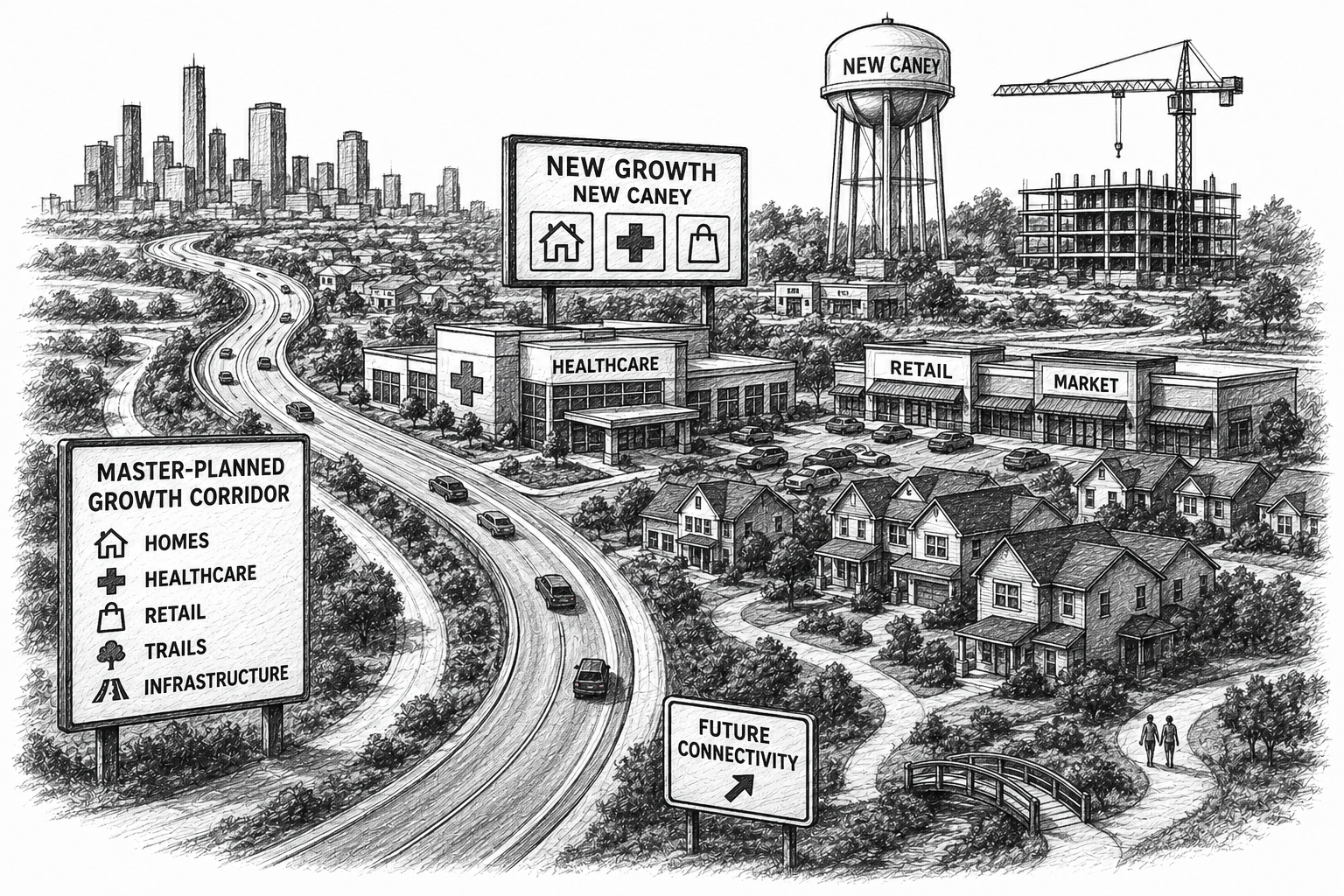
Houston is not growing up. It is growing out.
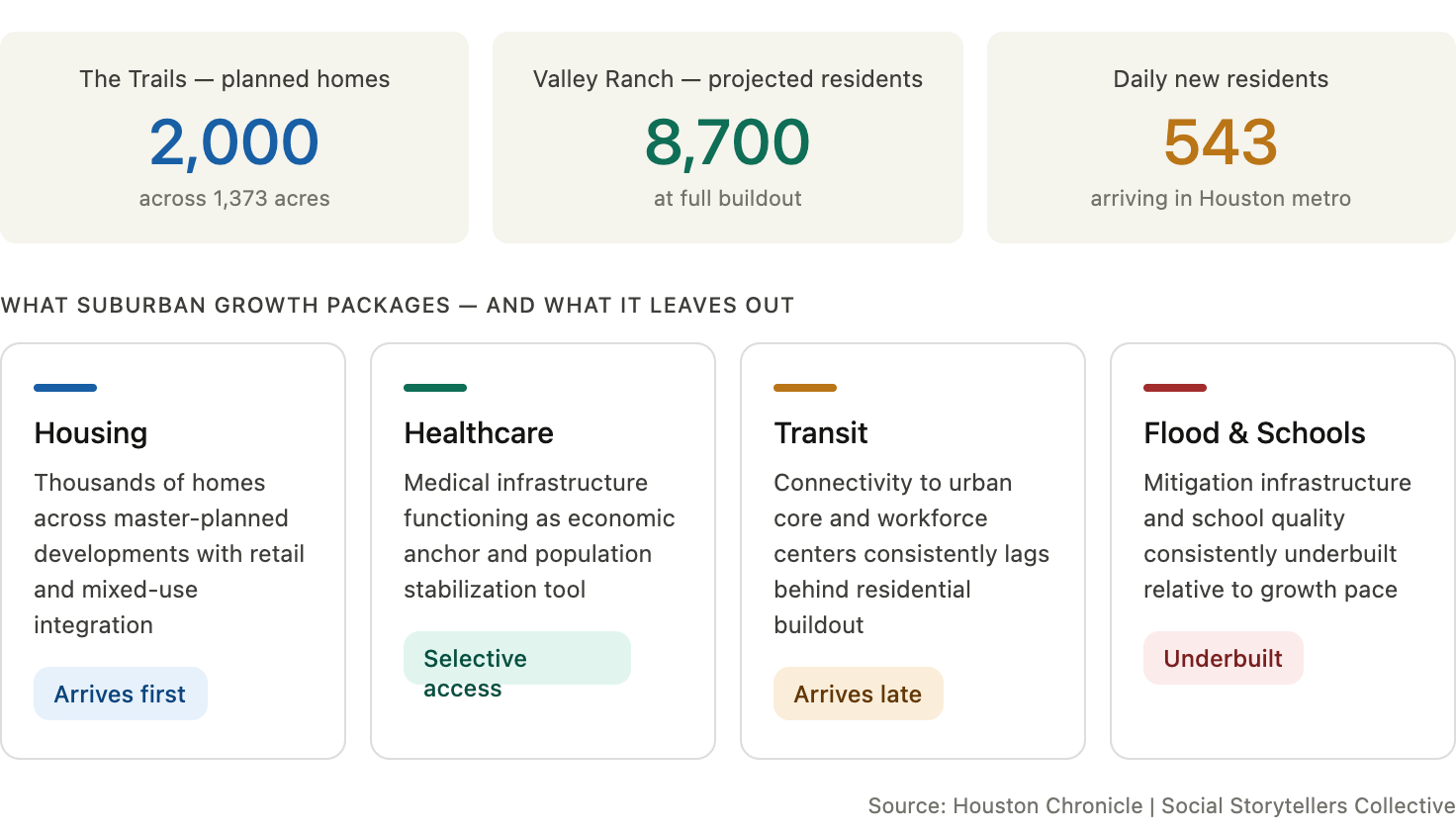
New development activity northeast of the city in New Caney — including Valley Ranch’s Azalea District and The Trails — is adding thousands of homes, healthcare facilities, retail corridors, trails, and mixed-use commercial space. The Trails plans approximately 2,000 homes across 1,373 acres. Valley Ranch is projected to house up to 8,700 residents at full buildout. These are not small additions to the edge of the metro. They are the construction of entirely new communities designed to absorb the population pressure the urban core can no longer hold at affordable prices.
Houston has always grown this way. Rather than building up through dense vertical redevelopment, the city converts land outward. Housing, healthcare, retail, logistics access, and road construction move together as a package — which is why these developments feel like towns rather than subdivisions. That model has absorbed enormous population growth over decades. It is also why the question of access matters more here than in cities where growth is concentrated and visible.
Suburban growth does not automatically solve the problems that push people toward the suburbs in the first place. In outer-ring communities growing as fast as New Caney, infrastructure arrives in a specific order: housing first, retail soon after, healthcare anchored to attract investment, and transit, schools, and flood mitigation whenever the budget allows. That sequence means the people who move out there earliest are often the ones living furthest from the full set of services the development eventually promises. By the time the infrastructure catches up, the land has appreciated and the affordability that drew them there has narrowed.
The healthcare-centered development inside Valley Ranch reflects a broader national pattern worth naming. Hospitals and specialty clinics are no longer just public services — they are economic anchors that attract higher-income residents and stabilize property values. When healthcare infrastructure is used primarily as a real estate tool rather than a community resource, access becomes embedded into geography. The people who can afford to live near the new medical district get the access. Everyone else drives.
Houston’s outward expansion is going to continue. The population pressure is real, the land is available, and the relative affordability compared to coastal markets still exists. But that advantage narrows over time if wages, transit, schools, and flood infrastructure don’t keep pace with the pace of development. 543 new residents are arriving in the Houston metro every day. The question worth asking is not whether the city is growing. It is whether the infrastructure being built is growing for all of them.