
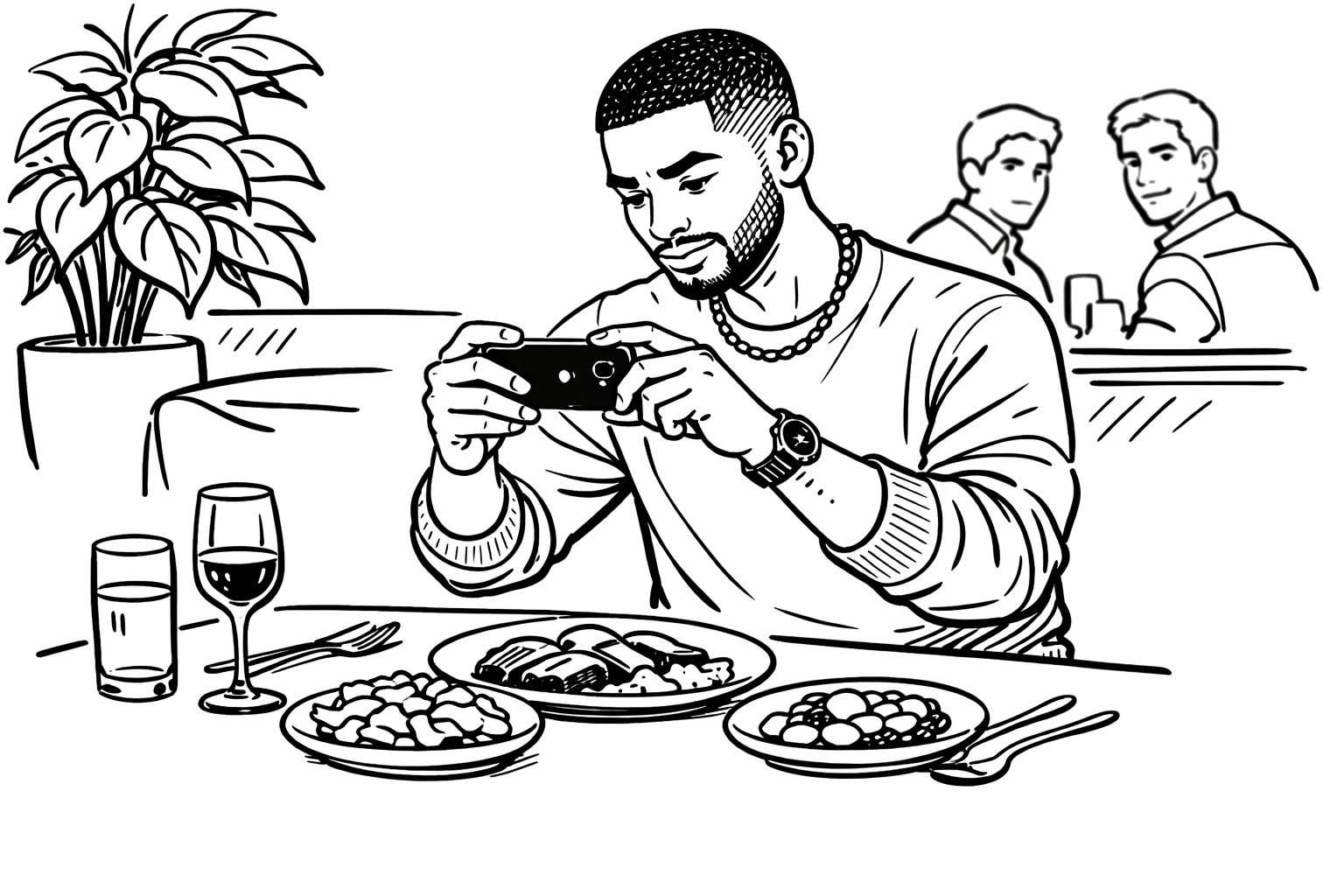
It started with a question about food photography, but it quickly expanded beyond that. A viral post asking why men photograph their meals surfaced a familiar argument about masculinity—who defines it, and which behaviors fall inside or outside its boundaries. What began as a casual observation became a broader conversation about gender expectations, one that now unfolds constantly across platforms in real time and at scale.
Photographing food, journaling, skincare, and curating a living space rarely draw scrutiny on their own. The scrutiny emerges when men engage in them. What is considered ordinary for one group becomes debatable for another. The internet did not create this dynamic, but it has amplified it, adding speed, visibility, and a feedback loop that keeps the conversation active and evolving.
The debate has also moved into spaces that once felt separate. NFL tunnel walks, once simply a transition from locker room to field, now function as stages for personal expression. Players like Stefon Diggs wear looks that challenge traditional expectations of male athletes, while more broadly, men are experimenting with nail polish, makeup, and designer bags in ways that feel less transgressive and more normalized, particularly among younger audiences.
At the same time, the content layer has intensified the conversation. Fitness influencer Ashton Hall went viral for a tightly curated morning routine built around discipline and aesthetics. The response cycle that followed—commentary, parody, and imitation—blurred the line between criticism and replication. The routine became a format, and the format became a template for visibility, collapsing the distinction between mockery and aspiration.
Dating formats like “Pop the Balloon” extend this dynamic further by turning evaluation into performance. Men are assessed in real time based on how they present themselves—what they wear, where they work, and how they talk—shifting judgment from something private into something collective and highly visible.
The contradiction underlying all of this is difficult to ignore. Many of the voices policing what men should or should not do online are participating in the same culture of visibility they critique. Social media rewards sharing, curation, and performance. The behavior itself is ordinary, but the reaction to who is doing it often is not.
The influencer industry, valued at roughly $24 billion in 2024, has pulled more men into spaces built on visibility—documenting routines, refining personal style, and building audiences in real time. What once existed privately—how men move, present, and define themselves—is now content, open to feedback, interpretation, and constant revision. Masculinity is not quietly evolving; it is being negotiated in public, shaped through participation, reaction, and repetition at a pace that resists stability, as what once lived at the margins of culture now sits at its center and drives the conversation rather than reacting to it.