
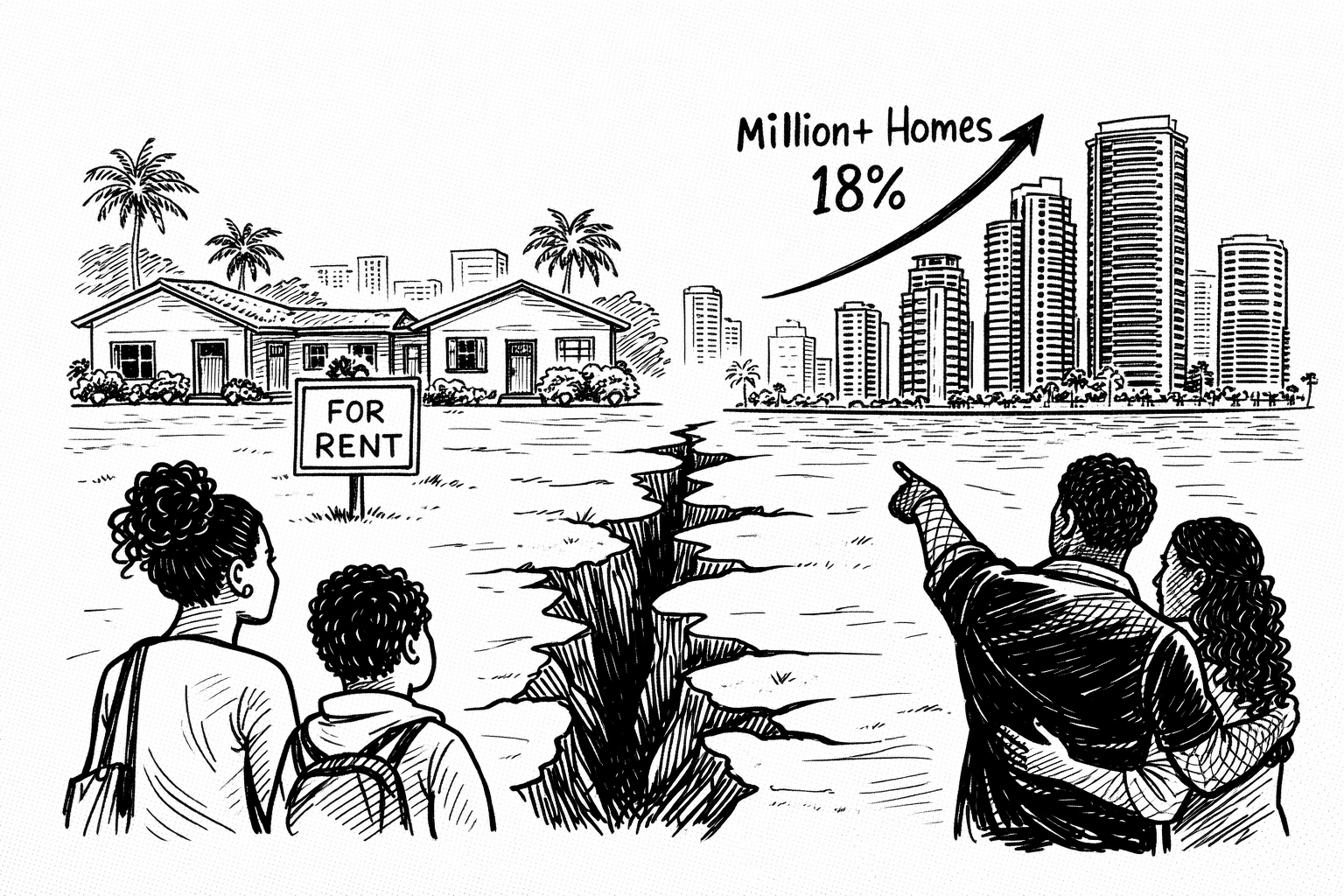
Miami’s housing market is not in crisis by the metrics that typically signal one. Prices have not collapsed. Demand has not evaporated. The money is still moving. What is happening instead is quieter and more durable: the market is reorganizing itself around two separate economies, one built for global capital and one increasingly inhospitable to the people who have always lived there.
The data makes the split legible. Million-dollar home sales increased 18.8% year over year, with both single-family and condo segments posting double-digit growth. Wealth continues to find its way into Miami, sustaining the top tier of the market with an ease that suggests the city’s position as a destination for international investment has not softened. Meanwhile, the broader market is losing its middle ground. Homes are sitting longer — a median of 87 days on the market compared to 70 days nationally — moving 16% slower than a year ago. More telling than the pace is the inventory. The share of single-family listings priced under $350,000 has dropped from 24% in 2020 to just 3.5% in 2026. The entry point has not risen modestly. It has been functionally eliminated.
What disappears with that inventory is not just a price tier. It is the mechanism through which working-class and first-generation homeownership has historically been possible in this city. Miami has long been a majority-minority city — predominantly Black and Latino, built substantially on Caribbean and Central and South American migration, with communities like Little Haiti, Liberty City, and Overtown carrying decades of cultural and economic history alongside decades of targeted disinvestment. Those communities are not encountering the luxury market’s expansion as an abstraction. They are encountering it as eviction pressure, as property tax increases that follow rising assessed values, as the gradual replacement of the neighborhoods they built with condominiums priced for buyers whose primary residence is somewhere else entirely.
This is what bifurcation looks like when it operates at scale and over time. Miami is not becoming unaffordable in the way that phrase is typically deployed — a temporary condition that policy might correct. It is becoming structurally reorganized around a clientele that does not require affordability because affordability is not a constraint they face. The skyline reflects that reorganization clearly. What it does not reflect is the displacement happening beneath it, the residents moving further from the urban core into Broward and Miami-Dade’s outer edges, absorbing longer commutes and higher transportation costs as the price of remaining proximate to the city they have always called home.
Miami is not losing demand. It is being selective, as markets always are, about who that demand serves — and building the infrastructure of a city optimized for visitors and investors while the people who sustain its labor economy, its cultural identity, and its daily life find themselves with fewer and fewer options inside it. That is not a market correction. It is a reallocation, and the communities absorbing its cost did not choose it and were not consulted about it.