
New York City officials are advancing a proposal that could enable the development of up to 35,000 housing units on approximately 2,850 underutilized or irregularly shaped lots across the city. The initiative focuses on narrow parcels and sites long considered impractical under existing zoning and building codes, aiming to remove regulatory barriers that have limited their development. The plan is being positioned as part of a broader effort to address record rents and historically low vacancy rates.
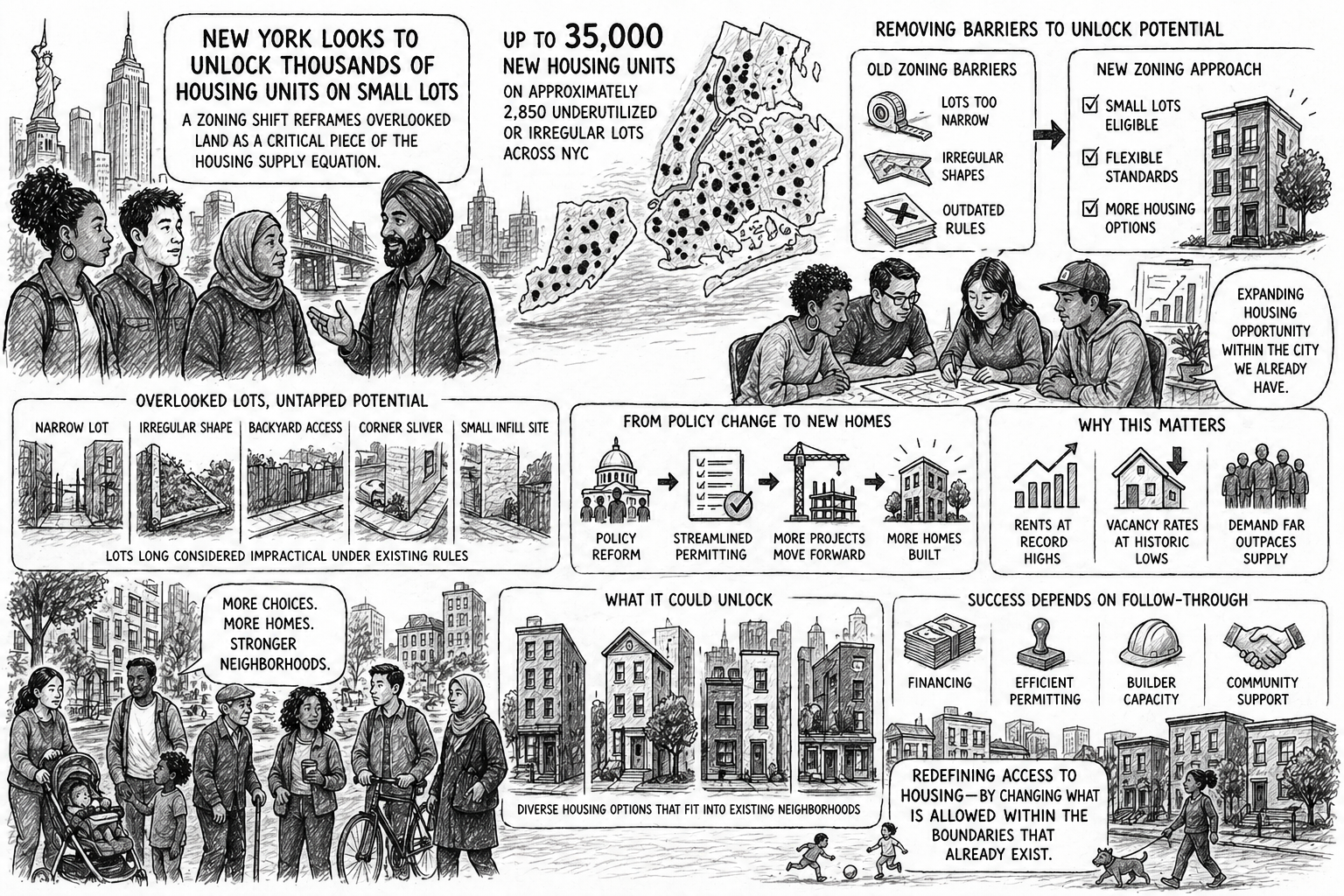
The proposal arrives as New York continues to grapple with a housing market defined by scarcity. Vacancy rates have hovered near historic lows, while rents have reached record highs, creating sustained pressure on both tenants and policymakers. Traditional large-scale development has not been sufficient to meet demand, prompting a shift toward smaller, distributed solutions that expand supply incrementally rather than through single major projects.
The structural change lies in how the city is redefining buildable space. Zoning has long determined not just where housing can be built, but what counts as viable land in the first place. By targeting lots previously excluded from development due to size or shape constraints, the city is effectively expanding its housing footprint without acquiring new land. The constraint is no longer geography. It is regulation.
This approach reflects a broader shift in urban planning toward maximizing existing infrastructure. Cities like Los Angeles and Boston have pursued similar strategies, including accessory dwelling units and infill development, to increase density without large-scale redevelopment. The common thread is a recognition that traditional development models are too slow and too limited to address current demand.
For residents, the impact will depend on how quickly these changes translate into actual construction. Unlocking zoning potential does not automatically produce housing. It creates the conditions for development, but financing, permitting, and market dynamics still determine whether projects move forward. The promise of 35,000 units is significant, but its realization will depend on execution.
The larger pattern is a shift from expansion to optimization. Cities are no longer relying solely on new developments at scale. They are reexamining the rules that govern existing space. In doing so, they are redefining access to housing not by building outward, but by changing what is allowed within the boundaries that already exist.