
Across the country, museums are undergoing a significant language shift. Terms like “community engagement,” “inclusive programming,” and “public access” have become central to institutional messaging, annual reports, and capital campaign materials. The rebranding is widespread enough to constitute a sector-wide posture. On the surface, the change signals genuine movement — an acknowledgment that cultural institutions have historically served narrow audiences and that broadening access matters. But inside the operational structure of these institutions, a different story is unfolding. Access is expanding rhetorically while becoming more conditional in practice.
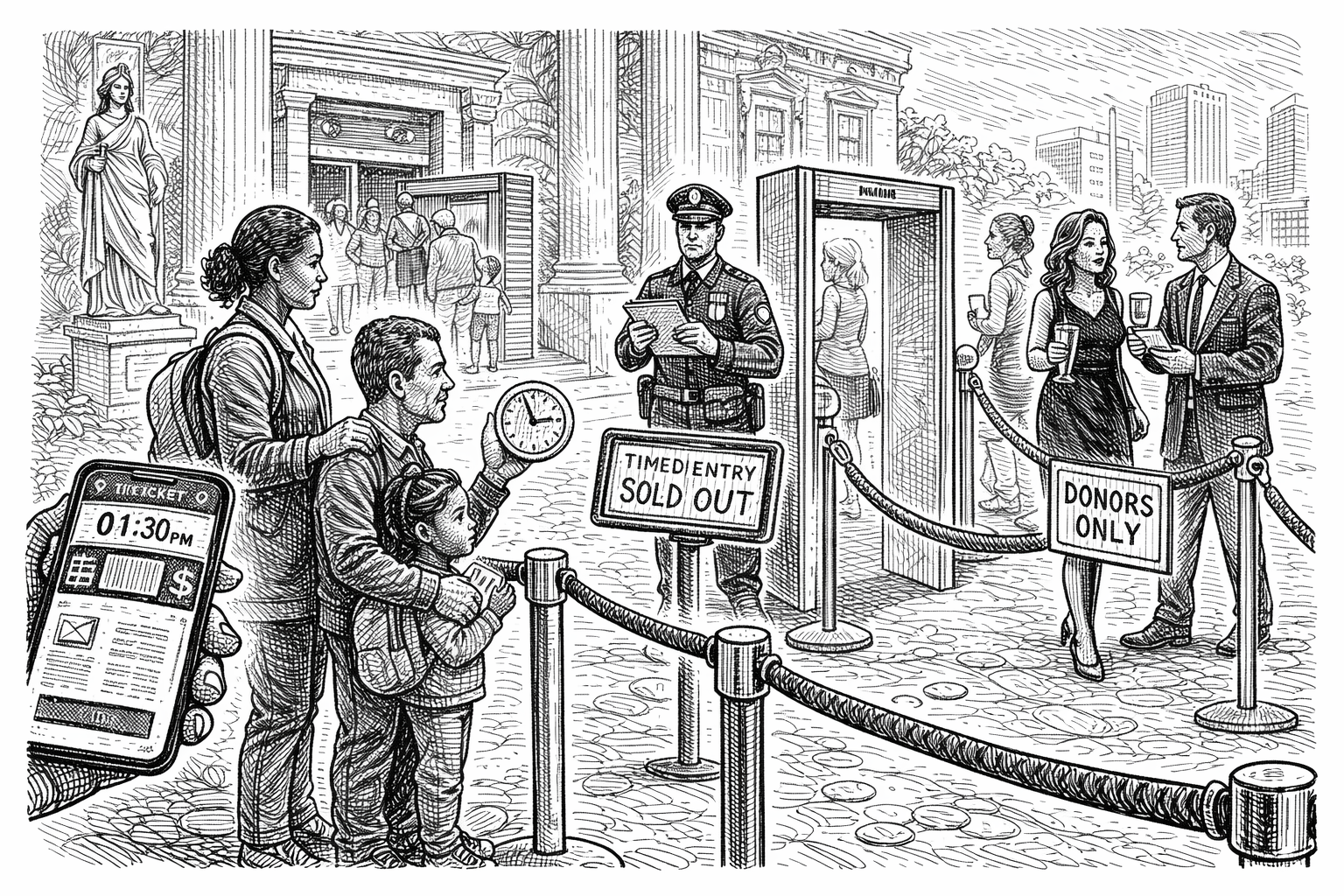
Ticket prices at major U.S. museums have increased by as much as 25% in the past three years. Some institutions have introduced dynamic pricing models that fluctuate based on demand — a practice borrowed directly from the airline and hospitality industries that, when applied to cultural access, effectively creates peak-exclusivity windows. Timed entry systems, initially introduced during the COVID-19 pandemic as a safety measure, have remained in place at a number of major institutions, fundamentally reshaping how and when the public can engage with collections that were, in many cases, built with public funding and public trust. For families without flexible schedules, reliable transportation, or digital literacy, timed entry is not a minor inconvenience. It is a structural barrier.
At the same time, donor-driven exhibitions continue to dominate programming decisions at major institutions. When a private foundation or a major corporate sponsor underwrites a show, programming follows funding. That is not a scandal. It is an incentive structure operating exactly as designed. But the result is an institutional calendar that frequently prioritizes prestige and funding relationships over local relevance, community history, or the needs of the neighborhoods in which many of these buildings physically sit. A survey of major U.S. museum programming from 2022 to 2024 found that donor-initiated exhibitions accounted for a disproportionate share of marquee gallery space, with community-originated programming overwhelmingly confined to education wings, after-hours events, and ancillary programming tracks.
The contradiction at the center of this moment is not accidental. It reflects the financial reality of institutions navigating decades of reduced public funding and growing reliance on private capital. The National Endowment for the Arts has never fully recovered from the funding cuts of the 1990s. State arts agency budgets have declined in real terms across most of the country. The result is a sector that has been quietly privatized in its revenue structure while maintaining the language and legal status of public cultural stewardship. Community is invited in. The infrastructure determines whether they can actually enter, on what terms, at what cost, and for whose agenda.
That managed access has taken on a harder edge in the current federal policy environment. As SSC reported in Museums Aren’t Just Losing Funding. They’re Losing Control., the conditions shaping what institutions can present are no longer limited to ticket prices and donor calendars. They now include executive orders, terminated federal grants, and the withdrawal of private support from corporations unwilling to be associated with anything the administration has labeled divisive. The gap between language and infrastructure has a new enforcement mechanism.
This tension is not unique to museums. SSC’s ongoing Society & Economy coverage has documented the same pattern across libraries, public parks, community pools, and cultural venues — public goods increasingly administered with private-sector logic, where access is managed rather than guaranteed and participation is conditioned on consumption.
The gap between institutional language and institutional practice is itself a data point. When the rhetoric of inclusion accelerates at precisely the moment that prices rise, access narrows, and programming becomes more donor-dependent, the acceleration is not coincidental. It is compensatory. The more the infrastructure closes, the louder the language of openness becomes.