
Part of The Access Shift — an ongoing series examining how access is being quietly reshaped across American life.
News Desk | Social Storytellers Collective
At a time when pathways into professional fields are becoming more competitive, more expensive, and more opaque, stories that move in the opposite direction reveal something deeper than inspiration. They expose how access actually works.
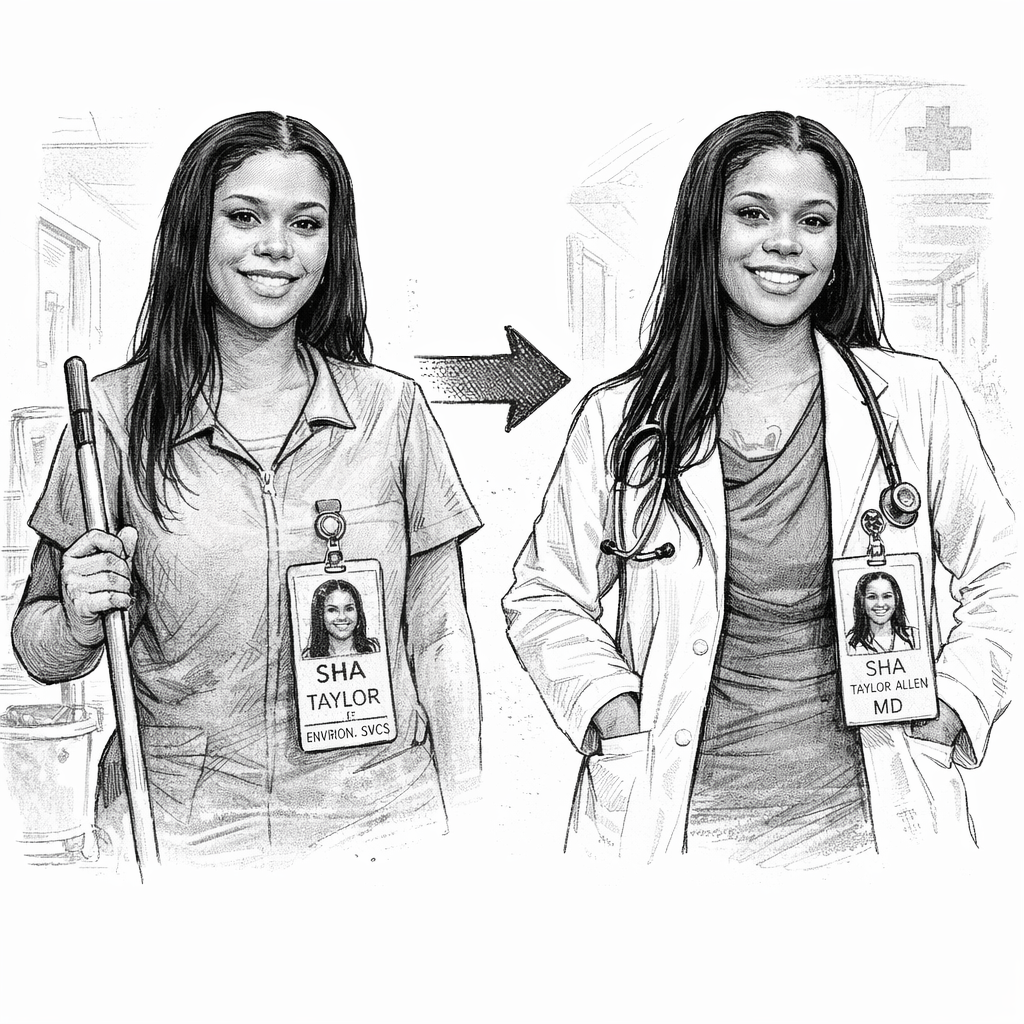
Shay Taylor Allen, 32, is preparing to begin her medical residency at Yale—the same hospital where she once worked as a janitor. At 18, she took a job in environmental services at the hospital where she was also born. Years later, she is returning as a physician, entering a system she once experienced from its margins.
According to ABC News, Allen recently matched into her first-choice residency program at Yale after completing her medical degree at Howard University College of Medicine. The trajectory—from janitorial staff to physician within the same institution—is rare not because the potential doesn’t exist, but because the pathway is not built for most people to navigate it.
Her decision to pursue medicine took shape during college, when she helped care for her ailing mother. That experience reframed healthcare from something she worked around to something she wanted to practice. It gave direction to a path that, like many, was not initially clear.
Her return to Yale carries symbolic weight, but it also highlights a structural reality. Healthcare remains one of the least accessible professional pipelines in the United States, shaped by cost barriers, educational gatekeeping, and uneven exposure to opportunity. Stories like Allen’s are often framed as proof of possibility. They are also evidence of how much persistence is required to move through systems that were not designed with equal access in mind.
Allen has been clear about what her presence represents. “People that look like us are needed,” she said. “Our patients are waiting for us to do it.” Representation, in this context, is not just about visibility. It is about trust, outcomes, and who is positioned to care for whom.
She is expected to graduate this spring and begin her residency in anesthesiology later this year. Her story is being shared widely, but its significance extends beyond a single achievement. It sits at the intersection of labor, education, and access—and raises the question of how many similar paths never materialize.
Why this matters:
Access is often framed as individual determination. In reality, it is structured by systems. When one person makes the journey from the margins to the center within the same institution, the story is not just about what’s possible—it’s about how rare that pathway still is.
The Access Shift
The gradual redefinition of who systems are designed to serve.
Across sectors—from public infrastructure to healthcare to everyday spaces—access is no longer assumed. As costs rise and systems face increasing pressure, services once built for broad reach are becoming more selective, more conditional, and less universal. The Access Shift explores how these changes are unfolding in real time—and what they reveal about who is included, who is left out, and how the structure of everyday life is quietly being reshaped.