
Part of The Access Shift — an ongoing series examining how access is being quietly reshaped across American life. New stories every Wednesday at 12:00pm CDT.
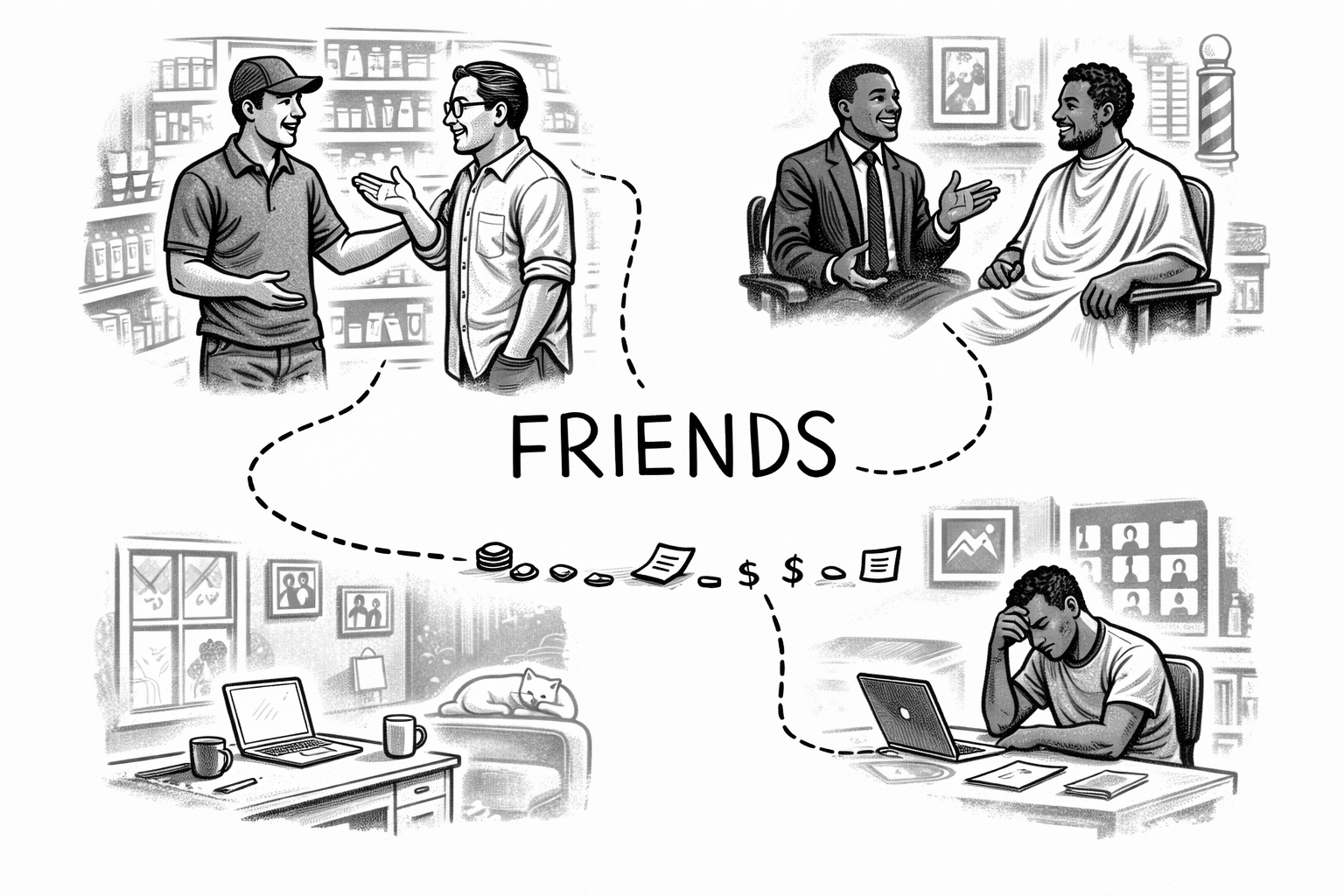
Picture the last time you ran into someone you used to be close to — not planned, just encountered. Maybe at a grocery store, a barbershop, a work event. The conversation was warm, genuine even. You both said you needed to catch up. You both meant it. And then life resumed, the moment passed, and the catch-up never happened. Not because either of you stopped caring. Because the structure that used to create the next moment — the shared commute, the office hallway, the weekly class — was no longer there to do it for you.
That is not a personal failure. That is what happens when the scaffolding of incidental connection gets removed and nobody replaces it with anything.
Remote work was framed as liberation, and in many ways it was. No commute, more autonomy, flexibility that working parents and caregivers had been asking for decades. What the framing left out was what the office, for all its dysfunction, had been quietly providing: a reason to be around people you didn’t choose, on a schedule you didn’t control, in a shared physical space where relationships formed not by intention but by proximity. When that disappeared, so did the low-stakes daily contact that had been doing most of the maintenance work in a lot of adult friendships. What remained required effort — and effort, in a life already stretched thin, is the first thing that doesn’t get made.
The data reflects what many people feel but rarely name directly. According to the Survey Center on American Life, the share of Americans reporting no close friends has quadrupled since 1990. Men have been hit hardest — 15% now report having no close friends at all, up from just 3% three decades ago. A 2024 American Perspectives Survey found that adults under 30, despite being the most digitally connected generation in history, report the highest rates of social isolation. The group chats are full. The closeness isn’t there.
But the loneliness conversation in mainstream media tends to treat this as a universal condition, and it isn’t. For Black and Brown communities, friendship and chosen family have never been optional extras — they have been survival infrastructure. The cookout, the church, the barbershop, the block — these were not just social rituals. They were the places where information traveled, where resources were pooled, where people were held when institutions failed them. The erosion of those spaces and rhythms doesn’t register the same way it does for communities where isolation was always a private inconvenience rather than a collective wound. As What Doesn’t Make It Into the Cart made clear, rising costs are already narrowing what everyday life includes — and for many families, the spontaneous dinner, the road trip, the concert that used to anchor friendships are among the first things that get cut. And as The Decline of Third Spaces examined, when the home becomes too efficient and complete, the daily reasons to leave — and the encounters those reasons created — quietly disappear.
There is also a class dimension that the wellness conversation around loneliness consistently sidesteps. Rebuilding social infrastructure after disruption requires discretionary time and money that are not evenly distributed. For people working multiple jobs, managing caregiving without support, or navigating housing instability, the advice to join a club or put yourself out there is not just tone-deaf — it is a reminder that the solutions being offered were designed for people with margin. As When the Economy Slows, Some Communities Feel It First documented, the communities with the least structural cushion absorb the earliest effects of any system under pressure. That includes the social system. Loneliness at this scale is not a personal failure. It is a systems problem that keeps getting diagnosed as an individual one.
What this moment requires is not a listicle about how to make friends as an adult. It is an honest reckoning with what has been structurally removed from daily life — the incidental contact, the shared physical space, the collective rhythms that once made community a byproduct of simply showing up. For some communities, those rhythms carried more than friendship. They carried identity, memory, and mutual aid. Getting intentional about rebuilding them is not just a wellness practice. It is, for many people, an act of resistance against a design that keeps making it easier to stay home and harder to stay connected.
The gradual redefinition of who systems are designed to serve.
Across sectors—from public infrastructure to healthcare to everyday spaces—access is no longer assumed. As costs rise and systems face increasing pressure, services once built for broad reach are becoming more selective, more conditional, and less universal. The Access Shift explores how these changes are unfolding in real time—and what they reveal about who is included, who is left out, and how the structure of everyday life is quietly being reshaped.