Britain’s Technology Secretary Liz Kendall announced Tuesday that the UK will work with other “middle power” nations — including France, Germany, and Canada — on AI security coordination, explicitly framing the effort as an attempt to shape the future of a technology dominated by the United States and China. The strategy centers not on building the largest models but on defining the standards under which they operate — a distinction that reflects a clear-eyed assessment of where the UK can realistically compete. The UK’s AI Security Institute generated significant international interest earlier this month when it evaluated Anthropic’s Claude Mythos model and identified exploitable security weaknesses — demonstrating that credibility in risk assessment can produce influence even without controlling the underlying technology.
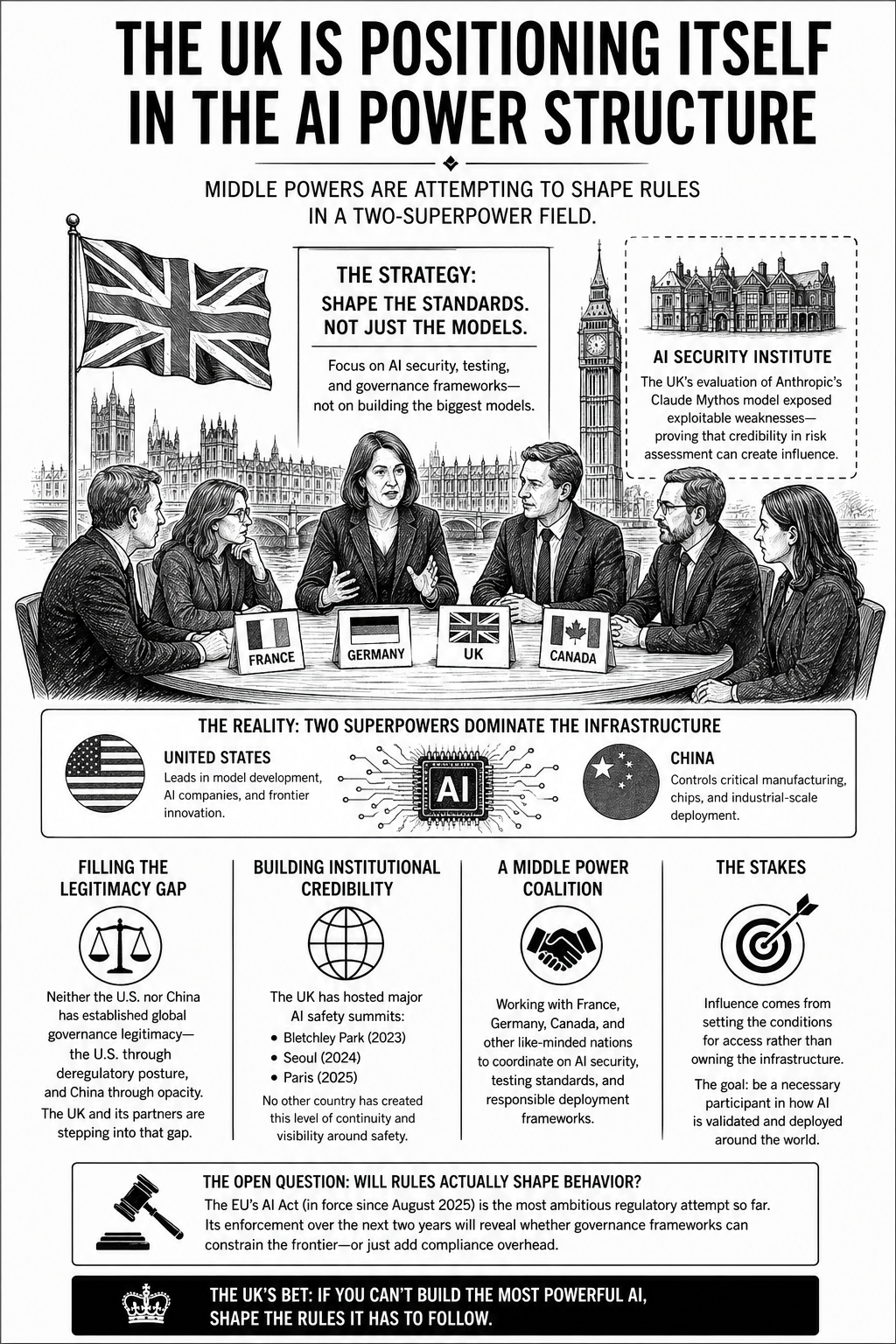
The approach is a form of strategic positioning that other mid-tier nations have used successfully in previous technology governance cycles. The EU’s AI Act, which began applying its broadest provisions in August 2025, established risk-based regulatory categories and transparency requirements that now apply to any company operating in European markets regardless of where the technology was built. The UK is attempting something similar — using safety frameworks and testing protocols to insert itself as a necessary participant in conversations about how AI systems are validated and deployed globally. Influence, in this context, comes from setting the conditions for access rather than owning the infrastructure.
The two-superpower framing is accurate but worth interrogating. The United States and China dominate AI model development and chip manufacturing, but neither has established global governance legitimacy — the U.S. through deregulatory posture and China through opacity. That gap is where the UK coalition is moving. The UK has hosted landmark AI safety summits at Bletchley Park in 2023, Seoul in 2024, and Paris in 2025, building institutional credibility around safety coordination that no other country has matched at the same frequency or visibility. The coalition being assembled around France, Germany, and Canada extends that credibility into a broader multilateral frame.
What remains unresolved is whether governance credibility translates into meaningful constraints on how the dominant players develop and deploy systems. The EU’s AI Act is the most structurally ambitious attempt to answer that question, and its enforcement record over the next two years will determine whether regulatory frameworks can actually shape behavior at the frontier — or whether they simply create compliance overhead for everyone except the companies building the most consequential systems. The UK’s bet is that shaping the rules is worth pursuing even without controlling the technology. Whether that bet pays off depends on whether rules, in this field, still have teeth.