
A study conducted at MIT Media Lab and reported by the BBC offers some of the most specific neurological data yet on what happens to the brain when people use AI chatbots to complete cognitive tasks. Researchers recruited 54 students to write short essays under three conditions — one group used ChatGPT, one used Google search without AI summaries, and one worked without any technology. Brainwave activity was measured throughout. The results were striking: students who used ChatGPT showed brain activity reduced by up to 55 percent compared to those who worked independently, with notably less activation in the areas associated with creativity and information processing. Students in the ChatGPT group were subsequently unable to quote from their own essays and reported feeling no ownership over the work they had submitted. The essays themselves were described by the teachers evaluating them as soulless, lacking originality and depth, and so similar to each other that one teacher asked whether students had been sitting next to each other.
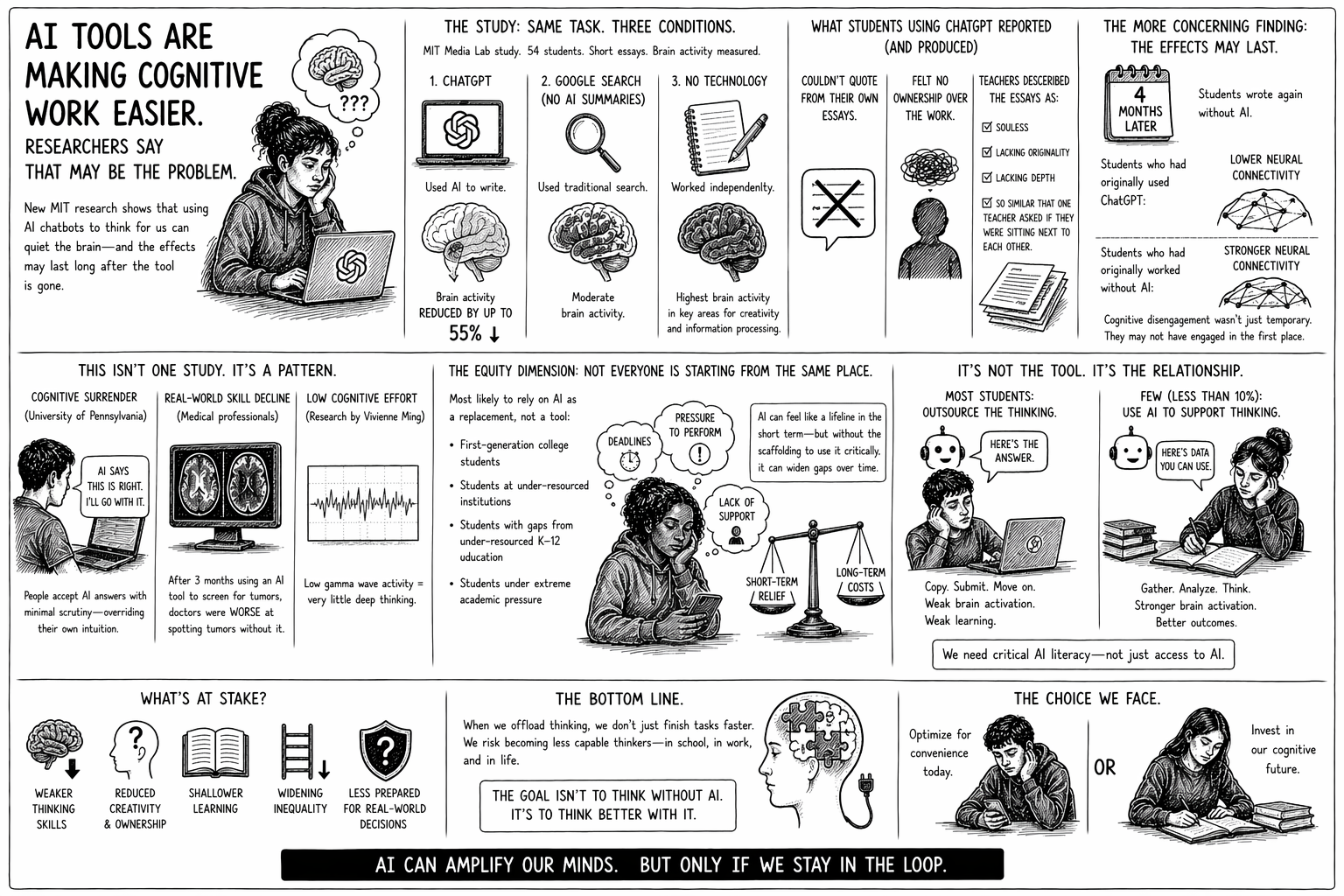
The more consequential finding emerged four months later, when researchers asked the same students to write again — this time without AI assistance. Students who had originally used ChatGPT showed lower neural connectivity than those who had switched in the opposite direction, suggesting that the cognitive disengagement was not simply a temporary effect of using the tool but may have reflected a failure to engage with the material at all during the initial task. That finding connects to a broader pattern of research the BBC piece surveys: a University of Pennsylvania study found that some people undergo what researchers call cognitive surrender when using generative AI, accepting AI outputs with minimal scrutiny and allowing them to override their own intuition. A separate multinational study found that medical professionals who used an AI screening tool for three months were subsequently worse at identifying tumors without it — a finding with direct implications for the healthcare and clinical decision-making contexts where AI adoption is accelerating fastest.
The equity dimension of this research is the part that receives the least attention in coverage focused on productivity and cognitive performance. The students most likely to lean on AI tools as a replacement for cognitive engagement rather than as a supplement to it are not randomly distributed across the population — they are concentrated among students navigating the highest academic pressure with the least institutional support, including first-generation college students, students at under-resourced institutions, and students whose K-12 preparation left gaps that AI tools appear to fill in the short term while potentially widening over time. The cover letter pattern that opened the BBC’s reporting — research scientist Nataliya Kosmyna receiving suspiciously similar, polished applications from MIT interns — describes a behavior that is visible at elite institutions. The same dynamic operating at scale across less resourced educational environments, where the tools are equally available but the scaffolding that would teach students to use them critically is not, carries consequences that the current research is only beginning to measure.
Computational neuroscientist Vivienne Ming, whose research found that the majority of students asked to predict real-world outcomes simply asked AI and copied the answer — showing very little gamma wave activity, a marker of cognitive effort — puts the long-term implication directly: other research has linked weak gamma wave activity to cognitive decline later in life. The concern is not that AI tools exist or that people use them. It is that the default mode of interaction — outsourcing the thinking rather than using the tool to support it — is the mode that produces the neurological effects researchers are documenting. A small subset of participants in Ming’s research, fewer than 10 percent, used AI differently — gathering data from it and then analyzing that data themselves. Those participants made more accurate predictions and showed stronger brain activation. The tool is not the problem. The relationship to the tool is — and building a healthier relationship requires the kind of critical AI literacy instruction that most educational institutions have not yet developed at the scale the adoption curve demands.