
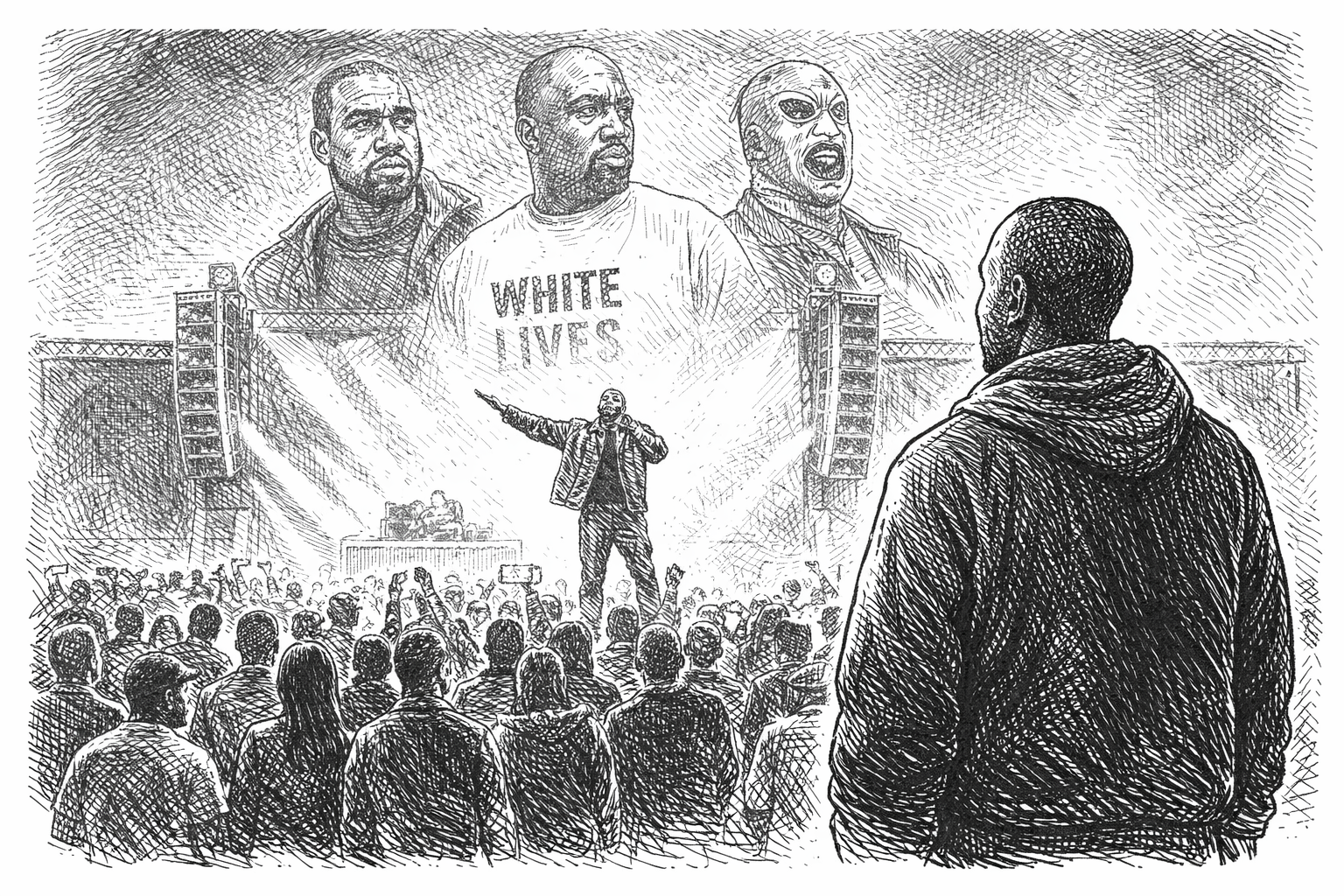
There was a moment not long ago when it felt like Kanye West had crossed a line the culture would not allow him to come back from. The backlash was immediate, the consequences were financial, and the distance between artist and audience seemed, for once, permanent. But culture rarely moves in straight lines. This week, that distance collapsed almost overnight. Kanye has been announced to headline all three nights of London’s Wireless Festival—his first UK performance in over a decade—marking one of the most visible returns in recent memory.
The reaction has been just as immediate, and just as divided. Critics have condemned the decision, pointing to his history of antisemitic statements and behavior, while some fans have called for boycotts. At the same time, the scale of the booking makes something else clear: whatever the cultural verdict once was, the market has made a different decision. Festivals, promoters, and platforms are not in the business of moral resolution. They are in the business of attention, and Kanye still commands it at scale.
That tension is the real story. Because comebacks in music are rarely about forgiveness in the way we like to frame them. They are about viability. Kanye’s return is happening at the same moment as a new album release, renewed demand for live performance, and the continued reality that his catalog remains deeply embedded in the sound of modern music. Even after years of controversy, he is still one of the most streamed and culturally referenced artists of his generation. The question isn’t whether people remember what happened. It’s whether that memory outweighs the value he still generates.
In Yeezy, Blue, and the Discipline of Reduction, I wrote about how Kanye’s career has always been rooted in a particular tension—between disruption and structure, between chaos and control. That tension hasn’t disappeared. It has evolved. What once showed up in the music now shows up in the public narrative around him. The unpredictability that made him compelling artistically is now the same force that complicates his place in the culture. And yet, the system continues to make room for it.
Because the system benefits from it. Controversy does not exist outside the economics of the industry—it feeds it. Attention converts. Streams convert. Ticket sales convert. A three-night headline slot at a major festival is not just a booking. It is a bet. A bet that the draw of Kanye West—the catalog, the legacy, the spectacle—still outweighs the risk attached to his name. And right now, that bet appears to be one the industry is willing to make.
What makes this moment different is not that Kanye is returning. It’s that the conditions that allow that return are now fully visible. The infrastructure of music—festivals, platforms, distribution—has shown that it does not operate on the same timeline as public accountability. It operates on demand. And as long as demand remains, re-entry is always possible.
Why This Matters
Kanye West’s comeback isn’t just about one artist. It’s a window into how the industry actually works. Culture may debate who deserves to return. The market decides who does. And when those two things don’t align, it tells us something important—not just about the artist, but about the system that continues to make space for them.