
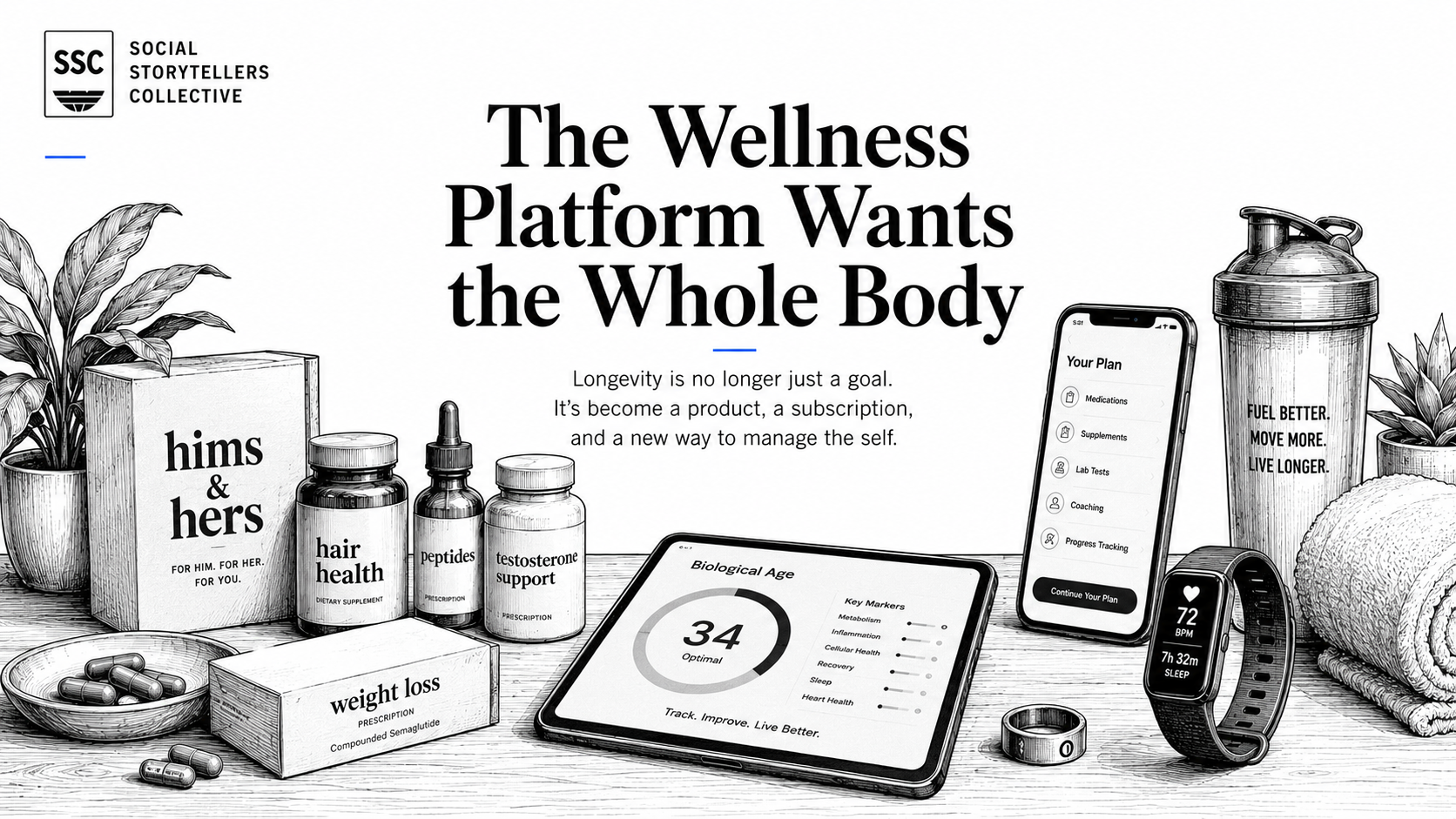
Hims & Hers is no longer just selling access to hair-loss drugs, erectile dysfunction medication, skincare, and weight-loss prescriptions. The company is now expanding into peptides, testosterone, biological-age testing, and full-body scans — a pivot that follows its explosive growth around compounded weight-loss drugs and the regulatory scrutiny that growth attracted. The shift matters because it reveals where consumer health is moving next: away from the doctor’s office as the primary gatekeeper and toward digital platforms that package optimization, prevention, and emotional reassurance into recurring subscription models.
The company’s earlier growth was built around reducing friction inside the health care system. Consumers frustrated by cost, wait times, insurance hurdles, or lack of access could receive treatments quickly through a branded digital interface that felt more like a lifestyle platform than a medical provider. That model accelerated during the rise of GLP-1medications — Ozempic, Wegovy, and compounded alternatives — which transformed weight loss into one of the most powerful consumer health categories in years. Analysts now project the broader GLP-1 market could surpass $126 billionglobally within the next several years, and the behavioral effects are already measurable: early research shows reduced grocery spending, shrinking restaurant consumption, and rising demand for protein-focused and wellness-oriented products as GLP-1 adoption scales. As SSC examined in The GLP-1 Economy Is Becoming a Control System, these drugs are no longer functioning purely as pharmaceutical products — they are becoming behavioral infrastructure, altering how people eat, shop, socialize, travel, and understand self-discipline itself.
But the new longevity push moves beyond treatment into anticipation — and that is a fundamentally different business. Hair loss and sexual health were already consumerized markets. Longevity sells something broader: the promise that aging, decline, fatigue, and metabolic instability can all be monitored, delayed, optimized, and managed before symptoms become visible. That promise does not require a diagnosis. It only requires a subscription.
Biological-age testing is the clearest example of how this works. The science remains genuinely contested — researchers disagree on what biological age measures, whether the tests are reproducible, and whether the interventions designed to improve the number actually extend healthy life. None of that uncertainty is visible inside the consumer interface. What the platform delivers is a number: trackable, improvable, comparable, and capable of generating anxiety that the next product or protocol can address. Once the body becomes measurable this way, the business model expands naturally. Consumers do not simply buy treatment. They buy management, reassurance, visibility, and the ongoing feeling of remaining ahead of decline.
That model is not operating in isolation. Hims & Hers sits inside a broader wellness ecosystem that includes wearables, continuous glucose monitoring, testosterone clinics, peptide culture, recovery technologies, sleep optimization products, and performance tracking platforms. The boundaries between medicine, technology, fitness, and lifestyle branding are collapsing into a single commercial system organized around constant self-surveillance. In that environment, health stops functioning purely as a medical condition and starts functioning as an ongoing project of maintenance. The consumer becomes operator, analyst, subscriber, and product participant simultaneously — and the platform profits at every stage of that cycle.
Hims & Hers and its competitors position themselves as democratizing care — making services available beyond elite concierge medicine, expensive clinics, and private wellness systems accessible only to the wealthy. In some ways, they are. Digital delivery lowers friction and genuinely expands reach for people who previously had no access to telehealth consultations, mental health prescriptions, or dermatological treatment.
But the same system that expands access also transforms health into a marketplace of recurring interventions. The old medical system primarily treated illness once symptoms appeared. The new platform economy increasingly teaches consumers to experience the unmanaged body itself as a source of instability and future risk. The disease model said: something is wrong, here is a treatment. The optimization model says: nothing is wrong yet — and that is exactly the problem the subscription will solve.
That reframing has economic consequences that extend well beyond Hims & Hers. When optimization becomes the baseline expectation rather than the aspiration, the people who can afford the subscriptions, the scans, the peptides, and the biological-age tests are being continuously upgraded. Everyone else is navigating a widening gap between basic care — which remains inaccessible, expensive, and fragmented — and premium self-management, which is available immediately, seamlessly, and at scale to those with disposable income and digital fluency.
Optimization is increasingly being framed not as aspiration but as responsibility. Fatigue, metabolic decline, hormonal imbalance, accelerated biological aging — these are no longer simply conditions. They are becoming failures of self-management, legible only to the person who chose not to subscribe, not to test, not to intervene early enough.
That is what makes the expansion of Hims & Hers significant beyond telehealth regulation or market competition. It signals a future where access to optimization becomes embedded into professional identity, wellness culture, and economic participation itself. The body is no longer just biological. It is becoming economic infrastructure — measured constantly, managed continuously, and increasingly treated as something that must remain productive, efficient, and under control.
The platform economy has not answered — and is not designed to ask — what happens to the people who cannot afford to optimize. The answer, as with every other infrastructure gap SSC covers, is that the system continues without them. The subscriptions renew. The numbers improve. And the distance between the managed body and the unmanaged one grows wider every quarter.