
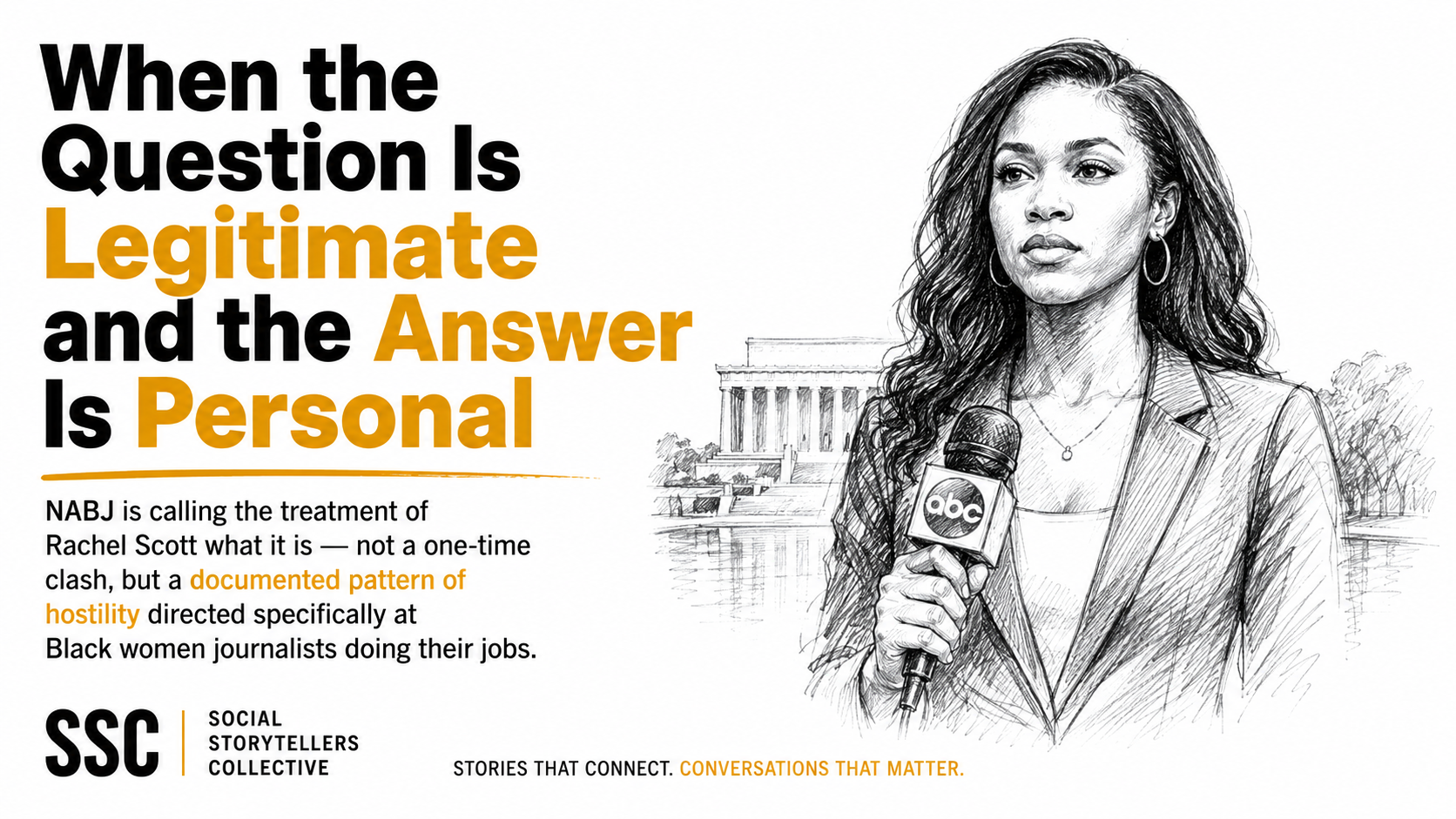
On May 7, ABC News Senior Congressional Correspondent Rachel Scott stood at the Lincoln Memorial Reflecting Pool and asked Donald Trump a straightforward question: with gas prices rising and a war in Iran underway, why focus on construction and renovation projects in Washington right now?
What followed was not a policy disagreement. It was personal.
“Such a stupid question,” Trump told her directly. “You can understand dirt, maybe better than I can, but I don’t allow it.” He then turned to a group of construction workers standing nearby. “This is one of the worst reporters. She’s with ABC fake news, and she’s a horror show.” He called the question “a disgrace to our country.” A viral clip circulating on X suggested — though it could not be confirmed by microphone — that he may have added something more after the press pool was ushered away.
Scott is 33 years old. She asked a question about war and economic pressure. The response named her personally, publicly, and in front of workers he had positioned as his audience.
The National Association of Black Journalists responded this week with a statement that placed the exchange inside a pattern that predates this administration — and that the organization says is accelerating.
Most of the coverage surrounding this exchange treated it as a political story — another clash between a combative president and a press corps he has openly declared his contempt for. That frame is accurate as far as it goes. But it stops short of the more specific and more consequential story underneath it. This is not primarily about Trump versus the media. It is about a specific subset of journalists — Black women — who face a distinct and documented version of the hostility that all reporters operating in this environment encounter. The attacks directed at Rachel Scott are not random. They follow a profile. They follow a pattern. And they have a specific effect: making the act of asking a direct question in a public setting feel like a risk that other reporters in that same room do not carry in the same way. That asymmetry is the story. NABJ is naming it. SSC is reporting it.
The pattern NABJ is naming
“The latest incident involving ABC News Senior Congressional Correspondent Rachel Scott is part of a larger and deeply troubling pattern,” NABJ wrote. “Black women journalists are too often singled out, insulted or demeaned for asking legitimate questions, reporting facts and holding power to account.”
The organization’s statement specifically identified what it called a recurring dynamic: “professionalism gets reframed as disrespect” when Black women reporters challenge public officials directly. The question becomes the problem. The reporter becomes the story. The accountability function of the press gets replaced by a personal attack that the official’s supporters can amplify and the reporter has to absorb.
NABJ President Errin Haines named the stakes plainly: “When Black women journalists are targeted, insulted or demeaned for asking legitimate questions, it is not only an attack on them personally — it is an attack on the role of a free press in our democracy.”
The documentation is not new
The organization pointed to a list of names that have become a record of this pattern in motion: April Ryan. Yamiche Alcindor. Jemele Hill. Jasmine Wright. Each one targeted. Each one made the subject of public attacks that went well beyond disagreement with their reporting.
Trump’s own record with women journalists in the current term has been consistent. He told Bloomberg’s Catherine Lucey to “quiet, piggy” aboard Air Force One. He called a female New York Times reporter “ugly, inside and out” on social media. He told ABC’s Mary Bruce she was “a terrible person and a terrible reporter.” He told CNN’s Kaitlan Collins “I don’t think I’ve ever seen you smile.” He told CBS’s Norah O’Donnell — a veteran journalist with decades of experience — that he could “get any woman off the street” and she would do as good a job.
The targets are not random. They are women. They are, with notable frequency, Black women. And the attacks are not responses to inaccurate reporting. They are responses to questions.
What this is actually about
NABJ’s statement is careful to frame this not as a political story but as a press freedom story — and that framing matters. The question of whether journalists can do their jobs without intimidation becoming normalized is not a partisan question. It is a constitutional one.
“A free press is not a privilege granted by those in power,” the organization wrote. “It is a constitutional pillar of our democracy.”
Rachel Scott asked why a president was focused on beautifying Washington during a war. That is a legitimate question. The answer she received was a public attack delivered in front of a live audience, recorded on camera, and posted to social media by the White House itself.
The question is still unanswered. That, too, is part of the pattern.