
A viral post this week reignited a long-running conversation: “Stop telling Black kids with great intellect that they act white.” The statement is direct, and the agreement it generated was immediate. But the replies underneath tell a more complicated story — one that exposes how fractured the meaning of that phrase has become, and how quickly internal dialogue can be repurposed once it leaves the community that gave it context.
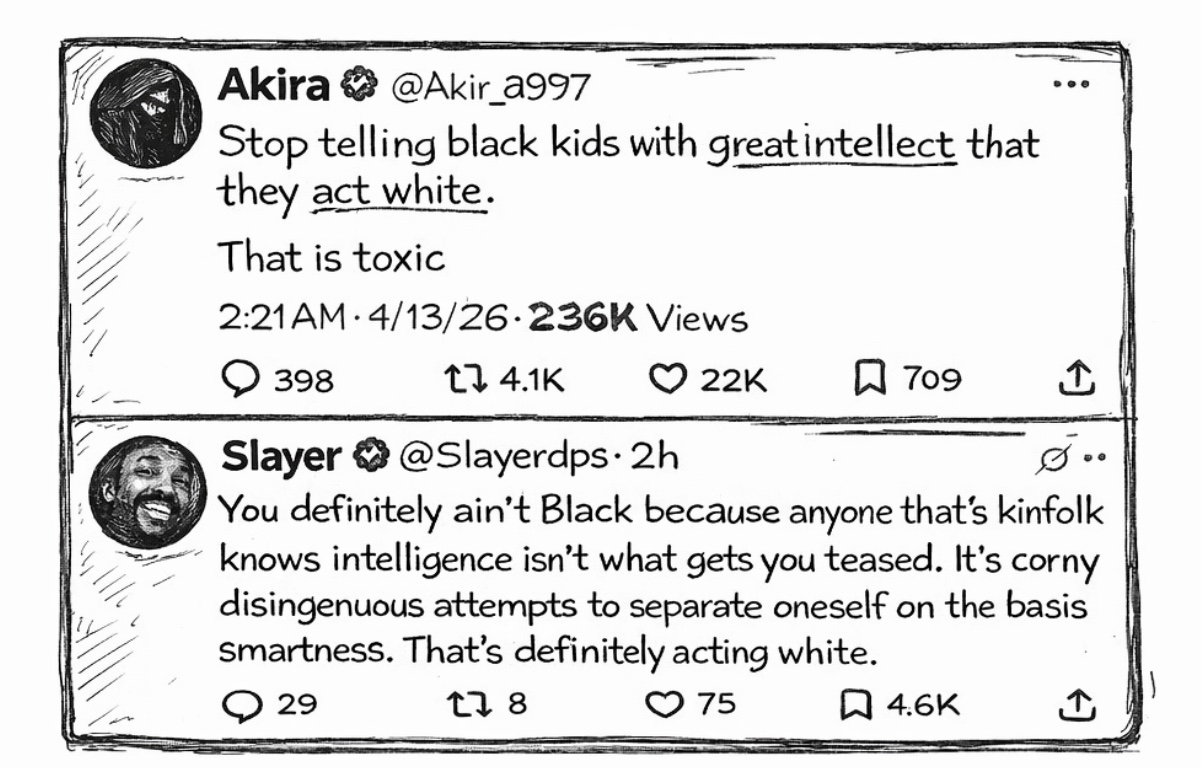
What shows up in the thread is not consensus, but collision. Some responses insist the phrase is toxic and should be abandoned entirely. Others argue it reflects a real social dynamic around belonging and identity. And then there are responses that move in a different direction altogether, using the conversation as an entry point to recycle broader anti-Black narratives about intelligence, behavior, and culture. The thread stops being about language and becomes a proxy for something else. It is a pattern SSC examined directly in Black Twitter Was Infrastructure. What Replaced It Isn’t. — the argument that when Black discourse loses a coherent, shared platform, the context that once traveled alongside content no longer arrives with it. What remains is the statement. What disappears is the frame.
The phrase itself has never been literal, and that is where much of the confusion begins. “Acting white” has historically functioned less as a description of race and more as a shorthand for deviation from group norms — often tied to environment, class signaling, or perceived distance from shared cultural experience. It is a phrase rooted in social boundary-setting, not a claim about who owns intelligence or discipline. Sociology has a longer name for what it describes: the tension between assimilation and authenticity that structural conditions force onto communities navigating predominantly white institutions. But once the phrase leaves that context and enters a broader public conversation, it flattens into something easier to misinterpret and easier to weaponize.
That flattening is visible throughout the thread. What begins as a critique of intra-community language gets reframed by outside voices as evidence of cultural deficiency or internal contradiction. The shift is subtle but consistent. A conversation about how Black communities talk to themselves becomes, in some responses, a conversation about what Blackness supposedly lacks. That transition is not accidental. It reflects how quickly internal dialogue can be absorbed into external narratives that were already waiting for an opening — and how little friction the algorithm provides between the two.
There is a generational and environmental layer that sits just beneath the surface and rarely gets named directly. People who grew up in predominantly Black environments often understand the phrase as a form of social signaling — sometimes teasing, sometimes policing, sometimes protective, sometimes all three depending on who is saying it and to whom. Those who grew up in more integrated or predominantly white spaces frequently experience it differently, as alienation or accusation. Both interpretations are grounded in real experience. Both can exist simultaneously. That is why the conversation rarely resolves cleanly — it is not actually one conversation. It is several, running on different shared histories, meeting in the same comment thread.
The Pew Research Center’s 2024 demographic portrait of Black America, analyzed in 49 Million and Still Uncounted, adds structural context that the thread implicitly circles without naming. Black degree attainment nearly doubled between 2000 and 2024 — but income gains have not kept pace, and Black Americans remain disproportionately concentrated in institutions and environments where the navigation of white-dominated spaces is not optional. The phrase “acting white” is not separate from that reality. It is one of the ways that reality gets named from inside — a linguistic marker of the cost Black students absorb when they move between worlds, and the community monitoring that sometimes follows them.
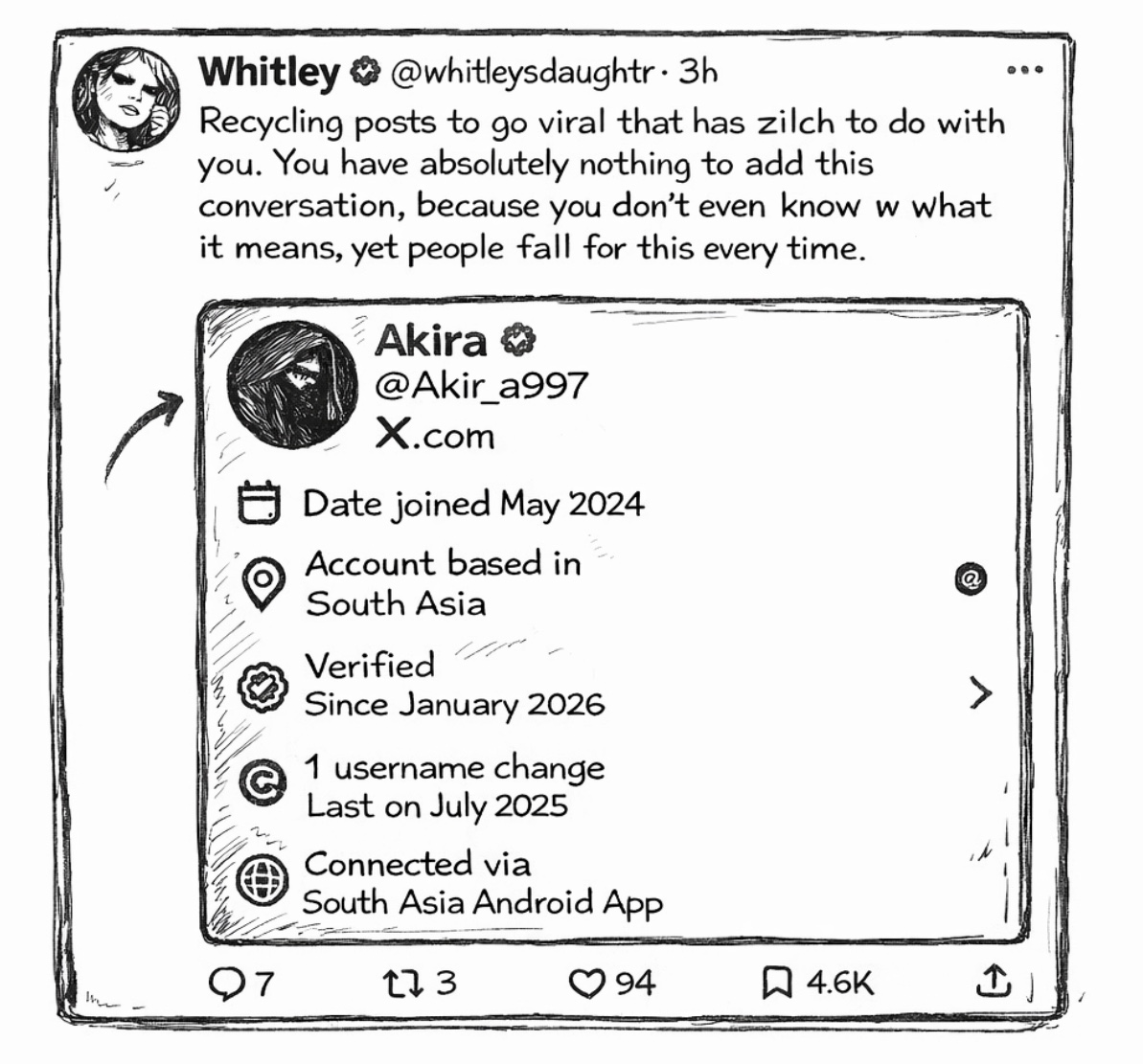
There is another layer in this exchange that complicates things further: authorship. One of the more pointed replies questions whether the original post is grounded in lived experience at all, pointing to the account’s profile and suggesting the voice driving the conversation may not be who the audience assumes. That matters more than it might seem. When a conversation rooted in intra-community language gets amplified by accounts operating outside that context, the meaning shifts at the point of origin. What begins as a specific, culturally situated critique can quickly become generalized, abstracted, or repurposed for entirely different ends. The distance between origin and amplification is where distortion most reliably enters.
This is not about gatekeeping who can speak. It is about understanding how context travels — and what gets lost when it doesn’t. Language that carries nuance within a community can read very differently once it is lifted into a broader, algorithm-driven space where audiences are not sharing the same reference points and the platform has no mechanism for preserving the difference. The same sentence, in the same thread, can function as solidarity in one reply and ammunition in another. The infrastructure does not distinguish between them.
What the replies are reacting to is not just the statement itself, but the sense that the conversation is being flattened, recirculated, and consumed without the context that gave it meaning. The frustration is less about disagreement and more about misalignment — between who is speaking, who is interpreting, and what the language was actually built to hold. That misalignment is not a bug in how these conversations travel online. It is increasingly a feature.
The more useful question is not whether the phrase should exist or disappear. It is what conditions produce it in the first place, and why those conditions continue to surface across generations in slightly different forms. The same negotiation SSC tracked at the institutional level in Morehouse, Masculinity, and the Fear of Redefinition — who gets to define what Black identity looks like inside a Black institution, and what happens when that definition is contested — operates in everyday language too. Removing the phrase without addressing the underlying dynamics does not resolve the tension. It changes how the tension is expressed.
What the thread ultimately shows is that this conversation is still happening. It is just happening in public now, with more audiences than it was ever meant to hold, and on platforms that were not built to honor the difference.