
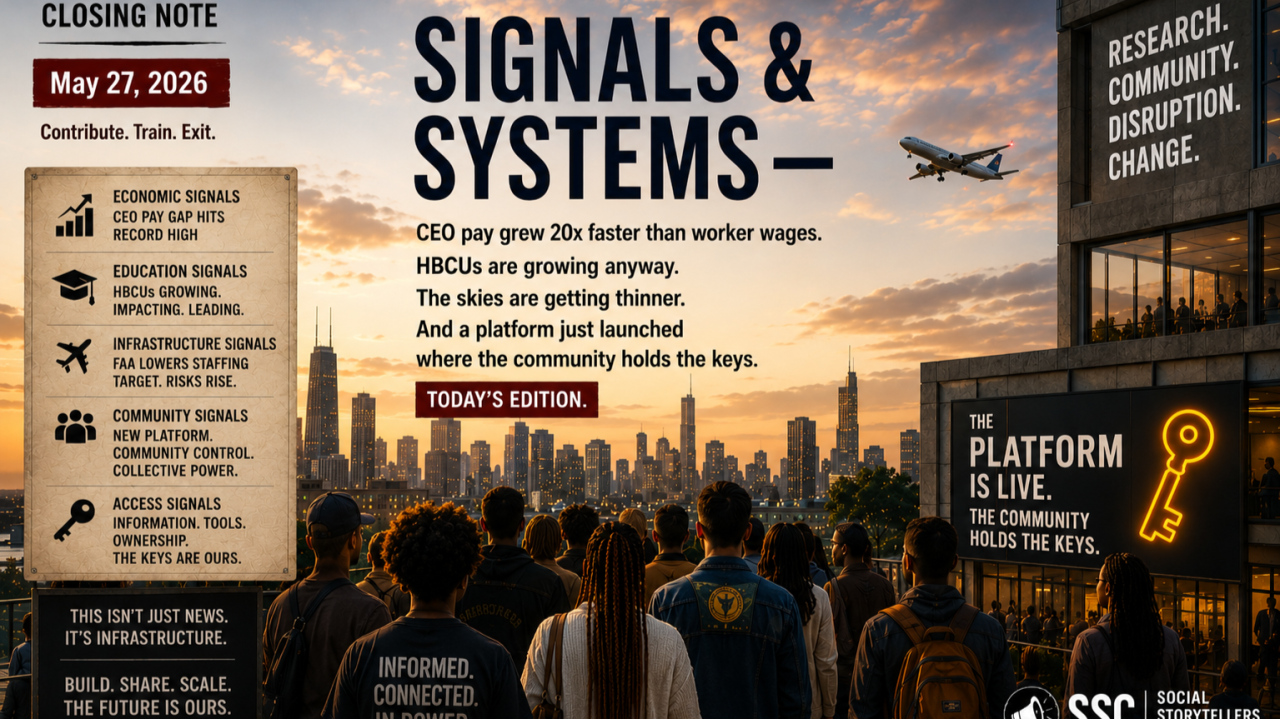
Signals & Systems – 5.27.26
We lost Clarence B. Jones yesterday. He was 95. As a speechwriter and confidante of Rev. Dr. Martin Luther King Jr., he helped pen the “I Have A Dream” speech — words that were written in the belief that the distance between what America promised and what it delivered could be closed. He lived long enough to watch that distance widen again. We honor him by continuing the work.
Last year, the top 1,500 CEOs of the world’s largest corporations received an 11% real-terms pay increase. The average global worker saw their real wages grow by 0.5%. That means CEO pay grew 20 times faster than worker pay in a single year — not over a decade, not across a generation, but in 12 months while gas prices, energy bills, and grocery costs were climbing for the same workers whose wages barely moved. Today’s edition is about that gap — who designs it, who benefits from it, and who gets told it’s inevitable.
The timing is not incidental. This is not a number from a period of economic expansion when rising tides could at least partially explain a rising executive class. This is a number from 2025 — a year defined by layoffs framed as AI transformation, workforce reductions described as efficiency, and a white-collar job market that contracted while the people managing the contraction took home significantly more. The economy did not perform equally for everyone last year. The data now confirms what most workers already suspected: it performed extraordinarily well for the people at the very top.
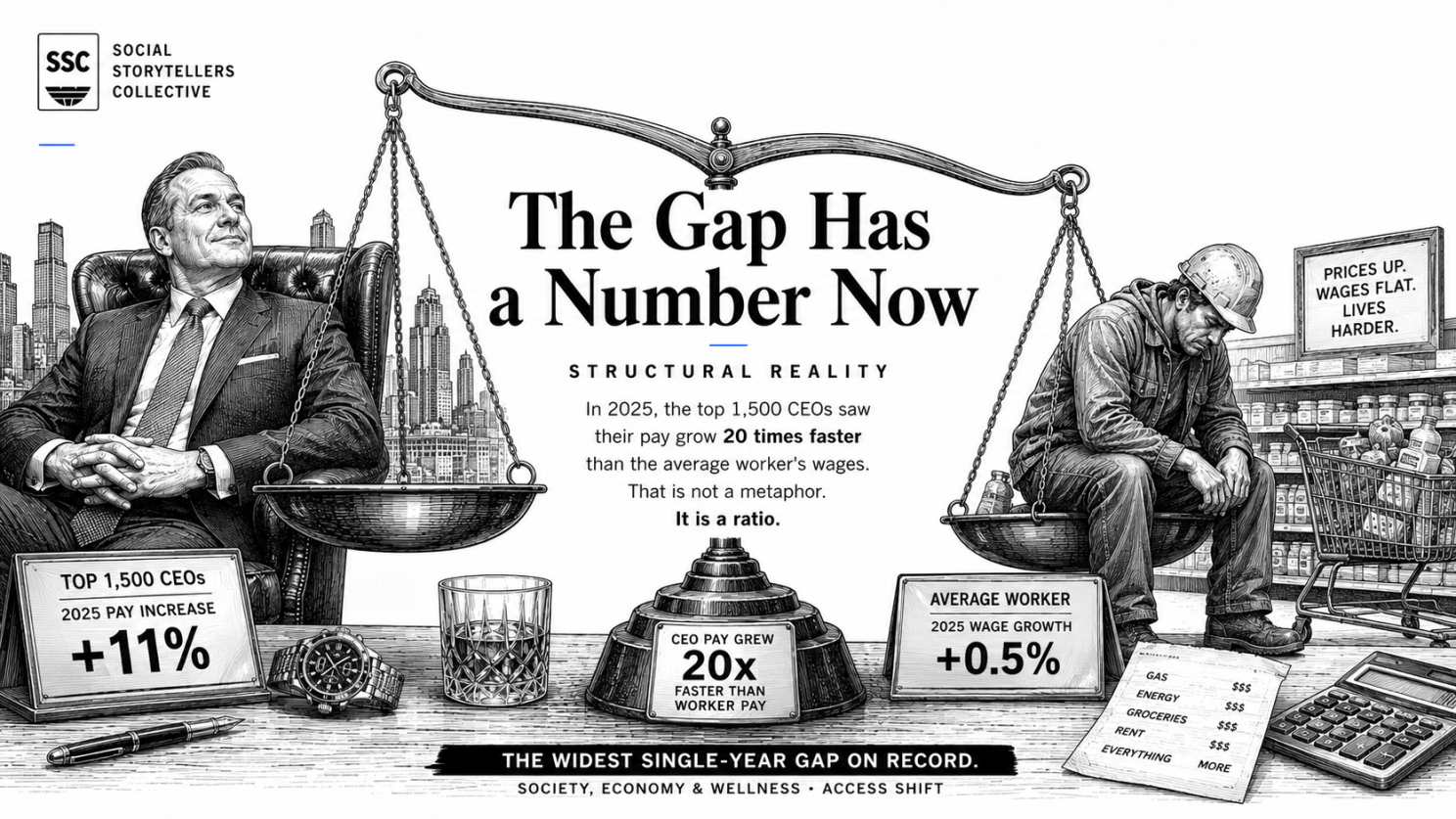
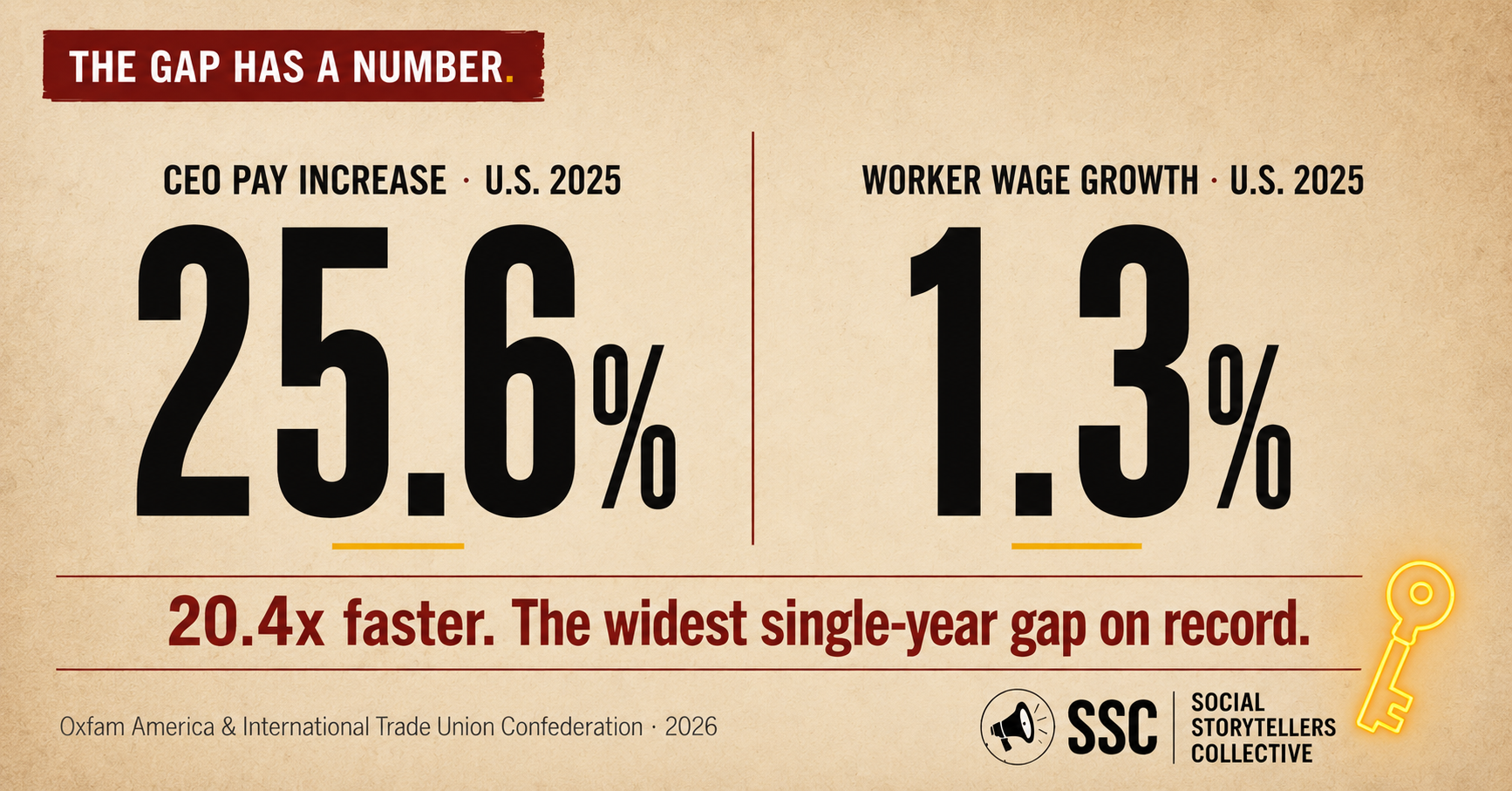
In the United States specifically, the gap is sharper. CEO pay grew 25.6% last year. Worker wages grew 1.3%. That is a 20.4x difference — the widest single-year gap on record, according to a joint analysis by Oxfam America and the International Trade Union Confederation. Patricia Stottlemyer, Policy Lead for Labor Rights at Oxfam America, was direct: you cannot talk about the affordability crisis without also talking about wealth inequality. The two are not separate conversations. They are the same one. The worker paying more for groceries and the CEO taking home 25.6%more are not living inside different economic stories. They are living inside the same one — just on different floors.
This data lands in the same week SSC has been documenting the “performance culture” vocabulary spreading across Nestlé, HSBC, 3M, Unilever, and Novo Nordisk — corporations calling for higher standards and leaner organizations while the people at the top of those same organizations took home 11% more in real terms last year. The language flowing down asks workers to do more with less. The compensation flowing up tells a different story about what the organization actually values. 85% of corporate culture transformations fail by the organizations’ own measure. The people being asked to perform better are not the ones whose compensation reflects that ask. The people whose compensation reflects it are the ones writing the memo.
This is not a trend from a decade ago. It happened in 2025, while gas prices, grocery bills, and energy costs were climbing for the same workers whose pay barely moved. Patricia Stottlemyer, Policy Lead for Labor Rights at Oxfam America, named it directly: you cannot talk about the affordability crisis without talking about extreme wealth inequality. They are not separate conversations. They are the same one — and The Gap Has a Number Now makes that impossible to ignore.
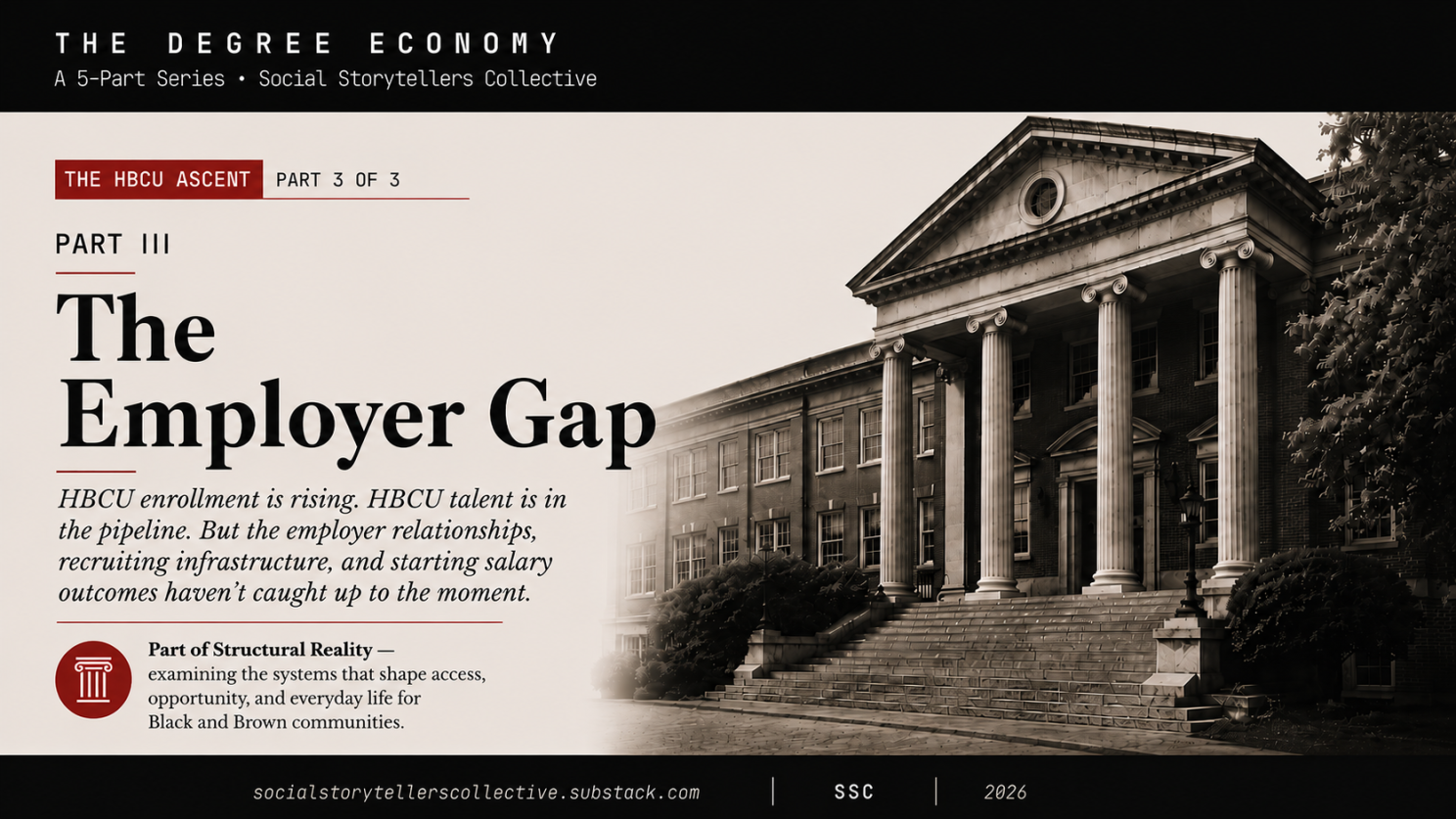
Today we close The HBCU Ascent with Part III — The Employer Gap. The enrollment numbers are real. The infrastructure investment is arriving. The students are coming in numbers that are breaking records at institution after institution. Part III asks what happens next — specifically, what happens when those students graduate and enter a labor market that has not kept pace with the momentum their schools have built. HBCU enrollment is rising. The employer relationships, recruiting pipelines, and starting salary outcomes that would translate that growth into durable economic mobility have not caught up. The schools are producing more. The market is not absorbing it proportionally. Part III examines what it would actually take to close that gap — and who has to move for it to happen.

The FAA needs 12,563 certified air traffic controllers to safely manage U.S. airspace. It has approximately 11,000. Controllers are working mandatory overtime — 10 hours a day, six days a week in some facilities — at a cost of $200 million in 2024 alone. Last week the agency released its 2026–2028 workforce plan and quietly lowered its own staffing target by more than 2,000 positions without consulting the National Air Traffic Controllers Association, which immediately challenged it. FAA Administrator Bryan Bedford told Congress in December: “The system is designed to be chronically understaffed. We’ll never catch up.” The NTSB is investigating whether controller absences at LaGuardia Airport contributed to a fatal crash in March 2026. The people most exposed when the margin disappears are not the business travelers with lounge access and flexibility to rebook. They are the price-sensitive travelers on budget carriers with the fewest alternatives. The Skies Are Getting Thinner — and Not Everyone Flies With a Safety Net traces exactly who absorbs the risk when the system gets thin.

Two juries. Two verdicts. Two days apart. When the Jury Said Meta Built a Predator’s Paradise, It Meant the Design Was the Crime makes the argument mainstream coverage keeps avoiding — this isn’t a child safety story, it’s a platform architecture story. A New Mexico jury ordered Meta to pay $375 million after finding the company misled users while enabling child exploitation. A Los Angeles jury followed the next day, finding Meta and YouTube negligent for designing apps that harmed children and teens. The jury wasn’t asked whether Meta knew bad things happened on its platforms. It was asked whether Meta designed systems that made those things more likely — and then told users the opposite. That’s a product liability argument applied to software, and it’s a more dangerous legal theory for the tech industry than anything content moderation disputes have ever produced.

We published India Just Attracted More Foreign Companies Than in Any Year Since 2017. Not Everyone Will Feel the Difference today — and the title tells you exactly where we’re going with it. Foreign company registrations hit a nine-year high in FY26, led by firms from Singapore, the U.S., and the UK, and the reason is explicit: global capital is hedging its China exposure and India is the largest, most institutionally stable alternative available. The growth numbers back it up — a $4.15 trillion nominal GDP, a services PMI of 57.5, manufacturing expanding. But a $2,813 nominal GDP per capita sitting underneath those figures is the number that anchors the piece. Capital moves to India as a country. It lands in specific cities, specific industries, and specific income brackets — and the communities historically excluded from India’s growth story by caste, geography, gender, and sector don’t automatically get included in this cycle just because the investment surge is real.
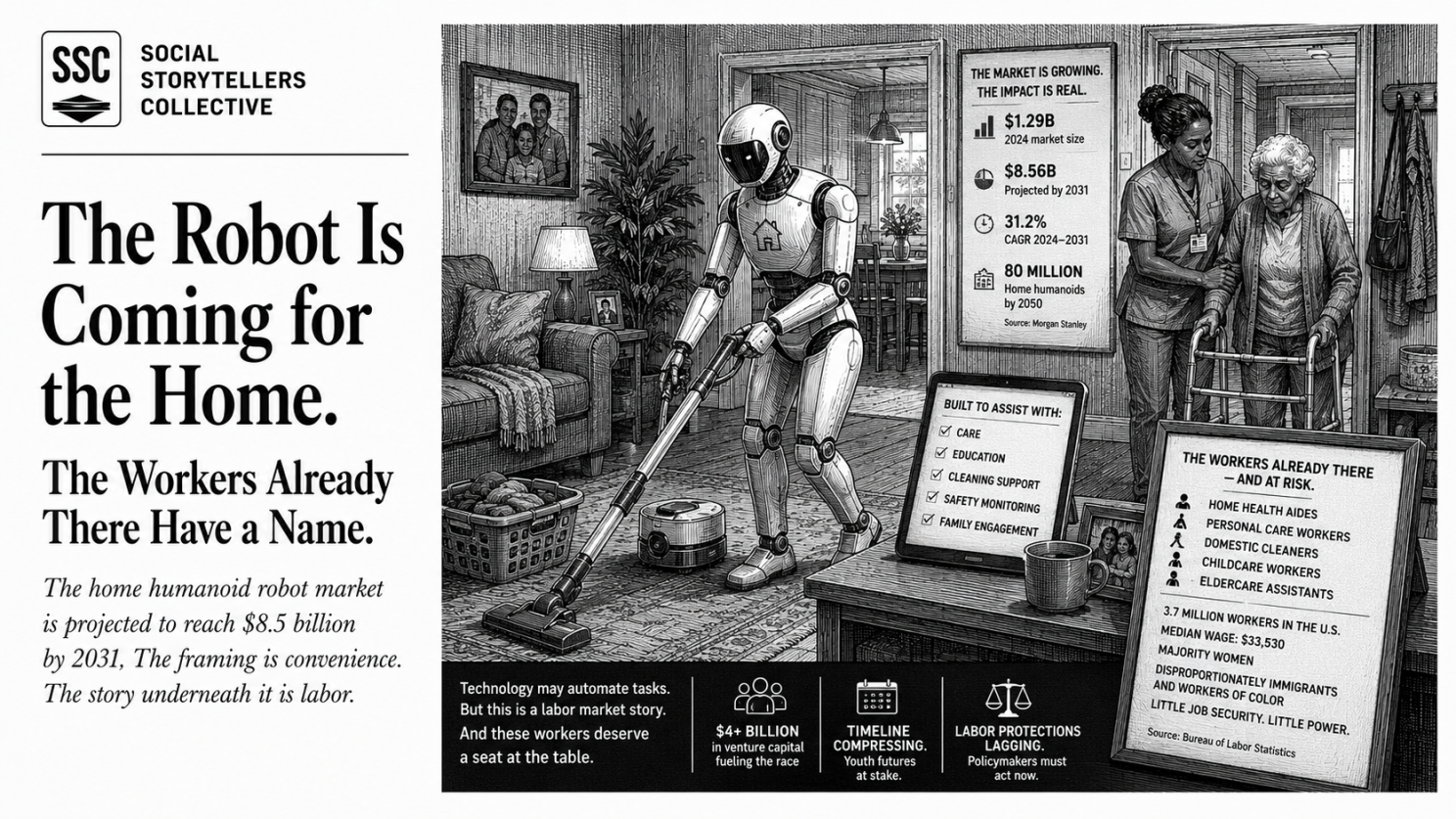
The home humanoid robot market was valued at $1.29 billion in 2024 and is projected to reach $8.56 billion by 2031. The framing across every market report is identical: robots that handle “daily routines,” “reduce repetitive domestic work,” and support “care, education, cleaning, and family engagement.” That framing is accurate. It is also incomplete. The domestic work being automated has a workforce already doing it. Home health aides. Personal care workers. Domestic cleaners. Childcare workers. Eldercare assistants. Approximately 3.7 million home health and personal care aides in the United States — majority women, disproportionately immigrants and workers of color, median wage $33,530, most with no union and no employer-provided health insurance. Their work is performed inside private homes where labor protections are weaker and organizing is harder. And it is the exact task set the $8.56 billion market is being built to replace. The Robot Is Coming for the Home. The Workers Already There Have a Name. names who absorbs the cost when the market report becomes a workforce reality.
A new study released by the Julian Bond Institute for Financial Equity Research — titled Ambition Without Access — found that 67% of Black Gen Z aspire to own a business, compared to 34% of white Gen Z. 77% of Black Gen Z and 70% of Hispanic Gen Z aspire to build an inheritance to pass on, even though only 18–20% expect to receive one themselves. The aspiration is not the gap. The access is. Candice Wang, Senior Researcher at the Center for Responsible Lending, named the mechanism: young Black and Hispanic Americans are more likely to have grown up in households where alternative financial services were the norm, while their white peers are more likely to have parents who owned homes and set up savings accounts for them in childhood. The inheritance gap is not just about money. It is about the financial infrastructure — the accounts, the credit history, the homeownership equity — that gets built in childhood and compounds across a lifetime. The Ambition Was Never the Problem examines what the data actually shows about who wants to build — and what keeps getting in the way.

Sway Calloway and DJ King Tech spent decades building hip-hop’s media infrastructure — The Wake Up Show on KMEL San Francisco, Sway in the Morning on SiriusXM, thousands of interviews and freestyles that documented the culture from the inside. The content was theirs. The platform never was. SKT Network — launched in April 2026 — changes that. More than 200 hours of content, a free ad-supported streaming channel, a mobile app, and an archive that now lives on something Sway and King Tech control. The ad revenue, the audience relationship, the brand partnerships — all of it flows through a platform they own.
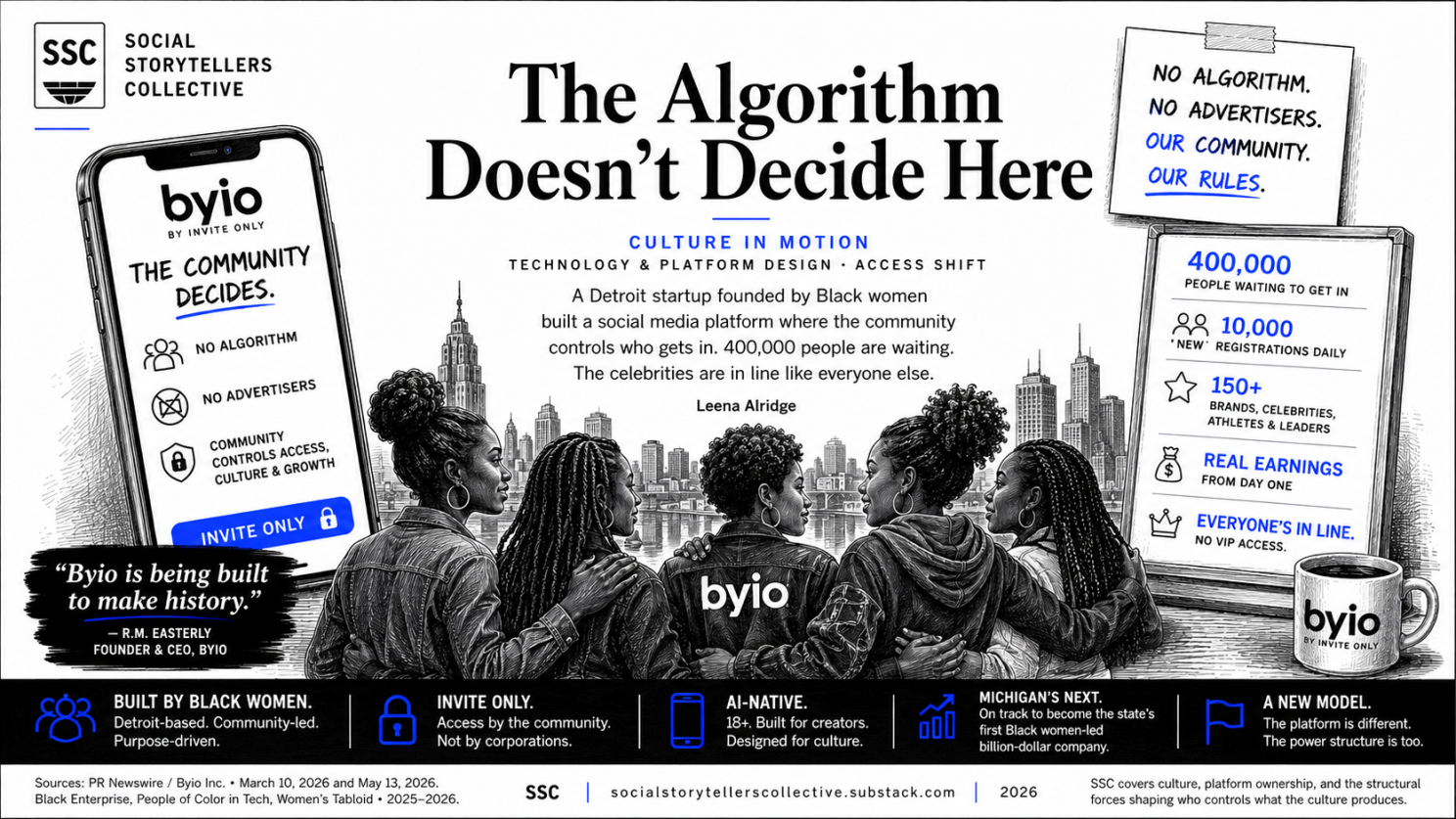
A Detroit startup is making the same argument in a different register. Byio — By Invite Only — launched its closed beta in early 2026 with 50,000 registrations. By May 13, 400,000 people were waiting to get in, with 10,000 new registrations arriving daily. The platform, founded and led by Black women, inverts every major social media platform’s governance model: the community decides who gets in, who stays, and what the culture looks like. No algorithm. No advertiser. No corporation making moderation decisions behind closed doors. R.M. Easterly, Founder and CEO, said it plainly: “Byio is being built to make history — the first platform of its kind created by Black women who have endured the same discrimination and silencing that millions of creators face on social media.” The Algorithm Doesn’t Decide Hereexamines what that governance model actually means — and why 400,000 people are already in line to find out.
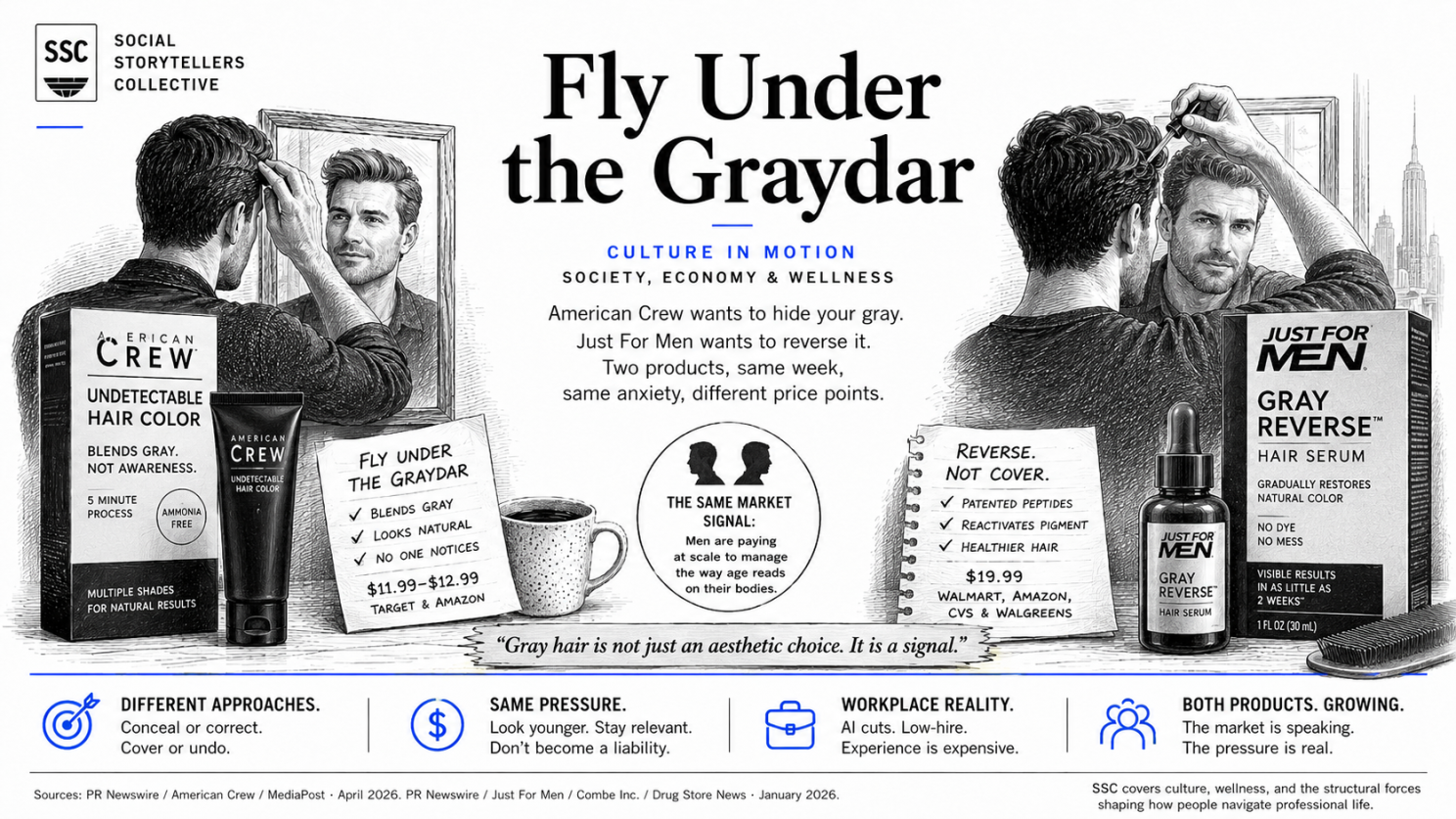
There is a reason two grooming companies launched products this year specifically designed to help men manage the way age reads on their bodies — and it is not vanity. A Just For Men survey of 2,000 men found 68% care more about their appearance than five years ago, gray hair ranked as the third top aging concern, and the average man finds his first gray at 29. That is not a beauty trend. That is a workforce anxiety signal. The same labor market running on “performance culture” vocabulary — where mid-career workers are the most expensive line on the org chart and AI is being used to justify cutting them — has made looking older feel like a professional liability. American Crew’s Undetectable Hair Color blends gray in five minutes at $12.99. Just For Men’s Gray Reverse™ uses patented peptide technology to gradually reverse gray rather than cover it at $19.99. Two products, two price points, the same pressure. In Men Are Paying to Look Younger. The Labor Market Is Why., SSC names what both campaigns are actually responding to — and why the products are under $20 but the problem costs considerably more.
Testicular cancer is the most common cancer in men between the ages of 15 and 44 — and when caught at stage one, it is 99% beatable. Every hour, a man in the United States is diagnosed. Most young men in that age range have never been told how to check. The Testicular Cancer Foundation launched If These Balls Could Talk in February 2026 — a book and awareness campaign with a title designed to stop a young man mid-scroll and make him curious enough to keep reading. By April’s Testicular Cancer Awareness Month, the campaign had reached 71 million people through nearly 500 media pickups with no paid media. More than 1,500 shower cards teaching self-examination have been distributed. Over 52,000 people visited the foundation’s site from more than 20 countries — and nearly 12,000 translation requests were processed so someone in Spain, Germany, or Turkey could access the same information as someone in Texas. 99% Beatable. Most Young Men Don’t Know That. covers why someone had to name a campaign something uncomfortable to reach the people who most needed to hear it.

Death Row Records Cannabis is now in Las Vegas — available at four dispensaries with a product lineup that includes vape cartridges in six flavor profiles, infused gummies, and “Sugar Cone” infused pre-rolls. The Nevada market welcomed more than 38 million visitors last year. Las Vegas dispensaries rank among the highest-performing cannabis retail locations globally. The brand selection is not sentimental. The cannabis industry has a well-documented history of generating wealth from Black cultural identity while distributing that wealth elsewhere. Death Row Records Cannabis is a direct answer to that history — an owned brand built on cultural IP that Snoop Dogg acquired and controls, entering the highest-volume cannabis market in the country with products designed for the consumer who already knows the name. Death Row Just Landed in Las Vegas. The Timing Is Not Coincidental. names the ownership argument underneath the product launch.

We end today on a culture story that arrived this morning and deserved more than a quick take. Vibe Is Coming Back to Print. That’s Not Nostalgia — It’s an Ownership Argument. looks at what it actually means that Vibe — the Quincy Jones-founded magazine that was moving 858,469 copies a month at its peak before going digital-only in 2014 — is returning to newsstands June 2 with a first run of just 1,000 copies. Most coverage is treating it as a collectible moment. The piece argues it’s a curatorial argument — that a quarterly, deliberately limited print edition in 2026 is a structural counter to algorithmic platforms that flatten Black culture into engagement metrics and an advertising market that has historically undervalued Black audiences despite their influence. Vibe isn’t coming back for nostalgia. It’s coming back to make a claim.
The thread running through today’s coverage is not pessimism. It is precision. The CEO pay gap is real and documented — and so is the HBCU enrollment surge happening inside the same economy that produced it. The skies are getting thinner — and so is the distance between the people who built the culture and the platform they now own. Letouer Turner spent 15 months in Iraq as a gunner in the U.S. Army. He came home rated 100% service-connected disabled. He bought a five-bedroom home in Chicago Heights so his children would always have a place to return to. He qualified for a Disabled Veterans Exemption that can reduce his property tax bill to zero. None of that stopped the foreclosure notice. Cook County wrongly charged him taxes he should never have owed. The refund came too late. Court records show him owing more than $243,000. His next court date is June 17. An Australian influencer named Samuel Weidenhofer met him, launched a GoFundMe, and the story spread. Black Enterprise Magazine made sure it kept moving. “I know I’m not the only veteran going through this,” Turner said. He is right. And the people around him are trying to make sure the system does not get the last word.
The Follow Up
A recurring section tracking the discourse our reporting generates — pushback from industry insiders, perspectives from the SSC LinkedIn community, and framing worth revisiting as the conversation develops.
Earlier this week we published Blue Dot Fever Is Exposing the Real Concert Economy — and the industry pushed back. Randy Nichols , a strategic advisor and artist manager with decades of live entertainment experience, challenged the Blue Dot Fever framing directly, arguing that the narrative didn’t originate with fans. It spread from scalper Twitter — amplified by secondary market operators whose arbitrage is under serious pressure as artists reclaim control of their inventory. His evidence was structural. StubHub went public in September 2025 at $23.50 a share and was trading around $8.70 by March 2026 — a decline of more than 60% in six months. Vivid Seats has lost roughly 88% of its value from its 52-week high. These aren’t companies struggling in a struggling industry. They are companies whose core business model is getting squeezed — and some of the loudest voices pushing the crisis narrative have a direct financial interest in keeping artists from controlling their own tickets.
We updated the piece to include his analysis. We stand by the core argument — Post Malone pulling a third of a stadium run off an aging album cycle, Chance the Rapper retreating to a Coloring Book anniversary tour after new work couldn’t sustain his previous venue size, and a $144 average ticket price in 2026 versus $82 in 2020 are all real and documented. But the scalper pressure angle was missing from our original analysis and it changes the framing in meaningful ways. That’s the kind of pushback worth publishing. Read Randy‘s full piece — Blue Dot Fever & the Scalper Narrative: Don’t Fall For It — alongside ours and decide where the evidence takes you.
The Daily Visual Signal
A visual interpretation of the deeper systems, tensions, and structural shifts shaping the current moment — designed to translate complex societal changes into a single image.
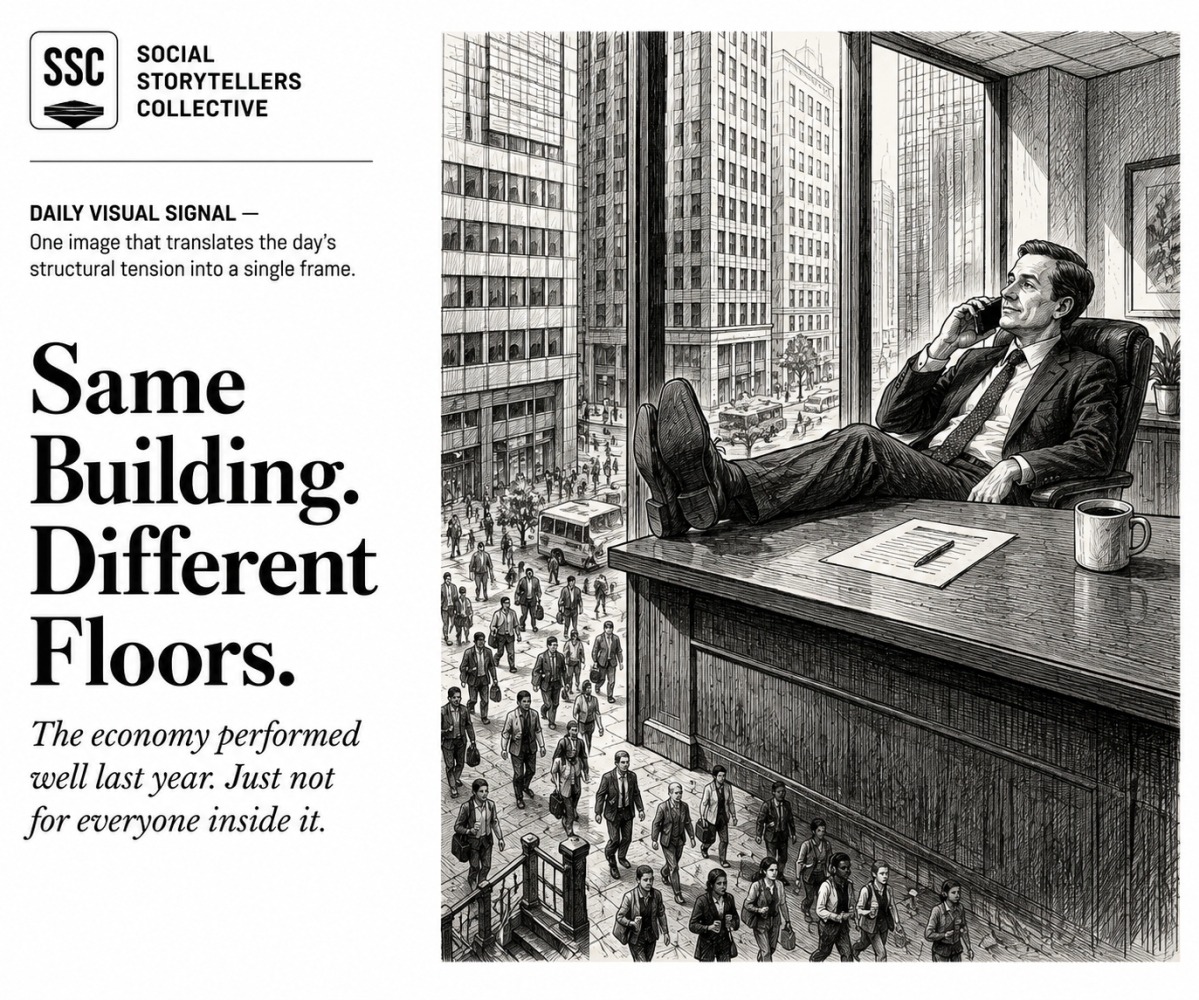
A corner office. Floor-to-ceiling windows, city skyline behind. A single figure at the desk — suit, relaxed, phone to ear. The desk is wide and clear. One document. One coffee. One chair. Below the building, visible through the window, street level: a crowd moving — workers, bags, transit passes, the ordinary machinery of getting through a day. The figure in the office is not looking down. The crowd below is not looking up. Same building. Same economy. Different floors.
Featured Story: He Did Everything Right. The System Still Came for His Home.

Letouer Turner is not a category in a policy report. He is a father, a veteran, a homeowner, a man who did what the system asked and found the system had not done the same. Black Enterprise brought his story to our attention and we want to make sure it keeps moving. Turner is back in court on June 17. If you want to support him, the GoFundMe launched by Samuel Weidenhofer is active. Read the full story in He Did Everything Right. The System Still Came for His Home.
We will be back Thursday with more.
— SSC
All of today’s coverage lives at socialstorytellers.substack.com. The full archive, beat navigation, and every linked piece are best experienced on a computer. If you have been reading and have not yet subscribed, we would be glad to have you with us.