
A now-deleted post from Donald Trump has opened a fault line that sits at the intersection of politics, religion, and image-making. The post featured an AI-generated depiction of Trump styled in explicitly Christ-like imagery — draped in white and red, placing a glowing hand on a sick figure while onlookers watched in reverence. Within hours, the image spread widely. By the next day, it was gone.
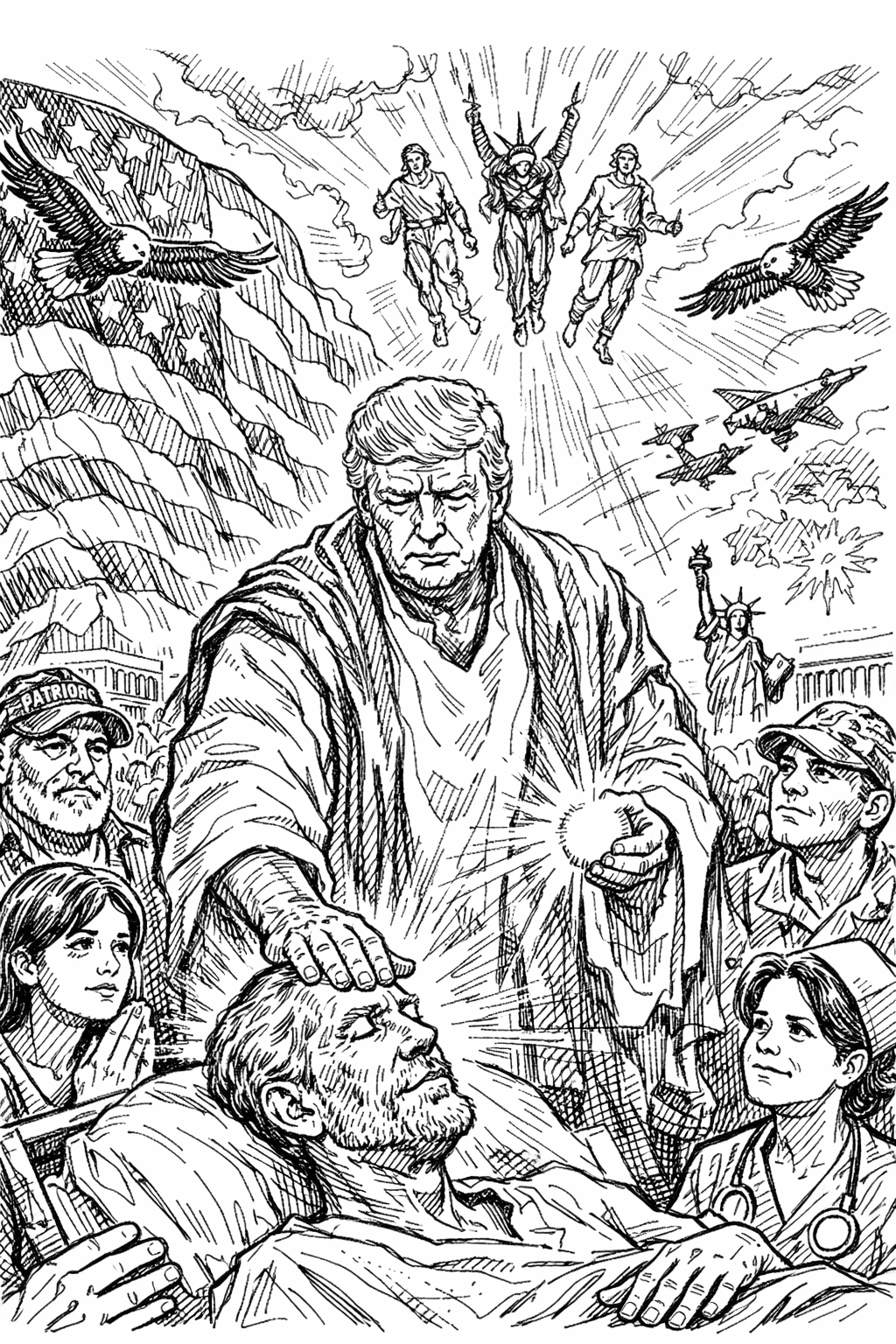
What followed is what makes the moment worth examining. The backlash did not originate from political opponents. It came from within his own base. Conservative commentators, religious figures, and right-leaning influencers publicly criticized the image as blasphemous, arguing that invoking the imagery of Jesus Christ crossed a line that political branding should not approach. Figures aligned with Trump’s broader coalition questioned both the intent and the judgment, with some framing the post as spiritually inappropriate regardless of whether it was meant symbolically or provocatively. That the criticism came from inside the coalition — not from the press, not from Democrats — is the detail that changes the nature of the story.
This is where the moment shifts from controversy to signal.
For years, religious language and symbolism have been embedded into American political messaging — often subtly, sometimes overtly. References to faith, divine purpose, and moral alignment have long been part of how leaders connect with certain constituencies, particularly within evangelical and broadly Christian conservative communities. But this instance pushed beyond language into visual equivalence. It did not suggest alignment with Christian values. It did not invoke faith as a governing principle. It placed a political figure inside a sacred narrative and asked the viewer to hold both images at once — the president and the Christ — without friction.
That distinction matters. Language can imply. Imagery asserts.
The history here is not short. Political figures have borrowed religious framing for as long as elections have required coalition-building. What has shifted is the technology enabling the production and the speed of the distribution. AI-generated imagery removes the friction that traditional production would require — the creative brief, the approval process, the deliberate signoff. A visual that once would have required weeks of coordination can now be created, posted, and circulated globally within the same news cycle. That compression changes not just how far imagery can be pushed, but how little time exists between the push and the reaction.
And the reaction, in this case, was immediate and pointed. The speed of the internal backlash suggests there are still limits within that alignment — limits that are usually managed more carefully and quietly. What the post exposed is a tension that political communication typically papers over: the difference between invoking faith and appearing to appropriate it. Supporters who accept, even celebrate, the fusion of Trump’s political identity with Christian nationalism still drew a distinction when the visual moved from metaphor to equivalence. The imagery did not read as inspiration. It read as substitution.
That is a meaningful line. And the fact that it came from allies, not opponents, tells us something about where the coalition’s self-understanding still holds.
There is a second register worth naming. AI-generated imagery is increasingly available to political operations at every level — not as a novelty, but as infrastructure. The question this post raises is not whether such imagery will continue to be produced. It will. The question is whether the speed and ease of production outpaces the judgment required to assess how it will be received. In an environment where spectacle is frequently rewarded and outrage is a form of engagement, the temptation to push further is structural, not incidental.
What the response to this particular image clarifies is that even audiences primed for provocation have thresholds. Especially when the symbol being borrowed is not political but devotional — held not as ideology but as identity. That is a different kind of line to cross. Political opponents can absorb the image as confirmation of what they already believe. But when the faithful see their central sacred figure repurposed as campaign branding, the response is not outrage. It is injury.
The image is gone. The boundary it tested is not. And the technology that generated it will only get faster.