
At an Oval Office event, Donald Trump announced plans to coat the Lincoln Memorial Reflecting Pool in what he described as an “American flag blue” hue — a $1.5 to $2 million project he says will be completed in weeks. The framing is straightforward: the pool is “filthy,” “dirty,” and no longer representative of the country. The solution, as presented, is equally direct — clean it, coat it, and restore its image. But the speed, the language, and the choice of intervention suggest something more than routine maintenance. This is not just about repair. It is about redefinition.

The Reflecting Pool is not an ordinary piece of infrastructure. It is a symbolic site embedded in the country’s civic memory — the backdrop of historic gatherings, including Martin Luther King Jr.’s “I Have a Dream” speech. Its meaning is tied not just to its physical condition, but to what it represents. When a space like that is altered, the change operates on two levels at once: physical and symbolic. Cleaning a monument restores it. Recoloring it reframes it.
The Reflecting Pool’s significance is not just architectural; it is historical — the site of moments like Martin Luther King Jr.’s 1963 “I Have a Dream” speech. That history cannot be removed. It is fixed in record, protected by federal preservation law, and embedded in the national narrative. But meaning is not only preserved through facts. It is shaped through experience. Altering the visual and symbolic environment of the space introduces a new layer of interpretation, one that can subtly shift what is foregrounded and what recedes. The question is not whether the legacy changes, but whether the conditions under which it is encountered do — and how that, over time, influences what the site comes to represent.
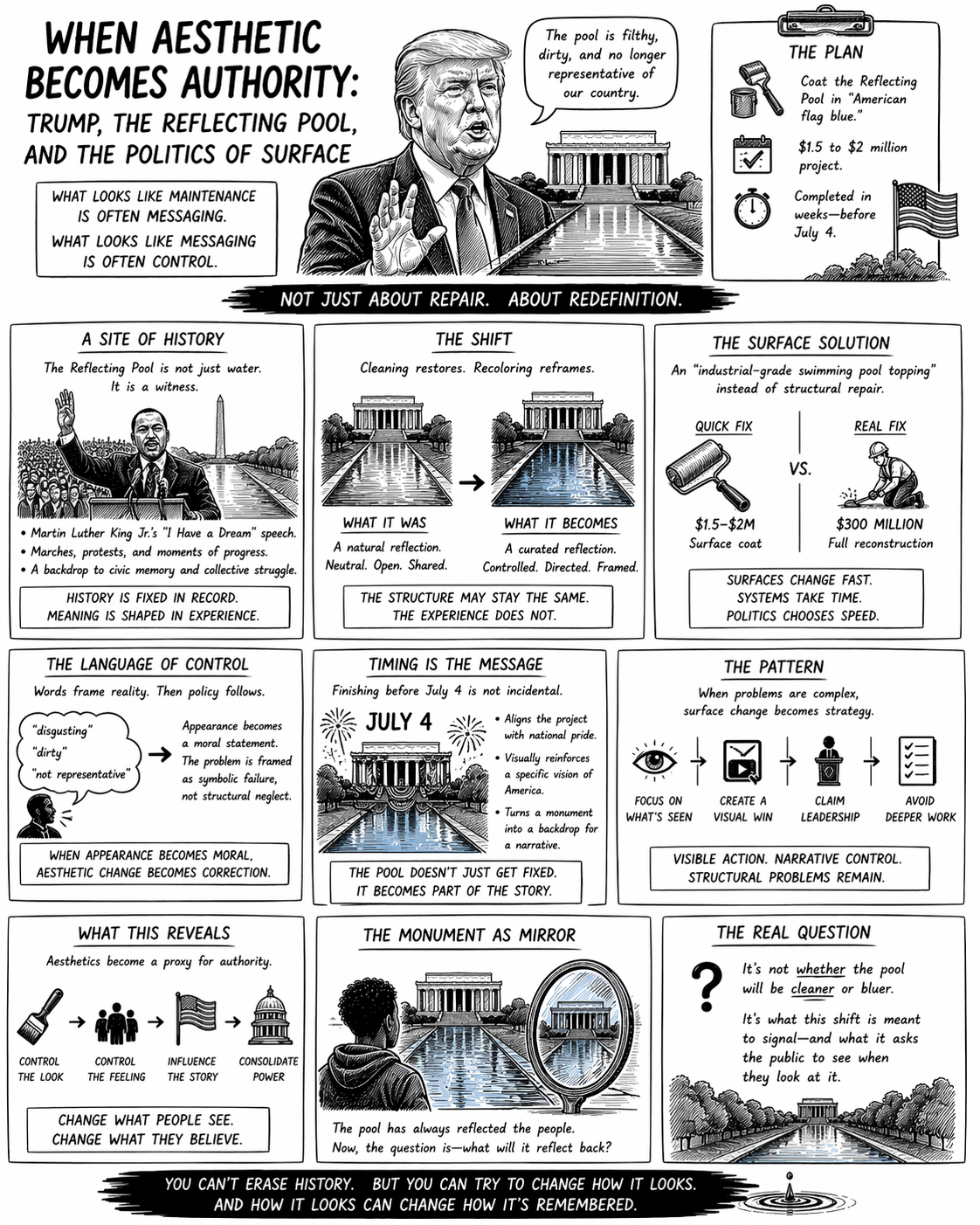
That distinction is where the story shifts. The decision to apply an “industrial-grade swimming pool topping” introduces a layer that is not historically inherent to the structure. It is an overlay — a surface-level transformation that changes how the space is experienced without fundamentally altering its underlying form. In isolation, that might read as efficiency: a faster, cheaper alternative to a $300 million reconstruction. But in context, it reflects a broader pattern in how authority is expressed — through visible, immediate change rather than long-term structural investment.w
There is also a temporal signal embedded in the timeline. The project is expected to be completed before July 4, aligning the transformation with a national milestone. That timing is not incidental. It positions the renovation as part of a broader narrative about national identity, one that is being visually reinforced through color, cleanliness, and presentation. The pool does not just become “fixed.” It becomes legible within a specific interpretation of what the country should look like.
This approach mirrors a wider governing logic: when systems are complex and slow-moving, surface interventions offer a way to demonstrate action quickly. They are visible, measurable, and easily communicated. But they also shift attention. Instead of asking whether the underlying infrastructure — leaks, structural integrity, long-term sustainability — has been addressed, the focus moves to what can be immediately seen. The question becomes not whether the system works, but whether it looks like it does.
The language used to justify the project reinforces that shift. Describing the pool as “disgusting” and “not representative” reframes a maintenance issue as a symbolic failure. It suggests that appearance is not just aesthetic, but moral — that the state of the surface reflects the state of the nation. Once that framing is established, the intervention becomes more than practical. It becomes corrective, even if the correction is primarily visual.
What emerges is a familiar pattern: the use of aesthetics as a proxy for authority. By altering how a space looks, leadership signals that it has altered what the space means. The change is immediate and legible, even if its depth is limited. And because the transformation is visible, it becomes a form of communication — one that does not require policy explanation or structural reform to be understood.
The Reflecting Pool has always functioned as a mirror, both literally and symbolically. What this moment reveals is how that mirror can be adjusted — not by changing what it reflects, but by changing how the reflection appears. The question is not whether the pool will be cleaner or bluer. It is what that shift is intended to signal, and what it asks the public to see when they look at it.