
NATIONAL | BOSTON | NEWS BRIEF
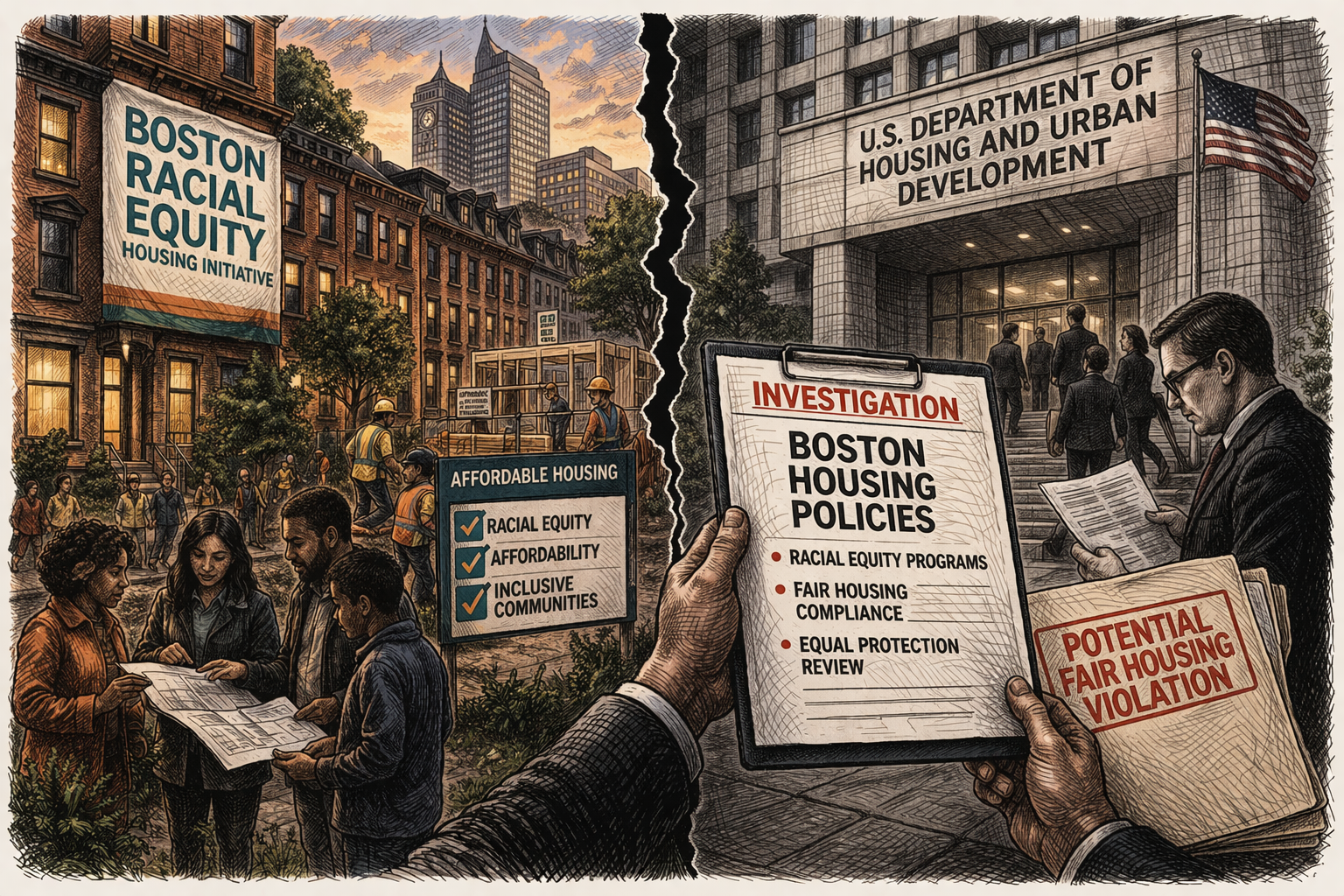
The U.S. Department of Housing and Urban Development has opened an investigation into Boston’s housing policies, arguing that the city’s racial equity initiatives may violate federal fair housing law. Under Mayor Michelle Wu, Boston embedded equity requirements into housing development to address long-standing racial disparities in access, affordability, and neighborhood stability. Federal officials are now framing those policies as discriminatory toward white residents.
The investigation centers on whether Boston’s approach constitutes unequal treatment under existing fair housing statutes — the same framework originally designed to combat segregation and discrimination. That framework is now being used to scrutinize policies explicitly intended to correct those disparities.
The underlying data provides context for why those policies exist. Black and Latino households in Boston earn roughly 50 to 60 percent of the city’s median income of $88,000 — a gap that reflects structural differences in income, housing access, and long-term wealth accumulation that Boston’s equity measures were designed to address. The Trump administration has characterized that approach as a “social engineering project,” positioning the investigation as part of a broader ideological challenge to race-conscious policymaking nationwide.
This is not about whether disparities exist. It is about whether governments are permitted to address them directly. In Digital Redlining, the focus was on how systems replicate inequality even when they appear neutral. In New York, the tension has been about where affordable housing is actually placed and which communities absorb the burden of that placement. Boston is now facing federal pressure for trying to intervene in that distribution explicitly.
The mechanism is what makes this moment significant. Civil rights law is not being rolled back. It is being reinterpreted. The tools designed to expand access are being used to challenge policies that attempt to do exactly that. The language of civil rights remains intact. The application has been inverted.
Boston’s policies are still in place. The investigation will take time. But the signal is already clear: embedding racial equity into housing policy now invites federal scrutiny — not in spite of civil rights law, but through it.