
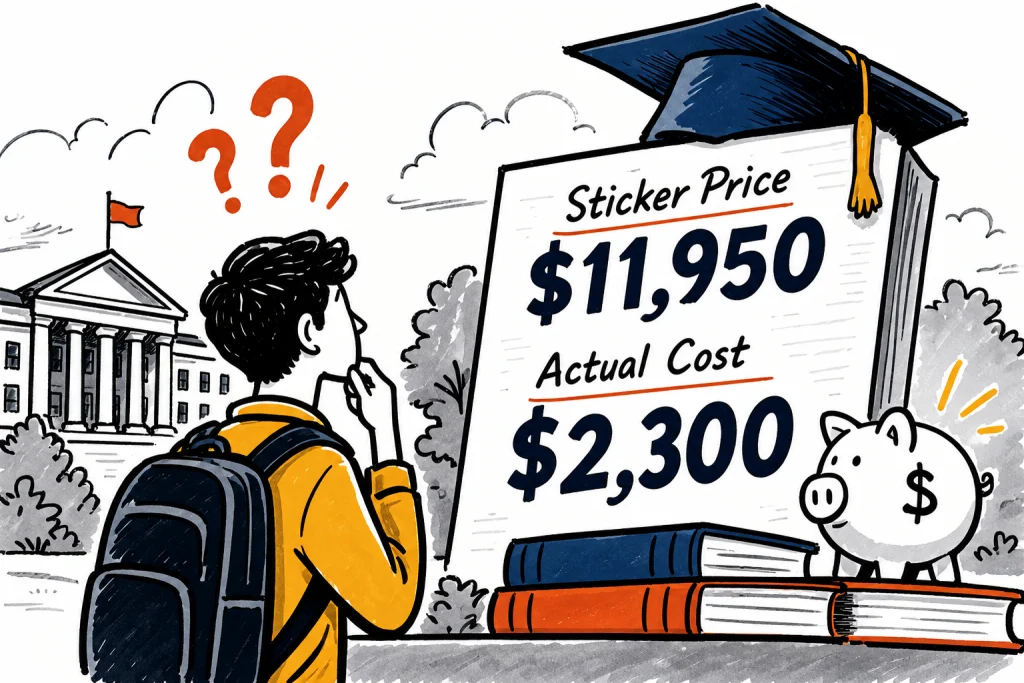
The average published tuition and fees at a public four-year university reached $11,950 for in-state students in 2025–26, according to the College Board. Yet its estimate of what first-time, full-time students in that sector actually pay for tuition and fees after grant aid is much lower: $2,300. Both figures are useful, and neither tells the whole story. The first is the advertised price; the second is an estimated average after grants, not a guaranteed offer to any individual family. The gap helps explain why college affordability has become as much an information problem as a financing problem. Students may reject a school based on its sticker price before learning whether its actual cost would be manageable.
The College Board’s 2025 Trends in College Pricing report puts the price differences in perspective. Average published tuition and fees were $4,150 at public two-year institutions for in-district students, $31,880 at public four-year institutions for out-of-state students and $45,000 at private nonprofit four-year colleges. These are national averages, with significant variation across states and institutions. At public four-year colleges, average in-state published tuition and fees ranged from $6,360 in Florida to $18,090 in Vermont. A family comparing colleges using one headline number could miss both the geographic differences and the grant aid that may change the actual bill.
The net-price story is more complicated than a reassuring discount. The College Board estimates average net tuition and fees for first-time, full-time in-state public four-year students at $2,300 in 2025–26, down from an inflation-adjusted peak of $4,450 in 2012–13. But students must also pay for housing, food, books, transportation and personal expenses. The report estimates a $21,340 average net cost of attendance for that group after grants, including an estimated $16,200 for tuition, fees, housing and food. That is why a lower net tuition figure does not necessarily mean a student can attend without borrowing, working substantial hours or relying on family support.
To address the information gap, the College Board announced in May that it had added MyinTuition to its college-planning resources. The platform was already used by 69 colleges and universities and generated about 800,000 personalized estimates each year, according to the organization. One tool offers a high-level price range using family income and the number of siblings in college; another asks six questions to produce a more personalized estimate. The College Board says the aim is to help families explore affordability earlier. Those usage figures demonstrate reach, not whether estimates are accurate for every household or whether the tool changes enrollment outcomes.
The stakes of early price information are not evenly distributed. Families with access to experienced college counselors or relatives familiar with financial aid may know to look beyond published tuition, while others may take the advertised figure at face value. The College Board’s report also notes that, between 1994 and 2024, average income rose 58% for families in the highest income quintile and 33% for those in the lowest, after inflation. That trend does not establish which students misunderstand college prices, but it underscores why the same sticker price can represent very different financial risks. Access depends on both what institutions charge and how clearly students can understand what they are likely to owe.
Net-price estimates have limitations that a responsible college comparison must make visible. Grants can depend on income, academic status, enrollment intensity and institutional policies; housing and transportation expenses can vary widely even among students at the same school. Prospective students should compare institution-specific net-price estimates, expected living expenses, grant eligibility and borrowing terms rather than relying solely on the tuition published on an admissions page. For institutions, the challenge is not simply to display an estimate but to explain the assumptions behind it and make it available before students narrow their options.
The emerging policy question is whether price transparency can meaningfully widen access without changing the underlying cost of attendance. Better information can prevent some families from prematurely ruling out affordable options, but it cannot pay a housing deposit, replace lost wages or close an aid gap. The College Board’s data show why both halves of the equation deserve attention: published tuition is not the same as net tuition, and net tuition is not the same as the full cost of earning a degree. SSC’s analysis is that the strongest affordability reforms will be judged not by how low a headline price appears, but by whether students can see—and realistically cover—the complete cost before committing.