
Part of The Access Shift — an ongoing series examining how access is being quietly reshaped across American life.
There was never a formal agreement that we would all become permanently reachable. No meeting where society decided that texts should be answered within minutes, emails within hours, and missed calls explained shortly after. And yet that expectation settled into daily life with the weight of something official — not legislated, not negotiated, just normalized, the way most of the most consequential social contracts are. Smartphones did not just make communication easier. They standardized access. And over time, being reachable stopped feeling like a convenience and started functioning like a requirement. Not answering became a statement. Silence became something that needed explaining.
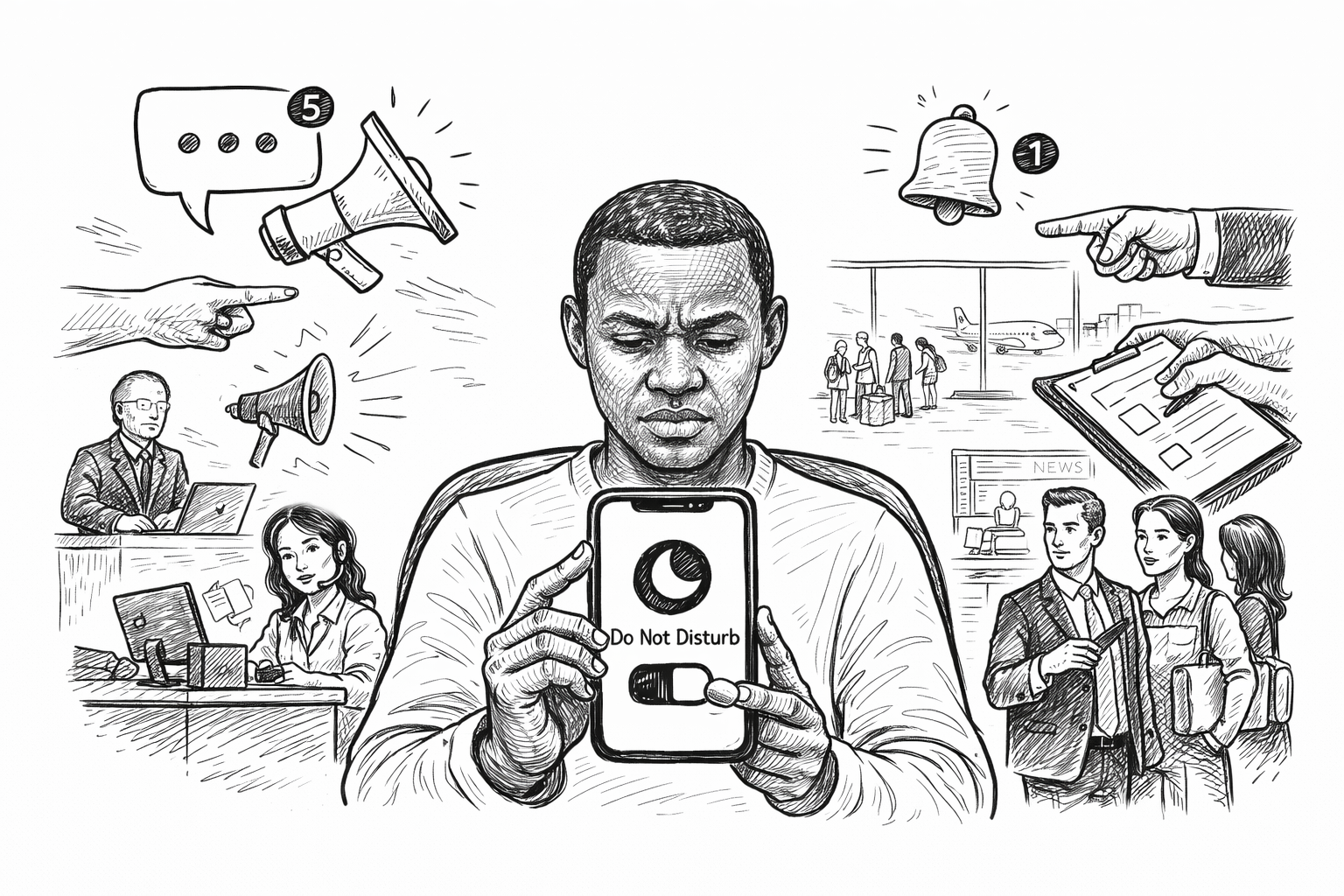
Now that expectation is beginning to fracture. Not through declarations or digital detox manifestos, but through something far quieter. A setting. Do Not Disturb mode allows messages, alerts, and notifications to arrive without announcing themselves. The world can still reach you — it simply no longer dictates when you have to know about it. That distinction, small on its surface, is doing much larger cultural work. It is not a refusal. It is a deferral. And the difference between those two things is where the real negotiation is happening.
For years, response time has functioned as a proxy for care and competence simultaneously — a dual signal that operates differently depending on whether the relationship is professional or personal, but operates in both with equal force. In work environments, a quick reply signals attentiveness and organizational loyalty. A delayed one raises questions about engagement, reliability, or whether you are taking the role seriously enough to stay present within it. In personal relationships, the calculus is different but the pressure is comparable. A late response can register as indifference, distance, or the particular kind of disregard that feels worse for being unspoken. The expectation is rarely articulated directly. It does not need to be. It is widely understood, quietly enforced, and almost never agreed to consciously. To be slow is to be suspect. To be silent is to be interpreted. That has been the operating social contract, whether or not anyone signed it.
Do Not Disturb interrupts that contract without directly confronting it. There is no out-of-office message, no explanation offered, no visible refusal that the other person can respond to or push back against. Just a phone that does not buzz. The messages still arrive, stacking quietly in the background, waiting to be engaged on the user’s timeline rather than everyone else’s. Research published in Computers in Human Behavior found that even brief interruptions from notifications disrupt cognitive processing for several seconds at a time — and multiplied across a day of constant interruption, those fragments accumulate into something larger: attention that feels perpetually divided, never fully owned, always partially claimed by whatever is arriving next. Do Not Disturb is a structural response to a structural problem. The question is what it costs to use it, and whether that cost is distributed evenly.
It is not. The friction this shift creates does not land the same way for everyone. A senior executive who does not respond until morning is exercising discretion. An entry-level employee who does the same may be perceived as disengaged or unreliable. A Black professional navigating a predominantly white workplace who becomes difficult to reach — even briefly, even intentionally — risks confirming an assumption that was already looking for evidence. The technology is neutral. The social context it operates inside is not. Access, and the expectation of it, has always been unevenly distributed. Do Not Disturb does not eliminate that unevenness. It surfaces it, because what reads as a healthy boundary for one person reads as a provocation or a failure for another, depending on the power dynamics of the relationship and the assumptions the other person is already carrying.
Underneath that tension is a quieter restructuring already underway at the level of individual choice. People are not just silencing notifications. They are sorting access — deciding which contacts bypass the silence, which apps are allowed through, which relationships are granted immediacy and which are filtered, delayed, or placed in a category that receives attention on a different schedule. It is a form of prioritization that mirrors the larger systems SSC has been documenting across The Access Shift: not everyone gets the same immediacy, not everyone is entitled to the same level of attention, and the people with the least institutional power tend to have the least ability to enforce those distinctions without consequence. As SSC examines in Doom Strolling, for Black news consumers navigating a feed that is not a neutral stream of general information but a specific and continuous documentation of their community’s vulnerability, the inability to step back is not a habit problem. It is a structural one — and the weight of what keeps pulling people back in is not evenly distributed across the people who would most benefit from the silence.
This is not a story about disconnection. Most people using Do Not Disturb are still on their phones, still scrolling, still present in the digital environment — just present on their own terms rather than everyone else’s. The device remains central. What shifts is the direction of control. And that shift, however small it seems at the level of a phone setting, is pointing at something larger about what it means to own your own attention in an environment specifically engineered to prevent you from doing so. The platforms are not neutral. The notification systems were designed to interrupt. The dopamine loops that make it difficult to ignore an alert were built deliberately, by teams of engineers optimizing for engagement at the expense of the user’s cognitive autonomy. Do Not Disturb is not a feature. It is a small act of reclamation inside a system that was never designed to give you the option.
We are not just silencing notifications. We are renegotiating access to ourselves — deciding who gets in, when, at what cost, and on whose terms. And like most renegotiations that happen at the level of the individual rather than the institution, the terms are being worked out unevenly, without a shared framework, and against a backdrop of existing power structures that determine whose boundaries get respected and whose simply get ignored. The setting is the same for everyone. The conditions under which it can be used without consequence are not.