

A New Jersey-based surrogacy agency launched a free consultation service this month specifically for single men researching Ghana as a surrogacy destination. The announcement is a press release. The story behind it is something more structural.
Ghana has quietly become one of the most accessible surrogacy destinations in the world for single men — including single gay men who cannot access surrogacy legally in their home countries. The country’s Registration of Births and Deaths Act, 2020 created a legal pathway for gestational surrogacy that explicitly accommodates single fathers, with birth registration in the biological father’s name and a DNA requirement for international parents seeking citizenship and passport processes. That legal framework, combined with costs running significantly lower than Western alternatives, has made Ghana a growing stop on what the industry now calls the global surrogacy map.
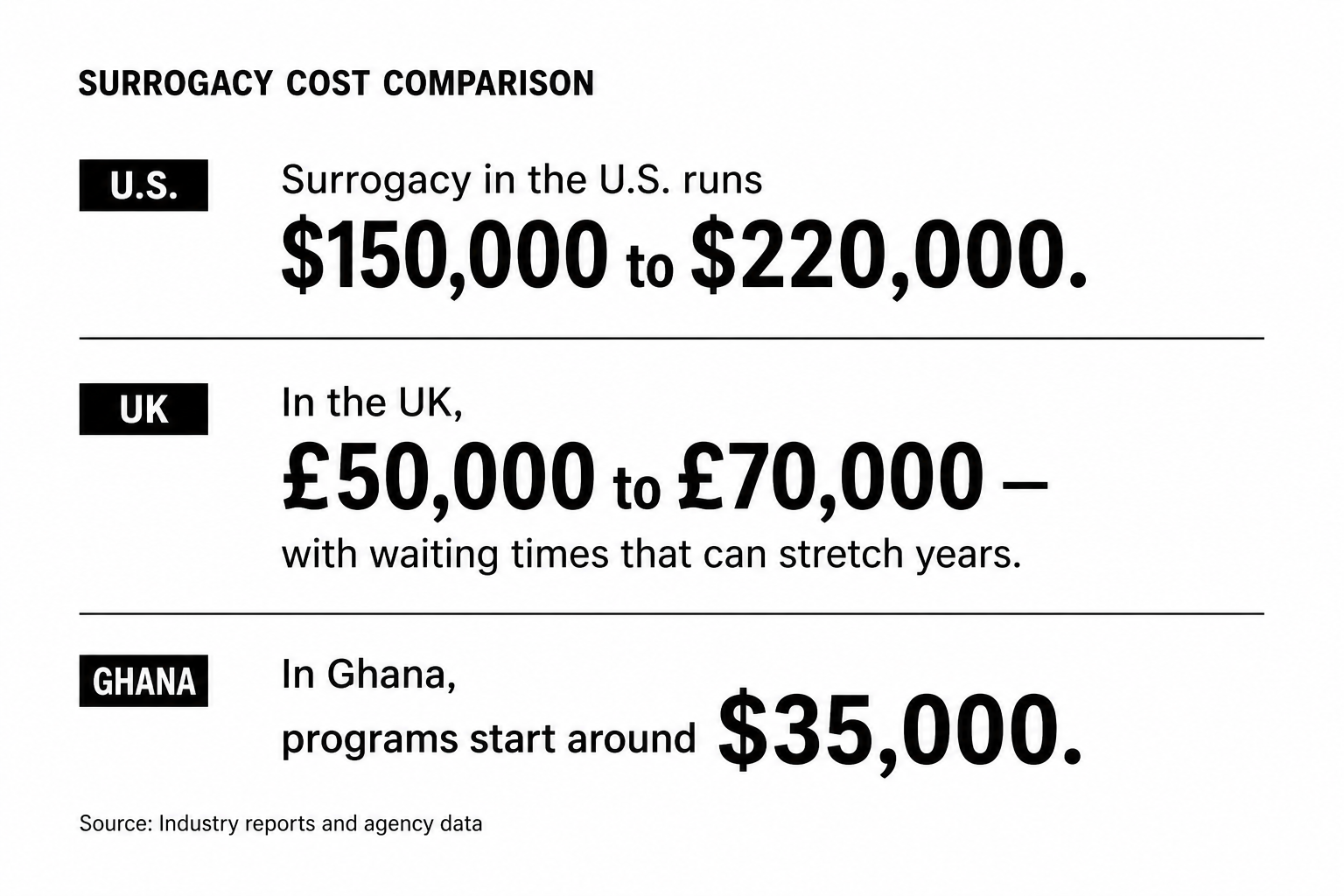
The cost differential is significant enough to explain the migration of demand. Surrogacy in the United States in 2026 typically costs between $150,000 and $220,000, with programs in high-demand states like California regularly exceeding $200,000. In the United Kingdom, where only altruistic surrogacy is permitted and surrogates cannot receive profit-based compensation, total costs typically range between £50,000 and £70,000 — and waiting times for a surrogate match can stretch into years. Surrogacy in Ghana starts at around $35,000, making it among the most cost-effective options in the world. Some programs now market hybrid models — embryos created in Ukraine, birth jurisdiction in Ghana — specifically designed to navigate the patchwork of international surrogacy law while keeping costs accessible. The market is organized, growing, and being actively promoted to Western intended parents.
What is less prominently featured in the marketing materials is what the arrangement looks like from the other side.
Surrogates in Ghana generally receive around $10,000 as compensation — in a country where the median annual income is a fraction of that figure. The compensation differential between what intended parents pay and what surrogates receive is substantial, and it exists because Ghana’s cost advantage over the U.S. and Europe is built, in part, on that gap. The affordability being marketed to single Western fathers is not abstract. It is the product of a specific economic relationship between international demand and Ghanaian women’s reproductive labor.
Research on surrogacy practice in Ghana has consistently found that the practice is marred with ethical issues including lack of informed consent, exploitation, abuse, issues of compensation, and maltreatment of surrogates — compounded by a weak legal and regulatory framework unable to address uncertainties and abuse. A 2025 peer-reviewed study from the University of Ghana and 37 Military Hospital confirmed that specific legislation on assisted reproductive technologies and surrogacy is urgently needed to protect the rights of surrogates and minimize abuse. Legal experts in Ghana have raised alarms about women advertising their fertility on social media to interested parties, warning that advertising and brokering in surrogacy must be legally regulated as it is creating an emerging market among young women seeking quick income.
None of this is an argument against single fatherhood or against Ghana as a site of family formation. The men pursuing parenthood through this pathway are making a considered choice about how to build their families, and that choice deserves respect. What it does not deserve is a framing that treats the structural conditions making it affordable as simply a feature of the market rather than a question worth examining.
The same logic that produces medical tourism — where patients from wealthy countries travel to lower-income countries for procedures that are too expensive at home — produces surrogacy tourism. The intended parents get the outcome they came for. The question of what the women providing the reproductive labor receive, and under what legal protections, tends to be answered in the fine print of the agency’s cost breakdown rather than in the headline number.
Academic experts have noted that Ghana’s Act 1027 is a meaningful step forward but does not yet constitute comprehensive surrogacy legislation. The assisted reproductive technologies bill that would close those gaps has been in draft form since 2021 and has not yet passed. In the meantime, the market has grown substantially — and the agencies promoting Ghana to single Western fathers are not the ones most motivated to build the legal infrastructure that would protect the women at the center of it.
Ghana is becoming a destination. The women who make it a destination are entitled to a legal framework that treats their role in that arrangement as something other than a cost line item. That framework does not yet exist. And the agencies marketing Ghana to single Western fathers have more incentive to fill their consultation calendars than to close that gap.
Culture in Motion examines who defines culture, how it moves, and what it reveals about the moment. Read more at socialstorytellerscollective.substack.com