
The federal government spent the better part of 18 months cutting its workforce in the name of efficiency — and now it cannot integrate the tools that were supposed to replace those workers. A Government Executive analysis published in April finds that federal managers across agencies are struggling to adopt AI as employee engagement collapses in the wake of mass layoffs. A GAO report cited in the analysis found that existing federal work models are structurally ill-suited to the new systems — and the employees who survived the cuts are too demoralized, too thinned out, and too distrustful of institutional motives to implement change effectively. The estimated economic hit from federal workforce reductions has reached $165.6 billion.
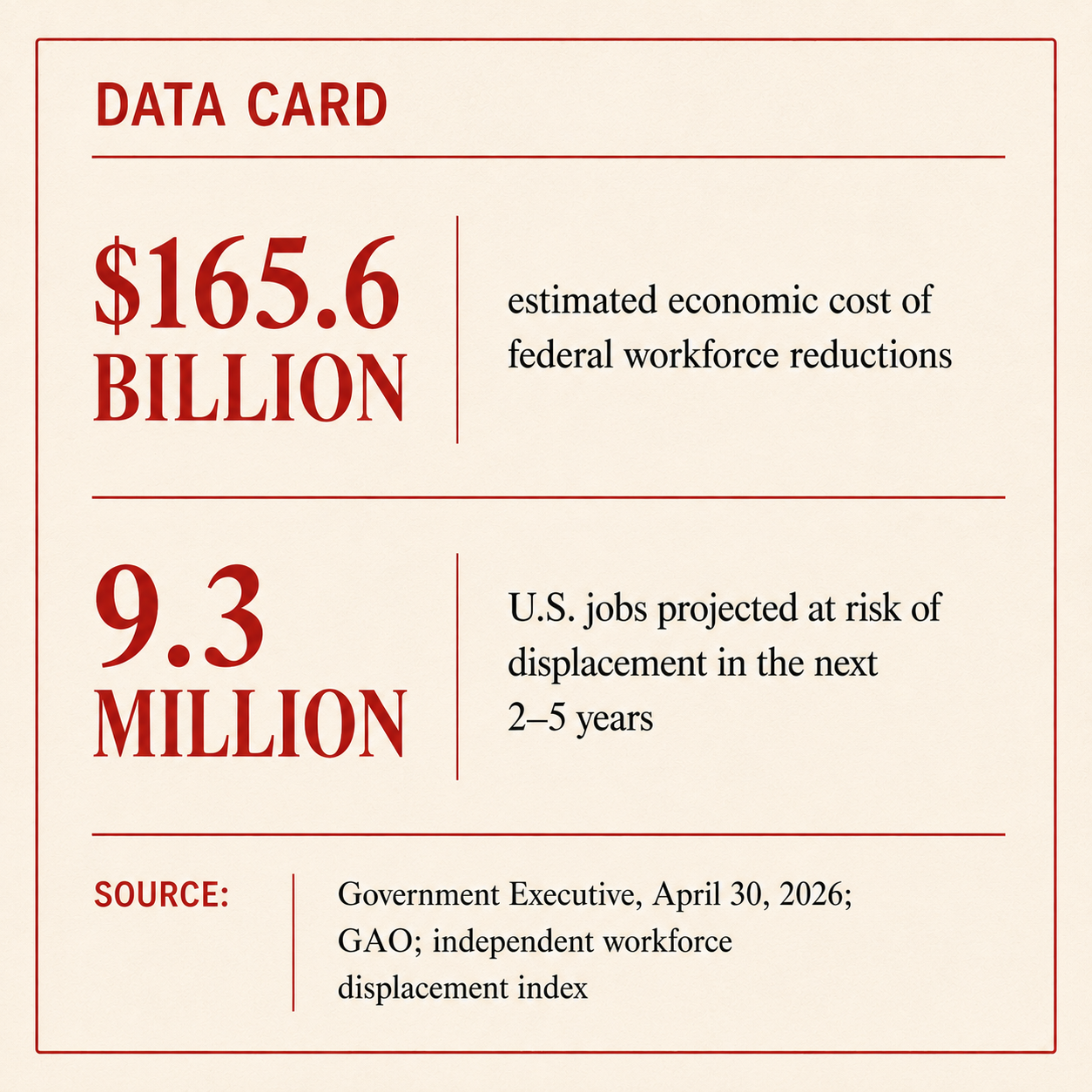
You cannot eliminate the institutional knowledge, the inter-agency relationships, and the organizational memory that makes government function — and then install tools that depend on structured data, clean processes, and human oversight to perform. The workforce trauma is not an obstacle to efficiency. It is the evidence that the efficiency argument was always more about reduction than performance. An independent index cited in the analysis projects 9.3 million U.S. jobs at risk of displacement in the next two to five years. The federal government, the single largest employer in the country, is now the most visible proof of what that transition looks like when it is managed badly.